Border Enforcement
All Content
Showing 181–190 of 493 results
When Emergency Measures Become the Norm: Post-coronavirus prospects for the Schengen zone
Most EU Member States closed their borders to travel from neighboring countries in the early stages of the coronavirus pandemic. While internal borders in the Schengen zone largely reopened in time for summer holidays, there is a lingering sense they could snap shut anew. Though the reflexive introduction of border controls speaks to an inherent lack of trust between states, the 2015-16 migration crisis offers lessons on how to begin to rebuild trust, as this commentary explores.

Dismantling and Reconstructing the U.S. Immigration System: A Catalog of Changes under the Trump Presidency
The Trump administration took more than 400 immigration executive actions during its first term, curtailing legal and unauthorized immigration and dismantling humanitarian protections.
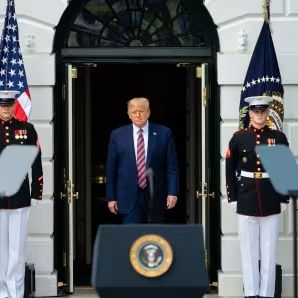
As #DefundThePolice Movement Gains Steam, Immigration Enforcement Spending and Practices Attract Scrutiny
U.S. immigration enforcement spending outpaces all major federal criminal agencies combined, but accountability, oversight, and transparency have not kept pace with the dramatic growth.

Mientras Crece el Movimiento para Desfinanciar a la Policía en EUA, el Gasto y las Prácticas de las Autoridades de Inmigración también se Someten a Escrutinio
El gasto en control de la inmigración en EE. UU. supera al de todas las principales agencias federales de lucha contra la delincuencia juntas, pero la rendición de cuentas, la supervisión y la transparencia no han avanzado al mismo ritmo que su espectacular crecimiento.

Beyond the Border: U.S.-Mexican Migration Accord Has Ushered in Sweeping Change in Mexico in Its First Year
As the U.S.-Mexico migration cooperation agreement marks its first year, this discussion examines how the accord has reshaped Mexico’s immigration enforcement policies, exposed weaknesses in its humanitarian protection system, and exacerbated precarious conditions for migrants along the U.S.-Mexico border. Speakers also explore how pandemic-induced changes to mobility may affect the future of U.S.-Mexico relations.

One Year after the U.S.-Mexico Agreement: Reshaping Mexico’s Migration Policies
The June 2019 U.S.-Mexico migration agreement pushed Mexico toward enforcement-first policies, cutting border crossings while straining humanitarian protections.

Un año después del Acuerdo Estados Unidos-México: La transformación de las políticas migratorias mexicanas
El acuerdo de junio de 2019 entre Estados Unidos y México redujo los cruces irregulares pero desbordó la capacidad humanitaria e institucional mexicana.

The Rocky Road to a Mobile World after COVID-19
COVID-19 has chilled many forms of human movement, from travel to temporary and permanent migration, refugee resettlement, and returns, among them. While a safe restart of travel is a precondition for a return to economic and societal normalcy, restarting mobility will not be like flicking a switch, particularly amid disagreements over the costs societies can and should absorb in the name of protecting public health, as this commentary explains.

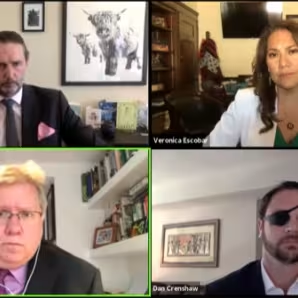
Immigration and the U.S.-Mexico Border during the Pandemic: A Conversation with Members of Congress
In this bipartisan discussion, two border-state members of Congress—Rep. Veronica Escobar and Rep. Dan Crenshaw—discuss the response to the coronavirus outbreak, how it is affecting the interconnected border region, and what the future might hold.
Humanitarian Protection in an Era of Pandemic
MPI and MPI Europe experts discuss the effects of the coronavirus pandemic on asylum systems in Europe and North America, as well as in developing regions, where 85 percent of refugees live. During this freeform conversation, our analysts also assess the implications for the principle of asylum and the future for a post-World War II humanitarian protection system that is under threat.