West African Countries Offer Citizenship to Descendants of Enslaved Africans
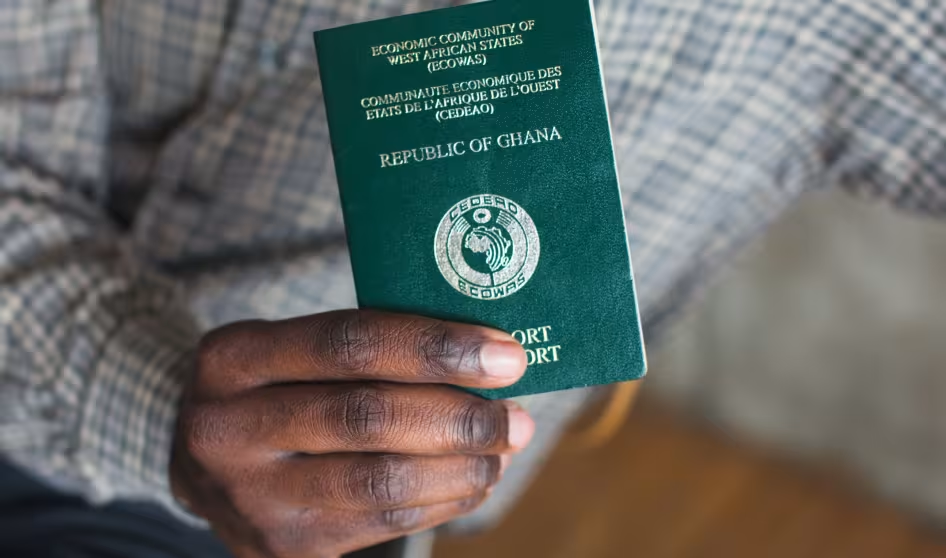
A man holds a Ghanaian passport.
Credit: iStock.com/IraEfremova
Highlights
West African governments are offering citizenship to descendants of enslaved Africans and other diaspora members as both a symbolic act of reparative justice and a practical strategy to attract investment, skills, and tourism.
- Benin, Ghana, Guinea-Bissau, and Sierra Leone have launched special citizenship pathways for members of the historic African diaspora, granting at least 1,213 people citizenship since 2016.
- Program design varies widely: Benin has a fully codified law, while others rely on executive action and other approaches that can be less predictable.
- The policies have generated tensions and criticism around DNA testing requirements, high fees, and uneven implementation, as well as the prospect that returnees increase the cost of living.
An increasing number of West African countries are offering citizenship to the descendants of enslaved Africans. Government initiatives since 2016 have made obtaining citizenship and living on the African continent more appealing to members of the historic diaspora, many of whom are in the United States. Yet some initiatives have also been criticized for requirements that applicants submit a DNA test to prove their ancestry, and a tension has emerged between visions of these processes as drivers of development versus as restorative justice for the horrors of the slave trade.
As of this writing, at least 1,213 people had received citizenship through these policies in Ghana, Sierra Leone, Benin, and Guinea-Bissau, with the vast majority receiving Ghanaian citizenship, according to publicly available data from news outlets and civil-society organizations. There are no centralized data for citizenships granted to diaspora members, so the actual number may be higher.
The diaspora members receiving citizenship have predominately been African Americans from the United States, although people from Canada, the United Kingdom, and countries in the Caribbean have also received citizenship.1 Among these new citizens are some famous names: Music legend Stevie Wonder received citizenship in Ghana, and singer Ciara and movie director Spike Lee received citizenship in Benin, with Lee also named an ambassador to help market Benin’s citizenship initiative.2 Additional African countries without formal diaspora citizenship programs have nonetheless offered citizenship to African American celebrities, including Gabon’s offer to Hollywood star Samuel L. Jackson and Guinea’s naturalization of actors Meagan Good and Jonathan Majors.3
Although diaspora return policies target both emigrants and their descendants who have ancestral ties to the country, these new citizenship initiatives overwhelmingly focus on the latter. Several factors are driving this rise in historic diaspora citizenship, including individuals’ interest in reconnecting with their ancestral homeland, concerns about growing racism and far-right rhetoric in Western countries, and increasing attention to reparatory justice.4 In this context, African citizenship is framed as one method of addressing the injustices created by the transatlantic slave trade.5
This article provides an overview of West African countries’ offers of citizenship to their diasporas.
From Pan-African Ideal to Legal Instrument
The new citizenship drive is only the most recent chapter in a long history of African countries encouraging diaspora members to engage, rooted in the history of pan-Africanism that connects the continent with the Americas and Europe.
Liberia was in part founded to provide a home on the continent for the descendants of enslaved Africans. Yet Ghana has been the leader in this area since its independence in 1957. Kwame Nkrumah, Ghana’s first president, envisioned the country as a pan-African nation-state, deliberately linking its independence to the liberation of Africa and the African diaspora. Building on relations he had cultivated in pan-African activist spaces, Nkrumah actively recruited diaspora members to participate in the nation-building process. For instance, Ghana’s first chief economic advisor was W. Arthur Lewis, from St. Lucia, while George Padmore, from
Trinidad and Tobago, served as Nkrumah's advisor on African affairs. Prominent descendants of enslaved Africans such as Maya Angelou and W.E.B. Du Bois also moved to Ghana in the 1960s to support the young country’s development.
Over the years, Ghana maintained its pan-African ideology through various diaspora return and tourism initiatives, including the Pan-African Historical Theatre Festival (PANAFEST), first held in 1992; Emancipation Day, which since 1998 the country has celebrated annually on August 1 to mark the end of slavery in the British Empire; and the 2007 Joseph Project, named for the enslaved biblical figure. Ghana first granted citizenship to diaspora members in 2016.
The most popular initiatives have been more recent: the Year of Return, which took place in 2019 to commemorate the 400th anniversary of the beginning of the transatlantic slave trade, and its ongoing follow-on, Beyond the Return. In 2019, Ghana welcomed approximately 1.1 million international visitors, an increase of about 18 percent over the previous year, according to the Ghana Tourism Authority.6 The Year of Return and Beyond the Return were also the only Ghanaian return initiatives with a citizenship component; 126 diaspora members received citizenship in 2019 and 674 since Beyond the Return started in 2020.7 As of 2023, 1,500 African Americans had relocated to the country since 2017, according to the Diaspora Affairs Office.8 Following the visibility and success of these return initiatives, alongside sustained advocacy from diaspora groups, other African nations followed suit; Sierra Leone, Benin, and Guinea-Bissau have created their own return initiatives for diaspora members since 2021.9
Table 1. Citizenships Granted through West African Diaspora Initiatives, 2016-26
|
Country |
Grants of Citizenship |
|---|---|
| Ghana |
834 |
| Sierra Leone |
300 |
| Benin |
50 |
| Guinea-Bissau |
29 |
The citizenship programs align with broader regional and international diaspora frameworks. In 2012, the African Union designated the African diaspora the continent’s sixth region (in addition to North, West, Central, East, and Southern Africa), acknowledging its role and contributions to the continent’s development.10 The United Nations declared 2015 to 2024 the International Decade for People of African Descent, and the African Union has proclaimed 2026 to 2036 as the Decade of Reparations.11 African countries have adopted this rhetoric in their own frameworks. Ghana, for instance, in 2025 officially recognized the diaspora as its 17th region, while Benin explicitly tied its return program to the UN International Decade for People of African Descent.12 More recently, in March 2026, a landmark UN resolution pushed by Ghana declared the transatlantic slave trade “the gravest crime against humanity,” which Ghanaian leaders tied to the Decade of Reparations.13
These efforts are often distinct from other forms of naturalization in African countries. Members of the historic diaspora can also obtain citizenship through more conventional means, such as through marriage or by meeting standard residency requirements, but these processes can take a significant amount of time. More standard naturalization processes are also generally open to anyone regardless of ancestry, although there are some exceptions in countries such as Liberia, where citizenship is limited to people of African descent. Diasporic citizenship policies, by contrast, are designed specifically for people with ancestral linkages. Once applications are approved, the process moves quicker than traditional naturalization. It is also more ceremonial, with official government events covered by international media, and more explicitly restorative, framed as a return home.

How Policies Work
Ghana, Benin, Sierra Leone, and Guinea-Bissau are currently the only African nations offering diaspora citizenship programs. Across these countries, pathways to citizenship vary in eligibility criteria, legal frameworks, and implementation structures, reflecting different policy priorities and relationships with the historic diaspora.
Ghana
Ghana’s diaspora citizenship pathway has operated through executive order since 2016 and operates without a formal legal policy. It is open to any person of African descent who can provide the required documentation, including biodata from their passport and evidence of strong ties to Ghana. Naturalized citizens hold full rights, although dual citizens face some restrictions on holding certain public offices.
In February 2026, the government temporarily suspended the naturalization process for diaspora members following controversy over the introduction of a requirement that applicants also submit DNA samples showing a connection to Ghana, as well as a significant fee increase from 2,500 Ghanaian cedis (about U.S. $220) to 25,000 cedis (U.S. $2,220).14 The process was later reinstated without the DNA requirement. Critics have argued the changes were exclusionary and inconsistent with Ghana’s pan-African heritage, and diaspora advocates have campaigned for more inclusive participation in the planning process.15 Three thousand people applied for the 2026 citizenship process; 150 received citizenship at a public ceremony in March.16
Ghana also offers a form of legal residence known as right of abode, which allows holders to live and work in Ghana indefinitely and is the highest residency status short of naturalization. Right of abode is available to former Ghanaian citizens who renounced their nationality as well as to members of the historic African diaspora. However, historic diaspora applicants must also demonstrate a contribution to Ghana's economic development through certain criteria such as monetary value of shares, bank statements, or employment of Ghanaians, whereas former Ghanaian citizens do not.17 Applicants of both types must secure presidential approval.
Benin
Benin is the only African country with a diaspora citizenship policy codified into law. Law No. 2024-31, passed in September 2024 to grant Beninese nationality to recognized African descendants, explicitly frames citizenship for the diaspora as restitution for the transatlantic slave trade.18 In 2025, Benin launched the My Afro Origins program to allow descendants of enslaved Africans to apply for Beninese nationality. Eligibility is limited to descendants of enslaved Africans, with DNA testing (proving a connection to anywhere in sub-Saharan Africa) required alongside other documentation. The law established a staged process of granting nationality, requiring applicants to submit their application to the Ministry of Justice, preferably in person to show applicants are genuinely connected to the nation. Applicants may also apply from abroad, in which case nationality is granted on a provisional basis for three years, during which the individual is expected to establish residence in Benin; failure to do so results in the loss of nationality. Provisional nationals receive a provisional nationality certificate and are entitled to entry and residence rights, but do not receive a passport. Those who are approved after applying in person in Benin receive a Beninese passport and nationality certificate. However, citizenship obtained through the Afro-descendent process does not include the right to vote or run for political office; these citizens may later apply to receive full political rights.19
Sierra Leone
Sierra Leone has two diaspora citizenship pathways, both of which confer citizenship and require DNA testing to prove African ancestry. Eight people also received citizenship in 2019, though not as part of a formal government program.
The primary citizenship pathway, the African Diaspora Ascension program, was implemented in 2021 through a Ministry of Tourism partnership with African Ancestry, a DNA-testing company specializing in African diaspora lineage tracing.20 Applicants were required to apply using a certified tour operator in Sierra Leone, further embedding the process within the country’s tourism ecosystem. However, it is unclear whether the program is currently active following changes in government in 2023.
There is a separate citizenship-by-investment pathway (also known as a “golden passport”) open specifically for people of African heritage. Launched in 2025, this route requires a $100,000 investment, reduced from the $140,000 investment required for regular citizenship by investment, and provides an expedited pathway to citizenship, with approvals coming in 60 days.
Guinea-Bissau
Guinea-Bissau grants citizenship by decree of the Council of Ministers without any formal diaspora citizenship policy. Eligibility is the most restrictive among the four countries, limited to descendants of specific ethnic communities in Guinea-Bissau, primarily the Balanta, Fula, and Djola. The program emerged from advocacy by the diaspora’s civil-society groups rather than a formal tourism or investment strategy; 29 people were granted citizenship through this process between January and October 2025, with recipients receiving full citizenship rights.21 However, as of this writing the process had been paused due to political instability.
Patterns Across the Region
Across these four countries, three broad patterns emerge. First, having diaspora citizenship codified into law supports the programs’ continued execution. Benin, the only country with a dedicated law, has maintained program stability, while Ghana, Sierra Leone, and Guinea-Bissau have all experienced pauses, suspensions, or periods of inactivity linked to political or administrative changes.
Second, the use of DNA testing is not always controversial, although it can be in certain cases. In places where DNA requirements were introduced gradually and established at the outset, as in Benin and Sierra Leone, they generated comparatively limited criticism from applicants. In contrast, Ghana’s late and abrupt introduction of DNA testing in 2026, combined with a significant fee increase, created backlash, was ultimately halted, and contributed to the program’s suspension. More generally, critiques of DNA requirements tend to come less from applicants and more from legal scholars and bioethicists, who question the reliability of commercial testing and the privileging of genetic evidence over cultural or historical connection.
Finally, citizenship is applied unevenly. Benin’s staged model of nationality without full citizenship, in which individuals may have entry and residence rights but not full political rights until completing a subsequent naturalization step, is the only differentiated system.
Forces Driving Policies
Globally, diasporas have long been positioned as development actors who provide billions of dollars annually in remittances as well as investment, skills, and tourism to the homeland, all of which are seen as tools of economic and social development.
As Western nations have cut foreign aid and shifted toward a “trade-not-aid” model of engaging with Africa, African countries have worked to become more attractive to investors, including those in the diaspora. Many calls for diaspora members’ return include an expectation that they will contribute to development. Some countries have explicitly linked development to their diaspora definitions. The Ghanaian government’s official definition of diaspora, for instance, includes “all persons of African descent who have historical and cultural ties with Ghana and are also interested in Ghana’s development.”22 Applicants for right of abode must show how they will contribute to development. Countries without explicit development language in their diaspora policies still frame the call to return around development, aligning with the African Union's definition of diaspora as “people of African origin… who are willing to contribute to the development of the continent and the building of the African Union.”23
While historic diaspora citizenship has been touted for its ability to increase economic growth in African countries, there are limited data on its actual impact. Some naturalized members of the diaspora have created businesses in their new homelands, in sectors including tourism, agriculture, and real estate, but the full number of such businesses and the extent of their economic impact is not known. Additionally, some diaspora members in Ghana have received the traditional title Nkosuohene (“development chief”), associated with promoting the social and economic development of a local area.24 Existing research has explored the symbolic significance of these roles, but there is limited data on their impact on development.
The effect of historic diaspora citizenship has been primarily measured through tourism, as heritage tourism has underpinned many of these initiatives. Sierra Leone’s diasporic citizenship program is administered through the Ministry of Tourism, while Ghana’s early diaspora engagement efforts were also housed in what was then called the Ministry of Tourism and Diasporan Affairs (they are now managed between the Diaspora Affairs Office, the Office of the President, and the Ministry of the Interior). This tourism-rooted approach is not new. In 2003, Ghana launched an action plan to position the country as a homeland for Africans in the diaspora, and the World Bank identifies heritage tourism as a driver of economic development.25 The 2019 Year of Return was branded both as a homecoming and a tourism initiative and generated $1.9 billion, according to the Ghana Tourism Authority.26
Some governments also grant citizenship as a form of restorative justice, presenting policies as an acknowledgement of the transatlantic slave trade and their country’s historical role in it. This is closely tied to the principle of right of return, which would allow descendants of enslaved Africans to return to the countries from which their ancestors were taken. Benin explicitly invoked this principle when launching its diaspora citizenship program at the United Nations.27 Diaspora organizations have advocated for this view of citizenship as part of broader conversations about reparations and reparative justice, as illustrated by Guinea-Bissau’s program, which emerged from groups’ advocacy.
Justice Mechanism or Development Enabler?
There can be confusion and tension about these policies, including among applicants. The lack of a unifying continental framework for diaspora citizenship is one factor, as potential applicants may be unaware of the procedural differences between countries’ various policies. Moreover, the fact that policies in Ghana, Guinea-Bissau, and Sierra Leone stem from executive or administrative orders mean programs can be suspended, modified, or restarted with little notice, creating uncertainty.
A key tension is whether citizenship functions primarily as a form of restorative justice or as a development policy. Governments often invoke pan-African ideals while seeking investment, skills, and money from the diaspora. Applicants often cite reasons relating to identity, belonging, or security for wanting to return: Some may want a strong connection to their African heritage, feel exhausted with racism, and want to live in a place where they are in the demographic majority. Returning diaspora members have cited the political rise of the far right, the rollback of diversity policies, and events such as a U.S. police officer’s 2020 murder of George Floyd.28
There can be friction when these expectations clash with reality. The right of return itself is affirmed unevenly, common in official rhetoric but inconsistently operationalized in national policy. This tension has become more pronounced amid the African Union’s Decade of Reparations: Does citizenship count as a type of reparations? Ghana's introduction of a DNA requirement created pushback for exactly this reason, as the requirement that applicants have a connection to Ghana in particular seemed to contradict Ghana’s longstanding pan-African identity. Critics also opposed the significant fee as a money grab.
New citizens’ relocation can also be more complicated than expected. Some locals have worried about returnees’ impact on local economies, especially in Accra, where returns have been blamed for rising costs of living.29 There have also been disputes over land. In Ghana’s Pan-African Village in Asebu, a few hours west of Accra, land given to diaspora returnees by the traditional ruler was later claimed by residents who said they were the rightful owners.30
Historic diaspora citizenship also raises questions about fairness, considering the challenges many African migrants face in navigating Western immigration systems. Some question why historic diaspora members should receive citizenship easily when Africans in the United States or Europe often face years of procedural hurdles. However, that perception may be rooted in a lack of transparency in how these African programs actually work; clear, more consistent procedures could ease some resentment.
An Evolving Return
West Africa’s diaspora citizenship policies are still evolving, and their long-term impact will depend on how they continue to develop. More effective and equitable versions will require clearer and more transparent eligibility criteria, stronger policy codification, better post-arrival support for returnees, and build greater public support within African countries about the programs’ aims. The lack of a continental framework presents questions about whether intra-African coordination is feasible, leaving applicants to navigate uneven systems and governments operating independently.
In other African regions, questions remain about citizenship for diaspora members. While an increasing number of African countries allow emigrants and their descendants to have multiple citizenships, adoption is limited: 28 African countries allowed dual citizenship as of 2023, 23 allowed dual citizenship in certain cases, and three banned it outright.31 Because dual citizenship can be contentious, some countries, such as Liberia32 and Burkina Faso,33 have positioned the offer of permanent residency for diaspora members as an alternative. Citizenship- or residency-by-investment programs may also serve as alternative pathways, due to their explicit connection between citizenship and economic development.
Some African leaders believe tourism and citizenship initiatives have been successful, as they have increased tourism and brought positive attention to their countries.34 The fact that more African countries are creating Year of Return-style initiatives, such as Kenya’s Journey Back to Eden program launched in December 2025, could be seen as an indicator of success. However, it is not yet clear whether long-term benefits such as sustained economic development and successful integration of diaspora citizens into their new societies have occurred. To accurately measure impact, data must be collected.
Diaspora citizenship initiatives sit at the intersection of migration policy, citizenship governance, and the fractures to identity and belonging created by the transatlantic slave trade. The evolution of diaspora citizenship will matter not only for West Africa but for broader global debates on mobility and reparative justice.
Sources
Abdulloev, Nodira. 2023. Diaspora and Transnational Identities: An Analysis of Legal Frameworks and Policies. Geneva: International Organization for Migration (IOM).
Adebayo, Bukola. 2019. Ghana Makes 126 People from the Diaspora Citizens as Part of Year of Return Celebrations. CNN, November 29, 2019.
Adjoha, Pulcherie and Robbie Corey-Boulet. 2026. Benin Offers Citizenship to African Diaspora, with Help from Spike Lee. Reuters, January 14, 2026.
Africa News Agency. 2025. Diaspora : In Ghana, the “17th Region” Takes Shape between Memory, Influence and Investment. December 22, 2025.
African Ancestry. 2025. AfricanAncestry.com Becomes a Path to Sierra Leone Citizenship for Black People Whose Roots Trace to the West African Country. Press release, May 12, 2025.
African Commission on Human and Peoples’ Rights (ACHPR). 2024. Resolution in Preparation for the AU Theme for 2025 “Justice for Africans and People of African Descent through Reparations” through Consultations on Afro-Descendants, Indigenous/Ethnic Ancestry, Reparations & the 6th Region (ACHPR/Res.616 (LXXXI) 2024). Banul, the Gambia: ACHPR.
African Union. 2025. African Union Declares 2025 the “Year of Reparations and African Heritage” and Launches Decade-Long Action Plan. Press release, August 12, 2025.
---. N.d. The Diaspora Division. Accessed July 16, 2026.
Agbassa, Eric Codjo Montcho and Renaud Fiacre Avlessi. 2025. Benin: A New Law on the Recognition of Nationality for People of African Descent. Blog post, Global Citizenship Observatory, September 3, 2025.
Agence France-Presse (AFP). 2026. “Home” at Last: Ghana Grants Citizenship to 150 Members of African Diaspora. March 10, 2026.
Akinwotu, Emmanuel. 2023. A New Home for the African Diaspora in Ghana Stirs Tensions. National Public Radio (NPR), December 29, 2023.
Armstrong, Jenice. 2024. Ghana Made History Last Week as It Granted Citizenship to 524 People — Some of Them Philadelphians. The Philadelphia Inquirer, November 26, 2024.
Asiedu-Addo, Shirley. 2019. Year of Return Generates $1.9 Billion. Graphic Online, December 16, 2019.
Balanta B’urassa. 2025. African Diaspora Repatriation & Citizenship Data. January 22, 2025.
---. Guinea-Bissau Naturalization Application. Accessed July 14, 2026.
Banchereau, Mark. 2024. Benin Grants Citizenship to Slave Descendants as It Faces Its Own Role in the Trade. Associated Press, December 14, 2024.
Bob-Milliar, George M. 2009. Chieftaincy, Diaspora, and Development: The Institution of Nkɔsuohene in Ghana. African Affairs 108 (433): 541–58.
Chibelushi, Wedaeli. 2026. From Hollywood to the Homeland: Why African Countries Are Courting Black American Stars. BBC News, February 6, 2026.
Dadzie, Kwame. 2020. Year of Return Left an Afterglow that Ghana Must Cherish – Nana Addo. CitiNewsroom, February 20, 2020.
Embassy of the Republic of Benin. N.d. FAQ: Citizenship for Afro-descendants (Courtesy Translation). Accessed July 14, 2026.
Ghana Tourism Authority. 2021. Tourism Report 2020. Accra: Ghana Tourism Authority.
Kleist, Nauja. 2013. Flexible Politics of Belonging: Diaspora Mobilisation in Ghana. African Studies 72 (2): 285-306.
Lartey, Winifred. 2026. Ghana Must Practise Reparatory Justice at Home Before Demanding It Abroad – Obenfo Kambon. Asaase Radio, June 27, 2026
LeFaso.net. 2026. Burkina : Des Afro-descendants obtiennent leur carte de résidence permanente. April 21, 2026.
Manby, Bronwen. 2023. Is Litigation in African States Establishing a Right to Dual Citizenship? Blog post, Global Citizenship Observatory, June 30, 2023.
Mensah, Kent. 2023. A Tale of Two Cities: Diaspora Influx Hikes Cost of Living for Ghanaians. Al Jazeera News, August 25, 2023.
Musambi, Evelyne and Desmond Tiro. 2025. The Reverse Migration: African Americans Relocating to Kenya Cite Heritage and Restoration. Associated Press, July 26, 2025.
My Afro Origins. N.d. Recognition of Beninese Nationality for Afro-Descendants. Accessed August 4, 2026.
MyJoyOnline. 2019. Akufo-Addo Confers Ghanaian Citizenship on 126 Diasporans. November 28, 2019.
Naadi, Thomas and Jean Otalor. 2026. Ghana Suspends Citizenship Process for People of African Descent. BBC News, February 2, 2026.
Paquette, Danielle. 2019. How Trump's Tweets—and Cardi B—Are Making More Americans Move to Ghana. The Washington Post, December 27, 2019.
Risemberg, Annie. 2025. Come Home, Ghana Told the African Diaspora. Now Some Black Americans Take Its Citizenship. Associated Press, January 3, 2025.
Sierra Leone Ministry of Tourism and Cultural Affairs. N.d. Tourism Minister Presides over Conferment of Sierra Leonean Citizenship to 50 African Americans. Accessed July 14, 2026.
Thomas, Abdul Rashid. 2021. President Bio Confers Citizenship on 22 African American Citizens. The Sierra Leone Telegraph, January 5, 2021
Tignor, Robert L. 2020. W. Arthur Lewis and the Birth of Development Economics. Princeton, NJ: Princeton University Press.
UN General Assembly. 2026. Resolution adopted by the General Assembly on 25 March 2026: 80/250. Declaration of the Trafficking of Enslaved Africans and Racialized Chattel Enslavement of Africans as the Gravest Crime against Humanity. New York: UN General Assembly.
UN Office of the High Commissioner for Human Rights (OHCHR). 2025. Returning to Africa: People of African Descent Seek Unique Status. June 13, 2025.
United Nations. N.d. International Decade for People of African Descent: 2015-2024. Accessed July 15, 2026.
Washington, Danlette G. 2026. Liberia Hosts Pathway to Citizenship: Grants Permanent Residency to African American Investors. New Americans Magazine, February 13, 2026.
World Bank. 2018. Project Appraisal Document on a Proposed Credit in the Amount of SDR 27.9 Million (U.S. $40 Million Equivalent) to the Republic of Ghana for a Tourism Development Project. Washington, DC: The World Bank.
---. 2025. Tourism for Development : Lessons Learned from a Decade of World Bank Experience Washington, DC: The World Bank.
Notes
-
1
Annie Risemberg, “Come Home, Ghana Told the African Diaspora. Now Some Black Americans Take Its Citizenship,” Associated Press, January 3, 2025.
-
2
Pulcherie Adjoha and Robbie Corey-Boulet, “Benin Offers Citizenship to African Diaspora, with Help from Spike Lee,” Reuters, January 14, 2026.
-
3
Wedaeli Chibelushi, “From Hollywood to the Homeland: Why African Countries Are Courting Black American Stars,” BBC News, February 6, 2026.
-
4
Jenice Armstrong, “Ghana Made History Last Week as It Granted Citizenship to 524 People — Some of Them Philadelphians, The Philadelphia Inquirer, November 26, 2024; Winifred Lartey, “Ghana Must Practise Reparatory Justice at Home Before Demanding It Abroad – Obenfo Kambon,” Asaase Radio, June 27, 2026.
-
5
African Commission on Human and Peoples’ Rights (ACHPR), Resolution in Preparation for the AU Theme for 2025 “Justice for Africans and People of African Descent through Reparations” through Consultations on Afro-Descendants, Indigenous/Ethnic Ancestry, Reparations & the 6th Region (ACHPR/Res.616 (LXXXI) 2024) (Banul, the Gambia: ACHPR, 2024).
-
6
Ghana Tourism Authority, Tourism Report 2020 (Accra: Ghana Tourism Authority, 2021).
-
7
Bukola Adebayo, “Ghana Makes 126 People from the Diaspora Citizens as Part of Year of Return Celebrations,” CNN, November 29, 2019; Ghana Ministry of the Interior, “524 African Diasporas Granted Ghanaian Citizenship,” November 20, 2024; Citi Newsroom, “Ghana Grants Citizenship to 150 Members of the African Diaspora,” March 9, 2026.
-
8
Kent Mensah, “A Tale of Two Cities: Diaspora Influx Hikes Cost of Living for Ghanaians,” Al Jazeera News, August 25, 2023.
-
9
Abdul Rashid Thomas, “President Bio Confers Citizenship on 22 African American Citizens,” The Sierra Leone Telegraph, January 5, 2021.
-
10
African Union, Declaration of the Global African Diaspora Summit (Johannesburg: African Union, 2012).
-
11
United Nations, “International Decade for People of African Descent: 2015-2024,” accessed July 15, 2026; African Union, “African Union Declares 2025 the 'Year of Reparations and African Heritage' and Launches Decade-Long Action Plan” (press release, August 12, 2025).
-
12
Permanent Mission of Ghana to the United Nations, “Diaspora Summit 2025,” accessed August 4, 2026; Eric Codjo Montcho Agbassa and Renaud Fiacre Avlessi, “Benin: A New Law on the Recognition of Nationality for People of African Descent” (blog post, Global Citizenship Observatory, September 3, 2025).
-
13
UN General Assembly, Resolution Adopted by the General Assembly on 25 March 2026: 80/250. Declaration of the Trafficking of Enslaved Africans and Racialized Chattel Enslavement of Africans as the Gravest Crime against Humanity (New York: UN General Assembly, 2026).
-
14
Thomas Naadi and Jean Otalor, “Ghana Suspends Citizenship Process for People of African Descent,” BBC News, February 2, 2026.
-
15
Decade of Our Repatriation, “Ghana Citizenship Process for Historic African Diasporans: Suspension Notice, Community Response, and the Path Forward” (press release, February 3, 2026).
-
16
Ghana the Motherland, “This Year Over 3000 Applicants Applied for 🇬🇭 Ghana Citizenship and So Far 150 Have Been Granted Ghanain Citizenship,” March 12, 2026; Agence France-Presse (AFP), “‘Home' at Last: Ghana Grants Citizenship to 150 Members of African Diaspora,” March 10, 2026.
-
17
Ghana Immigration Service, “Right of Abode,” accessed August 4, 2026.
-
18
Eric Codjo Montcho Agbassa and Renaud Fiacre Avlessi, “Benin: A New Law on the Recognition of Nationality for People of African Descent” (blog post, Global Citizenship Observatory, September 3, 2025).
-
19
My Afro Origins, “Recognition of Beninese Nationality for Afro-Descendants,” accessed August 4, 2026.
-
20
AfricanAncestry.com, “Africanancestry.com Becomes a Path to Sierra Leone Citizenship for Black People Whose Roots Trace to the West African Country” (press release, May 12, 2021).
-
21
Balanta B’urassa, “Guinea-Bissau Naturalization Application,” accessed July 14, 2026.
-
22
Nodira Abdulloev, Diaspora and Transnational Identities: An Analysis of Legal Frameworks and Policies (Geneva: International Organization for Migration [IOM], 2023).
-
23
African Union, “The Diaspora Division,” accessed July 16, 2026.
-
24
George M. Bob-Milliar, “Chieftaincy, Diaspora, and Development: The Institution of Nkosuohene in Ghana,” African Affairs 108, no. 433 (2009): 541–58.
-
25
World Bank, Project Appraisal Document on a Proposed Credit in the Amount of SDR 27.9 Million (U.S. $40 Million Equivalent) to the Republic of Ghana for a Tourism Development Project (Washington, DC: The World Bank).
-
26
Shirley Asiedu-Addo, “Year of Return Generates $1.9 Billion,” Graphic Online, December 16, 2019.
-
27
Eric Codjo Montcho Agbassa and Renaud Fiacre Avlessi, “Benin: A New Law on the Recognition of Nationality for People of African Descent” (blog post, Global Citizenship Observatory, September 3, 2025).
-
28
Evelyne Musambi and Desmond Tiro, “The Reverse Migration: African Americans Relocating to Kenya Cite Heritage and Restoration,” Associated Press, July 26, 2025.
-
29
Kent Mensah, “A Tale of Two Cities: Diaspora Influx Hikes Cost of Living for Ghanaians,” Al Jazeera News, August 25, 2023.
-
30
Emmanuel Akinwotu, “A New Home for the African Diaspora in Ghana Stirs Tensions,” National Public Radio (NPR), December 29, 2023.
-
31
Bronwen Manby, “Is Litigation in African States Establishing a Right to Dual Citizenship?” (blog post, Global Citizenship Observatory, June 30, 2023).
-
32
Danlette G. Washington, “Liberia Hosts Pathway to Citizenship: Grants Permanent Residency to African American Investors,” New Americans Magazine, February 13, 2026.
-
33
LeFaso.net, “Burkina : Des Afro-descendants obtiennent leur carte de résidence permanente,” April 21, 2026.
-
34
Kwame Dadzie, “Year of Return Left an Afterglow that Ghana Must Cherish – Nana Addo,” CitiNewsroom, February 20, 2020.