What Can Latin America Learn from Brazil’s Pragmatic, Politically Durable Migration Approach?
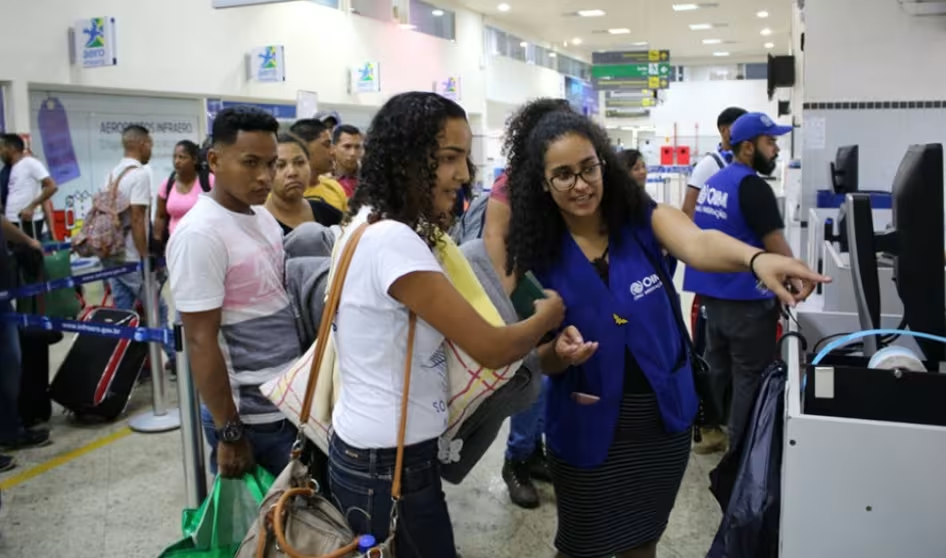
Venezuelan immigrants arriving at the airport in Dourados, Brazil.
IOM
Brazil’s migration approach, which has endured across ideologically varied administrations, offers a model for other countries in Latin America and the Caribbean, centering jobs, interiorization, and legal status for newcomers.
At a moment when Latin America and the Caribbean are pivoting toward more restrictive migration measures and increased enforcement, Brazil has been working to solidify and expand the pragmatic course it has carried out for nearly a decade to integrate migrants displaced from Venezuela and other arrivals.
The Brazilian approach, which recognizes migrants as agents of development rather than focusing chiefly on social service provision and rights, deserves the region’s attention—even as it remains a work in progress and the migration and integration pressures that Brazil faces are not of the scale that Colombia and other countries in South America have confronted.
Still, Brazil is entering the October 25 presidential runoff between leftist President Luiz Inácio Lula da Silva and right-wing senator Flávio Bolsonaro with an unusually durable foundation for its migration and integration policy.
"The Brazilian approach, which recognizes migrants as agents of development rather than focusing chiefly on social service provision and rights, deserves the region’s attention—even as it remains a work in progress and the migration and integration pressures that Brazil faces are not of the scale that Colombia and other countries in South America have confronted."
Operação Acolhida (Operation Welcome), which is Brazil’s multi-agency emergency response to the arrival of hundreds of thousands of displaced Venezuelans, has operated since its 2018 launch under the ideologically different administrations of Michel Temer, Jair Bolsonaro, and Lula.1 It has endured not because these governments shared a common vision of immigration, but because the response has been largely grounded in pragmatism: reducing pressure on border communities, connecting employers with needed workers, and helping migrants and refugees find more sustainable livelihoods.
One year ago, the federal government issued Brazil’s first national policy on migration, refuge, and statelessness.2 The policy represents an ambitious effort to turn lessons from Operation Welcome into a durable national system. It seeks to distribute responsibilities across federal ministries and levels of government while connecting migration governance with employment, public services, local integration, and national development.
The new framework is not flawless, and its practical significance will hinge on regulations, budget, and governing bodies that are not yet fully in place. Still, Brazil’s nearly decade-long approach has permitted a cross-party appeal that makes it more resilient than policies from other countries in the region that commonly rely on the political will of a single administration.
Undoubtedly, Brazil has not faced the same scale of demographic, fiscal, and political pressures that some of the region’s largest host countries—particularly Colombia, Ecuador, and Peru—have confronted. And it remains to be seen how the outcome of the presidential runoff will affect ongoing implementation of the 2025 decree. So, the Brazilian approach should not be treated as a blueprint that can translate without change to other contexts. But the country’s experience still offers valuable lessons about how to build migration policies that can appeal to diverse constituencies and are resilient to political change.
"Brazil’s nearly decade-long approach has permitted a cross-party appeal that makes it more resilient than policies from other countries in the region that commonly rely on the political will of a single administration."
From Emergency Response to National Policy
Brazil’s 2025 decree was neither the beginning of the country’s migration policy nor its completion. Article 120 of the 2017 Migration Law had already instructed the federal government to establish such a policy, but successive governments under Temer and Jair Bolsonaro left that provision unmet.3 In the absence of a national framework, Brazil developed an emergency-based response to address the large-scale influx of Venezuelans, chiefly through the creation of Operation Welcome and access to legal status.
Legalization was a central tenet of Brazil’s response. Drawing on its MERCOSUR residence agreement and citing national interest, Brazil in 2017 started granting residence permits, with pathways to permanent status, to nationals of neighboring countries that were not members of the agreement, primarily Venezuelans.4 Brazil also expanded international protection access by applying the broader definition of refugee outlined in the Cartagena Declaration to recognize Venezuelan refugees on a prima facie basis. 5Together, these two policies legalized hundreds of thousands of Venezuelans, with Operation Welcome offering reception and integration support.
Established by the Ministry of Defense, Operation Welcome has revolved around three pillars: border management, reception of Venezuelans in temporary shelters, and voluntary relocation or interiorization (perhaps the most emblematic component). The model brings together federal agencies, armed forces, private-sector recruitment networks, international organizations, civil society, and local governments. More than 100 organizations run the operation in concert. Through interiorization, Brazil uses several pathways to voluntarily relocate Venezuelans from the northern border state of Roraima to municipalities across the country that have greater socioeconomic absorption capacity. These pathways include relocation to reunite with family or acquaintances, access to shelters for those with the greatest vulnerabilities, or to take up identified employment opportunities.
Southern Brazil has received most Venezuelans, with access to jobs being the main relocation driver. Private-sector participation in Operation Welcome has largely been motivated by labor demand, with employers in agro-industry and other sectors struggling to fill entry-level positions locally, sometimes even after recruiting in other parts of Brazil.6 Participation comes with demands. Companies must provide documentation, demonstrate compliance, and help workers meet their immediate needs upon arrival.
By February 2026, Operation Welcome had helped more than 600,000 Venezuelans migrants access legal status and had relocated more than 157,000 of them to over 1,100 municipalities.7 Research by the UN High Commissioner for Refugees (UNHCR) found that 77 percent of relocated families secured employment within a few weeks of arrival at destination.8 Although these figures do not shed light on the quality of the jobs secured or opportunities for social mobility, they reflect what can be achieved when access to legal status is paired with employment support, private sector buy-in, and local assistance.
The Limits of Ad Hoc Responses
Nevertheless, Operation Welcome also has revealed the limits of governing through an ad hoc response. Even though municipalities have a significant role in receiving relocated migrants and providing integration services, the operation remains an exclusively federal initiative and does not formally define the responsibilities of state and municipal governments—or designate (and guarantee) resources.
The response was also solely built for Venezuelans, even as Brazil hosts immigrants and refugees from many nationalities, including Haitians, Syrians, and Angolans. That gap has become increasingly glaring as Brazil’s migration profile continues to evolve. In 2025, Cuban asylum applications superseded those of Venezuelans: more than 41,900 Cubans applied, compared to 21,200 Venezuelans.9 With resources for shelters earmarked for Venezuelans, service providers have narrow maneuvering room to deliver assistance to other nationalities.
Addressing the Gaps
The 2025 decree attempts to address some of these structural limitations. Responding to the increasing complexity of flows, it distributes implementation responsibilities across seven ministries and requires all federal bodies to incorporate migrants into programs such as the unified health and social assistance systems. Decisively, the decree explicitly recognizes migrant, refugee, and stateless populations as a driving force of Brazil’s economic and social development and commits to linking migration policy with labor market demands. The framework also opens the door to expand the interiorization strategy to other nationalities.
The process of developing the decree was unusually participatory. Brazil’s second National Conference on Migration, Refuge, and Statelessness, hosted in 2024, was preceded by more than 100 preparatory conferences involving roughly 14,000 participants.10 The process generated more than 2,000 proposals, some of which influenced drafting of the National Migration Plan, which was released in July.11 In a region where migration policy is typically developed from the top down, the participation of migrants, refugees, civil-society organizations, and local governments is an important innovation.
The decree, of course, is not a panacea. While the national policy was greeted largely favorably, civil-society organizations have noted some concerns and omissions, including the absence of explicit nonrefoulement commitments, inattention to indigenous migration and climate-driven mobility, and questions about how (and if) Operation Welcome will be folded into the policy.12
The Test Ahead
Implementation also comes amid a completely different context than the one that shaped Operation Welcome’s early years. Like others, Brazil is confronting the pressure of sweeping humanitarian aid cuts by international donors.13 In early 2025, it was reported that 60 percent of the International Organization for Migration’s operations in Brazil depended on U.S. humanitarian aid.14 Brazil will have to fill funding holes with domestic funds, which in turn, requires political will and permanent budget lines. Faced with U.S. cuts, the state of Paraná immediately invested its own funds to cover the shortfall.15 Whether future shortfalls are handled similarly remains to be seen.
The government will have to shift its institutional mindset to recognize migration as a shared responsibility across ministries and levels and government, rather than continuing to be led by the armed forces. Defining specific mandates for each level of government, establishing regular funding for municipalities receiving large numbers of migrants, and creating coordination protocols that do not rely on the willingness of individual governors or mayors will be key. And while the decree opens the door for expanding employment-based relocation support beyond Venezuelans, the operational mechanisms to do so are not yet in place.
The Elections and What Is at Stake
While migration scarcely figured in the presidential campaign, the outcome could determine the future robustness of the landmark policy.16 Lula, whose administration developed the framework, has pledged to continue its implementation; Flávio Bolsonaro has offered no specific migration management agenda.
There is no indication that a Bolsonaro victory would mark a break with the current approach. Operation Welcome was expanded during his father’s administration (despite openly hostile rhetoric toward migrants and refugees)17 and many big industries have vested interests in migrant workers and employment-based relocation.
A Lula victory would offer greater formal continuity but not eradicate policy implementation and omission challenges. Whoever wins the ballot will matter less for whether the policy survives than for how it is implemented.
A Model Worth Watching
The direction that Brazil takes will matter beyond its borders. The initially warm welcome that Colombia, Chile, and others demonstrated to displaced Haitians and Venezuelans has cooled significantly. Chile has pledged military deployments at its northern border;18 Ecuador introduced stricter migration controls and accelerated deportation procedures;19 Argentina has placed migration enforcement under the Ministry of Security;20 and Colombia, once the regional leader in regularization, has announced massive deportation operations.21
Brazil’s new migration policy, even if at a potential crossroads, marks an instructive approach for a region continuing to cope with widespread displacement—though it should not be mistaken for a wholesale or carbon-copy solution.
Specifically, Brazil’s experience points to four broader takeaways for the region:
- Existing regional frameworks can provide building blocks for national responses that offer access to legal status. Clear pathways to permanence can provide migrants with stability to build sustainable livelihoods and employers the predictability to invest in newcomers’ integration. Elsewhere, frequent policy changes and uncertainty about migrant workers’ continued legal status have undermined private-sector engagement.
- Linking migration policy and labor market needs can deliver tangible economic benefits. This in turn can broaden the base of support for migrant inclusion, thereby making policies more resilient to political change.
- When rooted in local needs, the connection of migrants to job opportunities and social networks beyond major cities can ease pressure on traditional destinations, help employers fill vacancies, and enable immigrants to strengthen the economic and social fabric of the communities they are joining.
- Ad-hoc responses, no matter how pragmatic or well-coordinated, are not a replacement for legal frameworks, clear institutional responsibilities across agencies and levels of government, and predictable financing.
"Brazil’s new migration policy, even if at a potential crossroads, marks an instructive approach for a region continuing to cope with widespread displacement—though it should not be mistaken for a wholesale or carbon-copy solution."
Latin American and Caribbean policymakers would do well to pay attention to the grounding in pragmatic policies Brazil has made to make its approach endure, as well as to the institutional, fiscal, and protection questions that linger.
Latin America and Caribbean Initiative
The Initiative combines rigorous research with direct engagement of governments, institutions, and stakeholders to help build orderly, rights-respecting migration systems across one of the world's most dynamic migration regions.
About the Global Program
The Global Program bridges policy advice, research, and candid dialogue to design effective migration policies, drawing on global evidence and anticipating the forces reshaping how people move.
Notes
-
1
Brazilian Ministry of Defense, “Operação Acolhida,” updated September 2, 2024.
-
2
Brazilian Presidency, “Decreto Nº 12.657, de 7 de outubro de 2025,” Diário Oficial da União, 192 Section 1, 8, October 8, 2025.
-
3
Brazilian Presidency, “Lei no 13.445, de 24 de maio de 2017,” Diário Oficial da União, 99, 1, May 25, 2017.
-
4
María Jesús Mora, Ariel G. Ruiz Soto, and Andrew Selee, Building on Regular Pathways to Address Migration Pressures in the Americas (Panama City and Washington, DC: International Organization for Migration and Migration Policy Institute, 2024).
-
5
Leiza Brumat and Victoria Finn, “Regional to National: Pragmatic Implementation of South American Migration Policies,” Globalizations (July 7, 2026): 1–18.
-
6
Author interview with a representative of the development nonprofit Associação Voluntários para o Serviço Internacional - Brasil (AVSI), April 13, 2026.
-
7
International Organization for Migration (IOM), “IOM Praises Brazil for Welcoming and Supporting Migrants” (news release, January 30, 2026); UN High Commissioner for Refugees (UNHCR), “Oito anos da Operação Acolhida em oito perguntas, fatos e curiosidades” (news release, February 24, 2026).
-
8
UN High Commissioner for Refugees (UNHCR), “Oito anos da Operação Acolhida em oito perguntas, fatos e curiosidades” (news release, February 24, 2026).
-
9
Eugênio Battesini, “Cuban Migration to Brazil in the 21st Century,” Columbia Law School, August 6, 2026.
-
10
Brazilian Ministry of Justice and Public Security, Conferência Nacional de Migrações, Refúgio e Apatridia: 8 a 10 de Novembro de 2024 (Brasilia, DF: Ministry of Justice and Public Security, accessed October 19, 2026).
-
11
MigraMundo Equipe, “Consulta pública rendeu 431 propostas para Plano Nacional de Migrações, diz governo,” July 3, 2026.
-
12
João Chaves, “Política Nacional de Migrações, Refúgio e Apatridia: avanços e cautelas necessárias,” MigraMundo, October 17, 2025.
-
13
Ricardo Brito and Lisandra Paraguassu, “Brazil Seeking Funds for Venezuelan Migrant Program After Trump Freezes U.S. Aid,” Reuters, January 29, 2025.
-
14
Rodrigo Borges Delfim, “Em meio a incertezas com EUA, OIM volta a atuar parciamente no Brasil com a Operação Acolhida,” MigraMundo, February 4, 2025.
-
15
Author interview with a former representative of the Ministry of Justice and Public Security, April 23, 2026.
-
16
Rodrigo Borges Delfim, “Apenas quatro candidaturas à Presidência em 2026 trazem propostas sobre migração em planos de governo,” MigraMundo, August 19, 2026.
-
17
Maeli Farias, “Bolsonaro’s Paradox: A Far-Right Leader’s Pro-Immigration Strategy?” University of Bristol, Migration Mobilities Bristol, May 12, 2025.
-
18
Geraldine Bajonero Vásquez, “Presidente de Chile, José Antonio Kast, firmó sus primeros decretos: ordenó 'construcción de barreras físicas' en la frontera con Bolivia y Perú,” El Tiempo, March 12, 2026.
-
19
Diego Chaves-González, “Security Reforms in Ecuador Should Not Be the Last Word” (commentary, Migration Policy Institute, Washington, DC, November 2025).
-
20
Swissinfo.ch, “Milei traspasa el control de la política migratoria al Ministerio de Seguridad Nacional,” Swissinfo.ch, November 11, 2025.
-
21
Manuel Rueda and Astrid Suárez, “Colombian President Orders Immigration Raids, Vows Deportations of Migrants Without Legal Status,” Associated Press, updated August 24, 2026.

Related Content