Enforcement & Borders

All Content
Showing 641–650 of 810 results
8th Annual Immigration Law and Policy Conference
The conference offered law and policy analysis and discussion on cutting-edge immigration issues. Featured panelists included high-ranking government officials, academics, advocates, and other immigration experts.

Obstacles and Opportunities for Regional Cooperation: The U.S.-Mexico Case
The U.S.-Mexico case shows regional migration cooperation is possible despite obstacles if interests align, especially on border management and co-development.

Pay-to-Go Schemes and Other Noncoercive Return Programs: Is Scale Possible?
Pay-to-go and other noncoercive return programs can be more humane and cost effective than removals, but weak take-up and sustainability make large-scale use difficult.
Lessons from the 2007 Legal Arizona Workers Act
Discussion on new Public Policy Institute of California (PPIC) report with PPIC Research Fellows; Bruce A. Morrison, Former U.S. Congressman from Connecticut (1983-1991) and Chair of the Immigration Subcommittee; and Marc Rosenblum, MPI Senior Policy Analyst.

Unanswered Questions Surround ICE's Secure Communities Program
The U.S. Secure Communities program operated in 1,080 jurisdictions in 2011.

Steps to Fix the U.S. Immigration System: What Can the Administration Do?
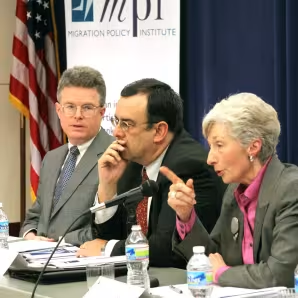
MPI report release with authors MPI's Donald Kerwin, Margie McHugh, and Doris Meissner who engage in a discussion with Eva Millona, Executive Director, Massachusetts Immigrant and Refugee Advocacy Coalition; and Juan P. Osuna, Acting Director, Executive Office for Immigration Review, U.S. Department of Justice, on what the U.S. administration can do to fix immigration policy absent congressional action.
Executive Action on Immigration: Six Ways to Make the System Work Better
Six executive actions could improve U.S. border control, integration, legal admissions, and fairness in enforcement without new laws.
A New Architecture for Border Management
Information-driven, risk-based “smart border” systems push controls away from the physical frontier toward advance data screening, while raising ethical concerns.
Quiet Demise of the Virtual Fence
After more than $1 billion in funding, the United States’ virtual border fence program was cancelled in January 2011.