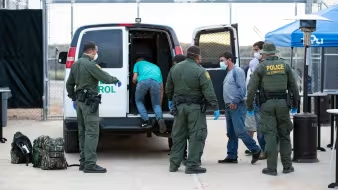
Reflections on Restoring Integrity to the United States Immigration System: A Personal Vision
The 1986 Immigration Reform and Control Act failures suggest durable U.S. immigration reform requires enforcing laws, expanding visas, and creating a fair path to earned legal status.
As the debate on how to better manage the U.S. immigration system unfolds, this policy brief reflects upon lessons learned from the last major attempt to resolve the problem of illegal immigration, under the Immigration Reform and Control Act of 1986 (IRCA). Arguing that stable reform will require three “E”s—enforcing immigration laws effectively, expanding visas, and earning legal status—the policy brief offers recommendations for immigration policymaking and management.
The brief finds that IRCA’s three-prong approach of creating a legalization process, establishing employment authorization, and strengthening border enforcement did little to control future illegal immigration flows. The author draws four key lessons from this fundamental failure. First, new policies must incorporate the demand for work and family reunification visas. Second, legalization should be approached not as an amnesty program, but as an opportunity to address the underlying causes of unauthorized migration. Third, reducing incentives for fraud should be a top policy goal. Finally, lawmakers must recognize that migration cannot be managed unilaterally, and seek bilateral and multilateral cooperation with neighbors.
Successful immigration reform must reflect and anticipate realities in the U.S. labor market, migrant family ties, and the United States’ domestic and international obligations. Based on the concept of the three “E”s, the author calls for a credible strategy for broader and more systematic enforcement of immigration laws; an expansion of visas for workers in low-wage, low-value added economic sectors, as well as their family members; a fair and clear process for transitioning from temporary to permanent status; and a realistic security registration process for unauthorized immigrants in exchange for a tough but fair path to permanent residency.
About the Independent Task Force on Immigration and America’s Future
This high-level, bipartisan task force developed a comprehensive post-9/11 blueprint to redesign the U.S. immigration system with flexibility, smart enforcement, and a robust integration policy.
About the U.S. Immigration Policy Program
The U.S. Immigration Policy Program provides analysis of U.S. immigration pathways, the impacts of enforcement and other policies, and the characteristics of immigrant populations.

Related Content