The Shifting Financing of Responses to Venezuelan Displacement
Venezuelan flags in front of government buildings in Caracas.
Credit: Tomasz Podolski/iStock.com
Related Content
Highlights
Financing for Latin American responses to Venezuelan displacement has changed over the years, and new approaches are needed in light of foreign aid cuts.
- Latin American countries have made notable—though uneven—progress receiving and integrating displaced Venezuelans, aided by a diverse network of donors, development banks, civil society, and philanthropies.
- Yet donor funding for displacement responses has fallen short of needs, and the shift from a focus on humanitarian relief to development has been nonlinear and lacked a clear road map.
- Local governments and businesses have emerged as strategic actors, using local knowledge and innovative financing to advance newcomer inclusion, though these actors’ full potential remains to be unlocked.
- After the 2025 foreign aid cuts by major donor countries, strategies for a leaner, more sustainable way forward include clarifying stakeholders’ roles and improving coordination, strengthening links between humanitarian and development programming, scaling promising private-sector-led integration models, and diversifying funding.
Executive Summary
The sharp cuts and restructuring of U.S. foreign aid starting in early 2025 and the shrinking of other major donors’ development budgets have reignited longstanding concerns about the future of international aid. Since the mass displacement of Venezuelans began in 2015, Latin America has made extraordinary though uneven progress in supporting and integrating migrants and refugees, relying on financial support from the United States and other donors. This progress is now at a turning point as budget cuts have shut down humanitarian assistance and services in Latin America for migrants and nonmigrants alike and weakened progress toward social and economic development.
In the wake of the Venezuelan crisis, a complex funding landscape emerged involving donor governments, multilateral development banks, civil-society organizations, and private-sector actors, including philanthropies and foundations. Some have provided funding through donations, loans, and credits, while others act as funding intermediaries or project implementers, and some perform both roles. The number and diversity of institutions involved and a lack of centralized data make it difficult to understand the full complexity of the funding ecosystem and what the implications of major changes in recent years will be.
"Looking back at how this ecosystem operated before the 2025 foreign aid cuts makes it possible to identify the capacities, relationships, and financing gaps that shaped the region’s response to displacement."
For this study, Migration Policy Institute (MPI) researchers mapped the international funding ecosystem supporting the response to Venezuelan displacement in Latin America between 2019 and 2024. To do this, the researchers conducted more than 40 semistructured interviews with representatives of intergovernmental organizations, donor governments, civil-society organizations, local governments, and private-sector and philanthropic stakeholders; analyzed data from the United Nations Office for the Coordination of Humanitarian Affairs’ Financial Tracking Service; and examined publicly available data from the European Investment Bank, the Inter-American Development Bank, and the World Bank, including the World Bank-hosted Global Concessional Financing Facility.
Looking back at how this ecosystem operated before the 2025 foreign aid cuts makes it possible to identify the capacities, relationships, and financing gaps that shaped the region’s response to displacement, how these dynamics evolved, and which approaches could help sustainably support migrant and refugee inclusion in a more constrained funding environment. Key trends in the 2019–24 period include:
- Donor attention has ebbed and flowed but consistently fallen short of needs and shrunk significantly in recent years. Although Venezuelan displacement initially drew global attention, support remained modest and episodic compared to other major crises (such as Syria), especially from donors outside the region, and it has consistently fallen short of the scale of need. Competing crises and shifting political priorities dictated which donor countries participated in the response and the extent of their engagement.
- Speed often took precedence over strategy, which weakened coordination. In the early stages of the response, many donors prioritized rapid deployment over coordination, resulting in a crowded field with limited alignment. New entrants—many engaging with migration in Latin America for the first time—launched projects without assessing local needs, gaps, or their own comparative advantages, leading to duplication and missed opportunities for collaboration.
- The transition from humanitarian assistance to long-term development support was uneven and nonlinear. As displacement became protracted, donors and host countries increasingly framed migration as a catalyst for development and called for a shift away from humanitarian aid—but without a clear road map for this transition. New crises prompted donors to reprioritize short-term assistance, and many organizations’ mandates focused only on humanitarian aid, leaving them poorly equipped to respond to a different, more enduring set of needs. Fully transitioning to long-term development funding would require major changes that would likely prove complex and costly, even if ultimately more effective.
- The private sector and local governments have emerged as strategic actors, but their full potential has not yet been unlocked. Despite operating within highly centralized political systems, local governments were able to leverage international collaboration to access resources, secure donor funding, and exchange best practices. Local private-sector actors also stepped in to fund, implement, and promote initiatives for the economic inclusion of Venezuelans, and to expand projects through partnerships and innovative financing models. Both sets of actors brought valuable understanding of local realities and community needs, but their work remains underrecognized and, in some cases, underfunded, despite its potential for impact.
- Host-country leadership has been inconsistent. Several Latin American governments initially demonstrated strong political ownership of response and coordination measures, but this momentum proved difficult to sustain. Leadership transitions often brought shifting priorities, institutional resets, and weakened continuity, frustrating donors and undermining confidence in local ownership. The lack of long-term policy planning and intergovernmental coordination contributed to inefficiencies and fragmented implementation.
- Major host countries’ middle-income status constrained donor engagement. Classification as middle income limited the countries’ access to concessional financing and other forms of targeted assistance, even as their national budgets were under considerable pressure, especially after the start of the pandemic. As a result, governments faced high expectations to receive and integrate displaced Venezuelans without sufficient resources, and donors were hesitant to fill the gap without clearer strategies and stronger assurances of policy continuity.
Host and donor governments, multilateral development banks, international and nongovernmental organizations, private-sector actors, and other stakeholders should consider the following strategic actions to respond more effectively to ongoing challenges in the region:
- Clarify roles and reinforce government leadership. Donors and operational partners should coordinate based on their comparative advantages, minimize duplication, and strengthen national government leadership. Host-country governments, with their authority to convene and coordinate across sectors and subnational jurisdictions, should establish clear and consistent migration policies and frameworks to build donor confidence. Local governments and civil-society organizations should also be empowered through capacity building, training, and increased access to funding mechanisms.
- Bridge humanitarian and development responses from the outset. Humanitarian relief and development assistance should be framed as interdependent rather than sequential. Many contexts require sustained humanitarian infrastructure even as development programs take place. By making humanitarian and development efforts mutually reinforcing, especially in protracted crises, countries can strengthen resilience and institutional capacity while ensuring more adaptive responses to ongoing and emerging shocks.
- Link migration strategies to broader development priorities and funding. Host countries should identify opportunities to align proposals with donor priorities, as well as their own national development goals. Recognizing and planning for the constraints facing middle-income countries, such as limited access to concessional financing, and the changing nature of donor priorities will be critical to diversifying and securing more stable funding.
- Replicate and scale promising private-sector-led integration models. Many local firms and associations run inclusion initiatives, often originally developed for vulnerable locals and later expanded to also benefit migrants. These often operate in isolation and are not framed as migrant integration efforts. Host-country governments and private-sector actors should seek to map existing programs, promote knowledge exchange, and build partnerships to scale effective models, rather than reinventing similar programs.
- Invest in innovative financing models to diversify funding pools. Innovative finance—leveraging public, private, and philanthropic capital—offers opportunities to broaden the funding base, alleviate donor fatigue, and reduce dependence on traditional donors. Aligning public and private objectives from the outset can lead to innovative partnerships that support sustainable migrant integration.
The foreign aid landscape in Latin America has in recent years been marked by a proliferation of donors supporting migration-related efforts in the region for the first time, donors grappling with a protracted crisis and how to adapt their strategies, and donors shifting their attention in response to competing global crises. Most recently, starting in 2025, the region has experienced the withdrawal of its largest donor. As a result, the foreign aid ecosystem has dramatically changed. Although the lack of updated, public, and centralized data makes it difficult to measure the full impact of this shift, Latin America clearly risks losing hard-won gains in migration management and immigrant integration if it does not proactively develop new funding solutions. The strategies discussed in this report can help the region prepare for what lies ahead.
1. Introduction
Latin America’s response to the Venezuelan displacement crisis has entered a new phase. The past decade has brought unprecedented migration challenges to the region and prompted international donors to finance innovative, collaborative solutions. But that funding is drying up even as more than 6.9 million Venezuelans remain in neighboring countries, which have become long-term destinations.1 At the same time, because of U.S. immigration policies during the second administration of President Donald Trump, many Venezuelans who had planned to migrate to the United States or who were already residing there with precarious legal status are reconsidering their options and may move or return to Latin American countries, particularly to cities that have absorbed large numbers of Venezuelans. This raises critical questions about Latin American immigrant integration systems, policy continuity, and how aid is mobilized in response to evolving displacement dynamics.
Particularly in its early years, the unprecedented scale of the Venezuelan crisis drew the attention of diverse stakeholders—including development actors, intergovernmental organizations, and donor agencies—that had not previously collaborated on international displacement in Latin America. They sought to build migration governance capacity in middle-income countries that had limited experience, resources, and the institutional capacity to manage migration effectively without external support. Overlapping and competing efforts to strengthen the region’s migration governance produced disjointed, often ad hoc programs as agencies competed for finite resources.
In response to growing displacement pressures and increasingly fragmented aid, multilateral institutions created mechanisms to streamline coordination and finance the response to Venezuelan displacement. The Regional Inter-Agency Coordination Platform for Refugees and Migrants from Venezuela (R4V), created in 2018 and co-led by the International Organization for Migration (IOM) and the United Nations High Commissioner for Refugees (UNHCR), became the primary mechanism for coordinating the international response. The R4V platform has brought together partners from across Latin America and the Caribbean (approximately 150 as of August 2026) to coordinate the regional response plan that serves as the strategic financial framework and appeal mechanism guiding the region’s response to displacement.2 Known as the Regional Refugee and Migrant Response Plan (RMRP), the plan guides donor contributions, aligns implementation efforts, and helps direct funding toward priority country and sector needs.
Multilateral development banks (MDBs) also stepped up by offering a range of funding mechanisms, including concessional financing, to assist governments hosting the largest numbers of Venezuelan refugees and migrants. The increased focus on migrant integration and development also attracted stakeholders from the private sector and the philanthropic community.
Despite these multilateral coordination efforts, global crises—from the COVID-19 pandemic to armed conflicts to natural disasters—have tested the international response to Venezuelan displacement. Latin America has had to compete for financial resources and political attention amid these mounting pressures and in an increasingly crowded global landscape, especially after the U.S. foreign aid cuts and funding freezes announced in January 2025. This proliferation of crises and humanitarian needs, combined with an overall decline in international aid, calls for a critical reevaluation of the resources available to fund migration and humanitarian responses in Latin America.
"Latin America has had to compete for financial resources and political attention amid these mounting pressures and in an increasingly crowded global landscape."
There is also a need to rethink how funding is allocated. Migration patterns in the region have evolved, with migrants transiting but also establishing lasting roots in many places. There is thus a need to shift funding away from a narrow focus on humanitarian aid and short-term fixes, toward long-term, holistic integration and developmental initiatives. Such a transition is nonlinear and uneven, however. Some places, such as border cities that continue to receive large numbers of migrants, still require humanitarian support. Meanwhile, making the case for sustainable integration efforts remains challenging in a region marked by inequality, where many native-born individuals live in poverty and conditions of fragility.
This report presents the first comprehensive analysis of the foreign aid and private-sector funding response to Venezuelan displacement in Latin America, focusing on Colombia and Ecuador to illustrate broader trends in development and humanitarian aid. It examines overall funding trends to help stakeholders strengthen coordination, mobilize more sustainable and diversified funding, and design responses that better bridge humanitarian, development, and integration needs.
To do this, Migration Policy Institute (MPI) researchers conducted more than 40 semistructured interviews with representatives of intergovernmental organizations (IGOs), donor governments, civil-society organizations (CSOs), local governments, and key stakeholders from the private sector and the philanthropic community. To identify funding trends, the researchers analyzed data from the United Nations Office for the Coordination of Humanitarian Affairs (OCHA) Financial Tracking Service (FTS) database, which tracks paid contributions to the regional plan and identifies their sources and recipients. They also analyzed publicly available data from the European Investment Bank, the Inter-American Development Bank, and the World Bank, including the World Bank-hosted Global Concessional Financing Facility (GCFF). (See the Appendix of this report for more information on the study methodology.)
This report explores the main funding mechanisms supporting the international response to Venezuelan migration, analyzes regional financing trends from January 2019 to December 2024, and assesses the limitations of tracking funding flows. It also maps the relationships among stakeholders in the funding ecosystem, their roles (as donors, intermediaries, recipients, or implementers), and how funds have been allocated. The report then examines how funding goals have changed over time and highlights key new actors that have emerged. It concludes with forward-looking recommendations that serve as a blueprint for strengthening coordination and complementarity among actors and promoting more sustainable financing for the region.
2. The Changing Scale of International Aid Funding
The response to Venezuelan displacement has often been underfunded, even compared with other humanitarian crises.3 In 2019, Venezuelans were the world’s second-largest displaced population, after Syrians, yet they received much less attention and support.4 During 2018–19, no Latin American countries ranked among the top 20 recipient countries of bilateral official development assistance (ODA) for refugee situations, while Turkey, Jordan, and Lebanon ranked as the top three in that order.5
Because many host countries in Latin America and the Caribbean are middle-income nations, they often found themselves in a difficult position: They lacked the financial capacity of high-income host countries in Europe and North America but did not qualify for many of the most generous grant-based funding mechanisms reserved for low-income countries. Eligibility for concessional financing generally relies on income per capita indicators and does not consider the multidimensional development needs of many nations, including middle-income countries.6 This situation reflects a version of the middle-income trap but applied to migration governance: Countries are neither poor enough to attract sustained international aid nor wealthy enough to fully finance large-scale integration responses on their own.
"This situation reflects a version of the middle-income trap but applied to migration governance."
A closer look at donor pledges, including the changing landscape of donors and financing mechanisms, helps paint a fuller picture of the scale and scope of funding for the Venezuela response. An initial surge in donor commitments occurred between 2019 and 2020 but then dropped precipitously. In 2019, international donor pledges of 120 million euros (approximately USD 134 million) amounted to about 18 percent of RMRP funding requirements (USD 738 million).7 In 2020, pledges grew significantly to USD 2.8 billion, double the USD 1.4 billion in plan requirements. Donor attention declined steadily afterward as international focus shifted to other displacement crises, notably Afghanistan in 2021 and Ukraine in 2022 (see Figure 1). For example, Ukraine rose from the 19th largest recipient of ODA in 2021 (USD 2.1 billion) to the largest recipient in 2022 (USD 28.7 billion).8
Donors interviewed for this project noted that the Venezuela crisis has not been a central foreign policy priority for many because of its geographic distance from donor capitals. Although Venezuelan migrant flows to the United States and Canada helped keep the crisis on these countries’ agendas, sustaining donor engagement has become increasingly challenging as the crisis has worn on.9 This decline intensified significantly in 2025, when the U.S. government announced a broad reevaluation and realignment of its foreign assistance, cutting 83 percent of funding managed by the U.S. Agency for International Development (USAID) as of March 2025. That decision further reduced resources available for both bilateral and multilateral programming.10 Only 10 percent of the regional plan’s funding needs for 2025 were met, and as of September 2026, only 16 percent of 2026 funding needs had been met.11
Figure 1. Venezuela Regional Refugee and Migrant Response Plan (RMRP) Funding Requirements and Donor Pledges in Donor Conferences (in USD), 2020–23
Fluctuating host-country engagement also influenced funding appeals and pledges. Initially, many political leaders across the region welcomed Venezuelans and prioritized the migrant response in their fundraising with international donors. But as public attitudes toward migrants worsened and competing domestic priorities emerged, political momentum and advocacy for integrating Venezuelans and securing donor financing for those efforts waned. This shift is reflected in the declining participation of host-country governments at international donor conferences. Early conferences drew high-level government leaders, but the seniority of participants dropped over time, and some governments stopped participating altogether.12 In an increasingly crowded global aid landscape, where multiple crises compete for limited resources, reduced host-country leadership and ownership have made it even more difficult to sustain donor engagement and secure long-term, predictable financing.
Data Challenges When Tracking Donor Pledges and Contributions
The data for this analysis are primarily from the R4V platform, which tracks donors’ commitments and paid contributions to the regional plan through the FTS. Based on voluntary self-reporting, the tool identifies the sources and recipients of contributions, funding amounts, the countries receiving the funds, and funding trends over time. Separately, MDBs also publicly report data on their transactions, including funding sources, project descriptions, recipients, and whether funds are reimbursable or not. As a result, FTS data provide insight into complementary funding flows (funding channeled through international organizations instead of directly to host governments), and MDB databases capture direct funding flows between MDBs and host governments. Therefore, funding from MDBs and donor governments to host governments, whether through development assistance or loans, must be analyzed separately.
Despite efforts to centralize and make funding data accessible, major challenges persist in assembling a complete picture of the financial landscape. One challenge is the gap between donor pledges and disbursements.13 For example, as of August 2026, at least USD 465 million from 2020 and 2021 remained categorized as pledges or pending commitments.14 These gaps stem from both donor decision-making and reporting issues. Pledges are nonbinding and can be withdrawn or revised as donor priorities shift, negotiations stall, or bureaucratic processes delay disbursement. In addition, funds are rarely transferred immediately after they are pledged. Disbursement dates often depend on donors’ fiscal calendars or on the complexity of loan negotiations, creating inevitable delays between commitments and actual inflows.15 In some cases, donors announce the same funding pledge through both bilateral agreements and at international conferences, leading to double counting of pledges, though not necessarily of disbursements.
Although overall pledging levels have declined over time, disbursement trends show no consistent pattern. Paid contributions increased between 2019 and 2020, mirroring the temporary surge in pledges, and the 2022 peak in disbursements could largely reflect the delay between pledges and their fulfillment. In addition, not all donor government contributions flow through the RMRP framework.16 Some donors channel funding through alternative bilateral or multilateral mechanisms. Thus, declining contributions to the regional plan in recent years could reflect either an overall reduction in foreign aid or a shift from humanitarian assistance to development financing, much of which occurs outside the RMRP framework (see Sections 3.A. and 3.B.).
Figure 2. Total Paid Contributions to the Venezuela Regional Refugee and Migrant Response Plan (RMRP) Each Year (in USD), 2019–24
Another complicating factor is that data outside the RMRP framework do not fully capture all resources directed to Venezuelan displacement either directly or indirectly. MDB financing to host countries could support projects that benefit Venezuelans even if they are not explicitly designed as migration programs. The Inter-American Development Bank (IDB) and the World Bank, for example, have financed efforts to strengthen Colombia’s health-care system while incorporating migrant-specific indicators, such as increasing the affiliation of regular migrants with the social security system.17 Integrating Venezuelan migrants into broader development planning is considered a good practice, but it also makes it challenging to precisely quantify the resources allocated to migration-related activities.
A similar challenge applies to humanitarian programs operated by IGOs and CSOs. Many of these organizations were already serving populations with humanitarian needs, such as internally displaced persons or victims of violence in Colombia and Ecuador, before expanding their services to include Venezuelans. These adapted programs often lack migrant-specific or nationality-based indicators, and as a result, implementers know that Venezuelans are among the beneficiaries but cannot always determine what share of funding or services is directed specifically to this population.
3. The Diversity of Actors in the Financing Landscape
Financial support for migrant-receiving countries in Latin America comes from a wide range of actors through both mechanisms specific to Venezuelan displacement and broader development assistance. Within the RMRP alone, at least 210 actors participated in the Venezuelan migration response between 2019 and 2024.18 This broad ecosystem includes entities that provide financial resources (through grants, loans, or credits), actors that serve as funding intermediaries, and those that function as project implementers, with some fulfilling multiple roles.19 Actors such as IOM and UNHCR have migration-specific mandates and both implement programs and channel donor funding. Others, such as the United Nations Development Program (UNDP) and Deutsche Gesellschaft für Internationale Zusammenarbeit (GIZ), operate under broader development or sustainability mandates and engage in migration-related programming through those mandates.
"This broad ecosystem includes entities that provide financial resources (through grants, loans, or credits), actors that serve as funding intermediaries, and those that function as project implementers, with some fulfilling multiple roles."
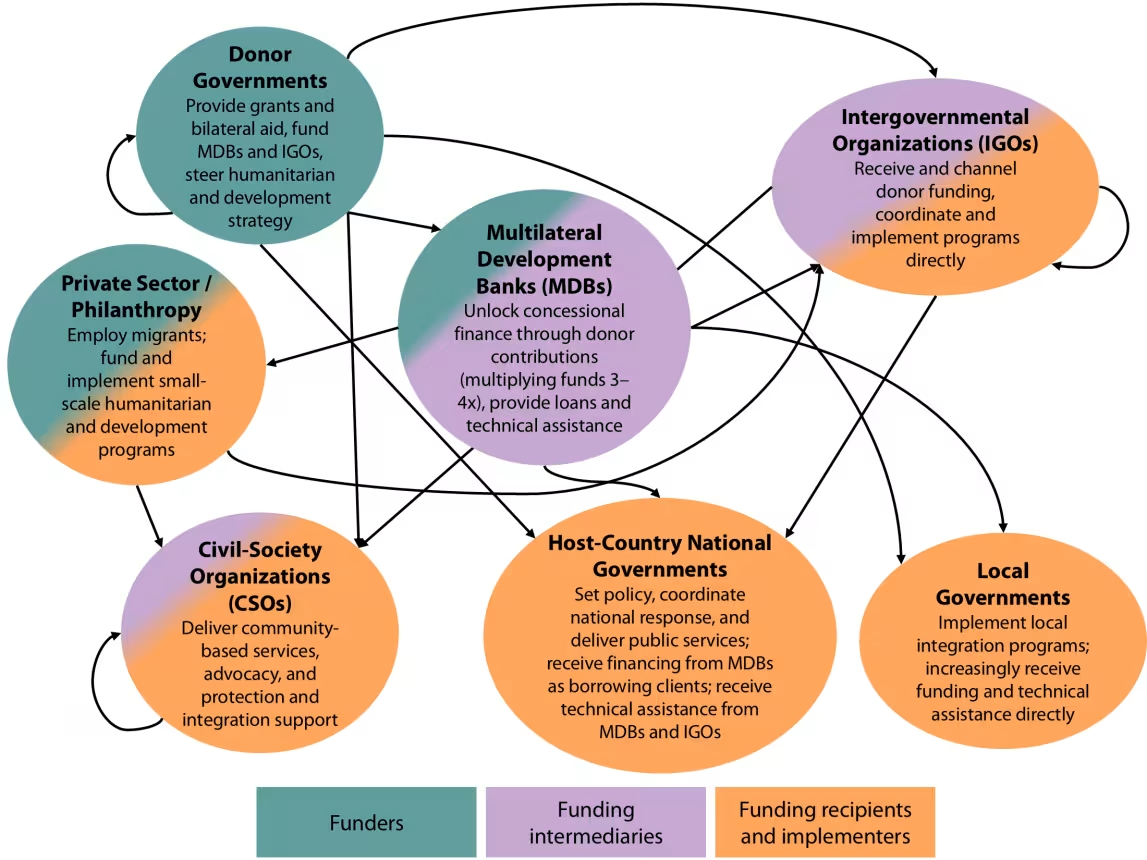
The large number of actors involved and the absence of centralized comprehensive financial reporting make it difficult to fully capture the scale of the funding ecosystem and the relationships between its participants. Drawing on available databases and in-depth stakeholder interviews, MPI researchers’ mapping exercise provides a systematic overview of the migration financing ecosystem in Latin America and the Caribbean, as well as a closer look at the examples of Colombia and Ecuador. The analysis identifies how funding flows among donors, funding intermediaries, program implementers, and funding recipients, while recognizing that funds often pass through multiple channels before reaching the final recipient (see Figure 3).
FTS data show that some actors perform multiple roles, meaning that funding (sometimes from the same source) flows in multiple directions. This section examines the main actors in the ecosystem; their roles as funding contributors, intermediaries, or recipients; and how funding is mobilized, channeled, and allocated through them.
Figure 3. Actors and Funding Flow for Migration-Related Projects in Latin America and the Caribbean, 2020–24
A. Donor Governments and Development Agencies
Donor governments have been the primary source of funding for the Venezuela response, providing humanitarian assistance to address urgent needs and long-term development assistance to support economic integration, social cohesion, and long-term integration. They typically channel contributions through their official development agencies (such as USAID, prior to major cutbacks in 2025, or Global Affairs Canada), although some governments provide funding through ministries of finance or foreign affairs or through specialized cooperation agencies.20 Donor governments also exert direct influence over program design by selecting and overseeing implementing partners, such as Chemonics, Mercy Corps, and ABT Associates.
Their engagement in the response has taken several forms:
- The RMRP: Donor governments are the primary funding source for the RMRP, pledging resources that are then channeled to IGOs, CSOs, and to a more limited extent, philanthropic organizations.21 These partners act as both intermediaries and implementers of RMRP activities.
- MDBs: Donors also fund the response through MDBs such as the World Bank (through the GCFF), IDB, and the European Investment Bank. These institutions act as financial intermediaries, enabling donors to leverage technical assistance, channel funding through institutions with established relationships with host governments, and increase the impact of their resources (for example, by combining donor grants with larger MDB loans).
- Bilateral cooperation: Donor governments engage in bilateral programming with host-country governments, but the scale is difficult to determine because a significant portion of funding is directed to national and local governments and is not reported in the R4V platform. Bilateral programming includes both national-level initiatives and funding to subnational governments.
The overall funding landscape can appear fragmented because donor involvement occurs across diverse channels and government branches. This complexity makes it difficult to track the full scope of donor contributions—particularly those outside the RMRP—and to understand how different funding streams intersect across humanitarian and development domains.
RMRP data, which exclude MDB and bilateral arrangements, show which donor governments provided funding directly through the framework and the size of their grants. Between 2019 and 2024, donor governments contributed approximately 2.3 billion to the RMRP framework. During this period, an average of 79 percent of funding was channeled to IGOs.22 This concentration reflects donors’ preference for working through multilateral and international institutions that provide technical expertise, operational capacity, and regional coordination mechanisms rather than directly through national or local actors. Many of these IGOs are UN agencies with longstanding humanitarian assistance and protection mandates.
The governments providing this funding and the amounts they have contributed have varied over time. Although a range of donor governments initially contributed to the RMRP, the number steadily declined from 23 in 2019 to 13 in 2024.23 Most notably, the U.S. share of total contribution rose from 65 percent in 2019 to 89 percent in 2024 (see Figure 4), and total U.S. funding contributions for the RMRP generally increased during this period. As a result, the response became increasingly dependent on a single donor, leaving it uniquely vulnerable to the U.S. foreign aid retrenchment in 2025.
Donors from outside the hemisphere have also engaged in the response to varying degrees. The European Commission, for example, was the second largest donor to the RMRP between 2019 and 2024 (see Figure 4). However, European and Asian donor governments did not demonstrate the same level of sustained engagement. Some governments, such as Korea and Norway, were prominent donors early in the reported period, while others, including France and Italy, increased their engagement in later years.24 These fluctuations often reflected changing domestic priorities, donor fatigue, or the lack of a long-term strategic approach to migration-related engagement in Latin America.
Figure 4. Share of Paid Contribution to the Venezuela Regional Refugee and Migrant Response Plan (RMRP) by Top Donor Governments, 2019 and 2024
European donor governments’ involvement in the Venezuelan response shifted notably as other displacement crises emerged, particularly those perceived as geographically or politically closer, such as Russia’s invasion of Ukraine. In 2022, Ukraine received the most ODA from European institutions and Germany, and the second largest amount from France and the United Kingdom. This reallocation of resources coincided with a decline in funding for Latin America, particularly for protracted displacement contexts. Interviews suggest that several preapproved or planned funding streams for South America were postponed, scaled back, or redirected as donor priorities adjusted to the evolving geopolitical landscape. As a result, fewer resources reached Latin America. For example, the Ecuadorian CSO Ending Violence Against Migrants was set to receive funding from a European development agency for education and health projects, but half of the promised funding was redirected to the response to the Ukraine crisis.25
In 2025, several key European donors also announced plans to reduce their ODA budgets for 2025–27. The announcements by France, Germany, and the United Kingdom were particularly significant because, together with the United States, these countries accounted for nearly two-thirds of total ODA from Organization for Economic Cooperation and Development members over the past decade.26 The United Kingdom, for example, announced in its multiyear budget that it would reduce ODA spending by approximately one-third.27 Although the Venezuela response has been less reliant on European donors than on the United States, these reductions also reverberate throughout the funding ecosystem.
The funding picture has become even more constrained in 2026. France announced another major reduction to its ODA budget, putting pressure on its development agencies.28 Germany reduced its development cooperation budget and adopted a reform that will reserve grant financing for low-income countries, while emphasizing loans, trade, and investment partnerships instead for middle-income countries.29 While the German reform does not explicitly mention a withdrawal from Latin America, its emphasis on loans rather than grants for middle-income countries is likely to reshape and reduce grant financing in the region. Meanwhile, in June, Switzerland stated explicitly that it plans to scale back development cooperation in Latin America beginning in 2027 as part of its 2029–32 cooperation strategy.30
B. Multilateral Development Banks
MDBs are an essential source of migration-related financing in Latin America and the Caribbean. The total amount of funds disbursed by MDBs through various mechanisms (grants, donations, and loans) significantly exceeds the volume other actors contributed via the RMRP, which reached approximately USD 2.5 billion between 2019–24.31 However, the total volume of nonreimbursable funding (such as grants) remains higher through the RMRP. Although donor governments were the first to mobilize grant-based humanitarian funding to meet the urgent needs of displaced Venezuelans, MDBs have since assumed an increasingly important role by providing substantially larger financial resources.
Unlike donor governments, MDBs traditionally provide financing through loans (including concessional loans with generous repayment conditions, such as low interest rates and long grace periods) or through blended finance mechanisms that combine loans and grants. This makes MDBs better suited to supporting long-term development responses to displacement, such as financing infrastructure or structurally strengthening systems such as health care or education. MDBs have historically engaged with migration as a peripheral issue, embedding it in broader portfolios such as social protection, labor, or fragility and have only recently begun developing migration-specific programming. The World Bank, for example, published its first migration-focused World Development Report in 2023.32
In Latin America, MDB engagement on migration reached a turning point in 2019, when Colombia and Ecuador joined the GCFF33 and IDB launched its Migration Unit,34 signaling recognition of migration as a structural development challenge. During this early phase, GCFF support to Latin America operated through the facility’s global window, allowing the region to benefit from pooled donor contributions responding to multiple crises. However, since 2023, the GCFF has moved toward a more geographically segmented model, now operating through six windows, including a regional window for Latin America and the Caribbean.35 Host countries in Latin America access GCFF resources primarily through their dedicated envelope instead of surplus global funds. At the same time, core GCFF donors that initially supported Latin America have increasingly directed new contributions and allocations to the Middle East and North Africa window and the East and Central Europe window, which prioritize displacement from Afghanistan and Ukraine.36
As a result, the concessional financing available to Latin American countries has declined significantly. Since 2023, the GCFF has approved four projects for Moldova, four for Jordan, and three for Armenia. During the same period, it approved only two for Latin American countries—one in Costa Rica and the other in Ecuador—and none for Colombia since 2021.37
Box 1. Multilateral Development Banks as Intermediaries
Multilateral development banks (MDBs) rely on funding from donor countries to enable their grant and loan operations. At the World Bank, the Global Concessional Financing Facility (GCFF) is the financial intermediary that provides concessional financing to middle-income countries hosting large refugee populations. This role is crucial because concessional and grant-based financing is usually reserved for low-income countries, including refugee-hosting low-income countries through the International Development Association Regional Window for Host Communities and Refugees. As such, the major migrant-hosting countries in Latin America would not qualify. The facility is funded primarily by Canada, Denmark, the European Commission, Germany, Japan, Norway, Sweden, the United Kingdom, and the United States. Its role is critical to unlocking MDB financing for migration-related activities in Latin America and the Caribbean and enabling donor countries to unlock larger concessional loans for the region by working through the facility.
The Inter-American Development Bank (IDB), the other major multilateral lender active in the region, channels migration-related financing through a different set of instruments. In addition to its grant facility and traditional loan operations, the IDB Migration Unit relies on funding from donors such as the European Union, Japan, Korea, Switzerland, and the United States. Along with the general capital they provide, some donor countries establish specific funds and finance migrant-related projects through them, such as Japan’s Special Fund and its Poverty Reduction Program and Korea’s Knowledge Partnership Korea Fund for Technology and Innovation.
Note: The GCFF relies on donor contributions to reduce borrowing costs for migrant-related development projects, which are supported by five partner multilateral development banks. For every U.S. dollar that these supporting countries provide, the GCFF unlocks USD 3–4 in concessional funding.
Sources: GCFF, “Overview,” accessed August 16, 2026; GCFF, Rising to the Challenge: Sustainable Support for Refugee Inclusion and Host Communities in Middle-Income Countries—Annual Report 2023 (Washington, DC: World Bank, 2024); IDB, “Non-Borrowing Member Countries,” accessed November 1, 2023; author analysis of information on projects CO-T1551 and CO-T1650 from IDB, “Projects,” accessed November 8, 2023; IDB, “Topics—Migration,” accessed October 31, 2023; World Bank Group, International Development Association, “Window for Host Communities and Refugees,” accessed May 28, 2025.
Between 2019 and 2024, the GCFF allocated USD 134 million in grants to catalyze approximately USD 1.7 billion in concessional loans for Colombia, USD 50 million in grants to catalyze USD 1.5 billion for Ecuador, and USD 20 million in grants to catalyze USD 370 million for Costa Rica.38 In total, the GCFF approved nine projects in these three countries during this period, primarily in partnership with the World Bank and, in some cases, with IDB.
Beyond its participation in the GCFF, IDB has disbursed additional migration-related financing through its Migration Unit, country offices, and other disbursement units.39 Between 2020 and 2023, IDB provided Colombia with at least USD 300 million in loans and USD 36.8 million in grants.40 These funds have supported a wide range of initiatives, including labor market integration, policy reforms, efforts to strengthen institutional and systems capacity, among others.41 Although IDB engagement in Ecuador began earlier, with at least four projects launched in 2019, the total resources disbursed to Ecuador have been significantly smaller.42 Between 2019 and 2023, IDB provided Ecuador with at least USD 50 million in loans (about 17 percent of the amount lent to Colombia) and USD 14.8 million in grants.43 These investments have focused on improving social services, strengthening education systems, building institutional capacity, and enhancing employability.44
The European Investment Bank—an important donor for the response, though on a smaller scale—announced at the 2020 donor conference its plan to build an investment pipeline of up to 400 million euros in loans to address Venezuelan migration.45 As of January 2026, it had cofinanced two projects in Colombia (contributing 24.2 million euros total) and one in Peru (contributing 7.2 million euros).46
CAF—the Development Bank of Latin America and the Caribbean—is increasingly incorporating migration components into its broader investments and services, although it does not have a portfolio dedicated to migration.47 Compared with other MDBs, CAF emphasizes its work at the subnational level and funding for local governments, its evolving role guided by its Strategic Framework on International Human Mobility. The framework adopts a comprehensive, multisectoral approach to all phases of human mobility: emigration, immigration, transit, and return.48
C. Intergovernmental Organizations
Intergovernmental organizations have been instrumental in the response to Venezuelan displacement, particularly through the R4V platform. Within this structure, IGOs have acted as both funding intermediaries and implementing partners and can be grouped into the following broad categories based on their mandates:
- Migration and displacement mandates: As co-leads of the R4V platform, IOM and UNHCR have coordinated the humanitarian response. Each organization has a distinct but complementary mandate: IOM focuses on facilitating orderly and humane migration and assisting vulnerable migrants, while UNHCR is responsible for protecting refugees and other forcibly displaced people. Their shared leadership reflects the legal and operational complexity of the Venezuelan displacement context. Framing the crisis solely as a refugee emergency or a migration challenge fails to capture its mixed nature. Many Venezuelans fall into a legal gray area: Some meet the 1951 Geneva Convention definition of a refugee, others are considered vulnerable economic migrants. These distinctions often blur in practice, even within a family unit. By sharing leadership, IOM and UNHCR combine their institutional strengths to support a more holistic and coherent response to mixed migration.
- Broader humanitarian mandates: IGOs with broad humanitarian missions have also been prominent, even though most do not have specific migration mandates. Organizations such as the World Food Program (the lead agency delivering food and nutrition assistance in emergencies) and the United Nations Children’s Fund (UNICEF) have been among the largest funding intermediaries and implementing partners. Their longstanding presence in the region, logistical capacity, and ability to scale up life-saving services made them indispensable in addressing the humanitarian needs of displaced Venezuelans, many of whom fled hunger and who include a large proportion of children.
- Development mandates: As the response transitioned from short-term emergency assistance to long-term integration needs, UN agencies with development mandates, such as the International Labor Organization and UNDP, became more actively involved. These organizations have brought extensive experience in the region and knowledge of development challenges and labor market dynamics in host countries. Their engagement reflects recognition that migration can contribute to development and that the durable inclusion of displaced populations requires linking humanitarian response with sustainable development planning.
These IGOs have acted as both funding intermediaries and project implementers, and they have been the primary recipients of RMRP funding. Between 2019 and 2024, international organizations received an average of USD 1.9 billion, representing 79 percent of all contributions. Approximately USD 1.8 billion (94 percent) came from donor governments, and USD 164 million came from other sources, most of it through transfers between IGOs, including UN National Committees and UN agencies and funds such as UNICEF and Education Cannot Wait.49 This has positioned IGOs as key actors in the migration governance ecosystem: They have received most donor government funding, channeled much of it to other organizations to implement projects, and, in some cases, implemented projects themselves.
"These IGOs have acted as both funding intermediaries and project implementers, and they have been the primary recipients of RMRP funding."
In their role as intermediaries, IGOs also disbursed 4 percent (about USD 98 million) of all paid RMRP contributions in the region between 2019 and 2024.50 Most of these funds were transferred to other IGOs and to nongovernmental organizations (NGOs). Some IGOs with broad mandates or flexible funding, such as the UN Central Emergency Response Fund and the COVID-19 Humanitarian Thematic Fund, have directed RMRP contributions to IGOs with more specialized mandates. For example, since 2020, they have allocated most of the funding to other IGOs focused on the needs of migrant children, including UNICEF. However, because some IGOs subsequently implement projects through CSOs (many of which are small organizations), it is difficult to trace how funding is ultimately distributed.
Decreases in foreign aid starting in 2025, particularly reductions in funding from the United States, have directly affected the ability of IGOs to fund or implement projects in the region. In March 2025, IOM announced an unprecedented 30-percent reduction in projected donor funding, forcing it to reduce its workforce significantly and scale back or terminate programs.51 UNHCR also announced that its budget for the year would be USD 1.3 billion lower than in 2024, forcing it to downsize or close operations.52
D. Civil-Society Organizations
CSOs have been instrumental in responding to Venezuelan displacement. Donors often rely on CSOs because of their deep understanding of local contexts and trusted relationships with affected communities and local leaders. Although many CSOs in the region did not initially focus on migration, some have adapted their operations to support Venezuelan migrants and refugees. An example is Save the Children, which had experience addressing violence and internal displacement in Colombia. As a result, CSOs with explicit human mobility mandates entered the region, and many others with broader mandates became involved in the response organically.
CSOs involved in the response to Venezuelan migration have included:
- International NGOs: Larger international nonprofits often operate across multiple countries and have extensive experience responding to humanitarian crises worldwide. For example, World Vision International, Oxfam, Norwegian Refugee Council, Save the Children, and HIAS provide a wide range of services, including emergency relief, legal aid, protection, education, and integration support. Their longstanding relationships with donor governments and strong grant management systems have enabled them to mobilize quickly and operate at scale.
- Community-based organizations: These smaller nonprofits are typically founded and operated locally and maintain close ties to migrant and other vulnerable communities, which makes them crucial partners for governments and international organizations aiming to disseminate information, communicate the needs of communities, and identify potential beneficiaries.53 For example, these nonprofits helped disseminate information to migrant communities during Colombia’s implementation of its Temporary Statute of Protection for Venezuelan Migrants, which grants eligible Venezuelans a Temporary Protection Permit.54
- Faith-based organizations: Groups such as the Jesuit Refugee Service and the Scalabrinian Missionaries have long supported Venezuelans across the region. Their established presence, commitment to social justice, and deep community ties have enabled them to provide both spiritual and material assistance, including shelter, legal aid, and psychosocial care.
However, many CSOs have smaller staffs and limited capacity to manage large grants, making it more difficult for them to receive and implement substantial funding streams. Because many also engage in advocacy, such as monitoring policies and demanding the enforcement of migrant rights, their relationships with host governments and donors can sometimes be tense.
The relationship between CSOs and other actors in the migration response has been multifaceted. To different extents, CSOs have operated simultaneously as funding recipients, implementing partners, and less frequently, intermediaries. However, available data significantly understate their role. For example, the FTS, which informs the RMRP, generally captures an initial disbursement of funding but may not capture all subsequent transfers to implementing partners. As a result, the full extent of CSOs’ involvement is not reflected in funding data, even though they frequently deliver services on the ground, often on behalf of larger IGOs or donors. Still, CSOs remain the largest group of organizations involved in the response: 84 distinct CSOs appear in the FTS alone, but the actual number is likely much higher.55
Between 2019 and 2024, an average of 21 percent of paid contributions to the RMRP was distributed to CSOs.56 Among the CSOs that consistently received large shares of funding were the Norwegian Refugee Council, Plan International, and Save the Children. Compared with IGOs, CSOs received funding from a wider range of donors and intermediaries, including donor governments, IGOs, other CSOs, philanthropic organizations, and the private sector. Their strong community ties, operational flexibility, and rapid response capabilities have made them essential partners for actors seeking to deliver aid effectively in dynamic and often under-resourced environments.
"Compared with IGOs, CSOs received funding from a wider range of donors and intermediaries, including donor governments, IGOs, other CSOs, philanthropic organizations, and the private sector."
CSOs primarily receive funding to implement programs and deliver assistance, but some have also functioned as funding intermediaries within the RMRP. Between 2019 to 2024, international NGOs such as Save the Children, Tearfund, World Vision, and Canadian Foodgrains Bank were among the principal organizations disbursing RMRP contributions. However, many of these funding flows have occurred within the same institutional network. For example, World Vision country offices in Canada, France, and Korea have channeled funds to World Vision International.57 This pattern suggests that a significant share of NGO funding circulates within organizational networks, raising questions about whether these resources are ultimately implemented by those organizations or passed on to other implementing partners.
E. The International Private Sector, Including Philanthropy and Foundations
The private sector is highly diverse and has engaged in the Venezuelan migration response in a variety of ways. Beyond private-sector actors’ critical role in directly employing migrants, some—notably philanthropies and foundations—have also financed and implemented employability, entrepreneurship, and skills training programs and contributed financially to the RMRP. Between 2019 and 2024, the private-sector contributed USD 46 million in paid contributions to the RMRP (approximately 1.9 percent of all contributions).58 Compared with other actors in the ecosystem, however, private-sector donations have been more dispersed, with few private-sector actors contributing consistently over time.
FTS data show that private-sector actors are important funders, although their primary role (not captured in these data) is employing migrant workers. The main international private-sector actors involved in the migration response include the following:
- Companies and corporations: Companies—many headquartered in countries outside the region—have made contributions to the RMRP, generally directing them to IGOs and NGOs. According to FTS data, companies such as GlaxoSmithKline and Airbnb have primarily channeled their funding to NGOs, including HIAS and Save the Children.59
- Corporate foundations: International corporations have also contributed to the RMRP through their corporate or company-sponsored foundations, commonly directing funding to NGOs, particularly those providing humanitarian aid. For example, according to the FTS, Fondation Chanel has paid contributions to UNHCR, and the LEGO Foundation has funded Sesame Workshop, an NGO focused on children.60
- Independent and private foundations: Foundations endowed by private individuals, families, or companies also contribute to the RMRP, and have generally directed their funding to NGOs. For example, the Ford Foundation has contributed to the Norwegian Refugee Council.61 Some foundations, such as the Open Society Foundations, have notably supported and financed Venezuelan migrant integration programming in the region, though not through the RMRP.62
- Private individuals and organizations: According to FTS data, some of the largest private-sector contributions to the RMRP are from private individuals and organizations. These donors have primarily directed their funding to IGOs, including IOM, UNHCR, UNICEF, and the World Food Program. When supporting NGOs, they have tended to fund child-focused organizations such as Save the Children and War Child.63 Because these donors choose to remain anonymous, no information is available about their identities or origins.
4. Evolving Funding Goals
The Venezuelan displacement crisis quickly evolved from an urgent humanitarian challenge into a protracted displacement crisis, requiring different financial responses. Initially, host countries and donors focused on providing emergency relief to migrants and refugees and supporting overstretched public institutions. As migration persisted and most people did not return to Venezuela, the movement increasingly became viewed as a potential driver of economic development, not just a humanitarian challenge. This transition has been uneven and nonlinear, with stakeholders shifting between humanitarian aid and long-term development strategies at different stages of the crisis and with different policy framings becoming more salient at certain moments.
A. Transitioning from Humanitarian Aid to Long-Term Development
The early years of Venezuelan displacement attracted substantial humanitarian support and funding, partly reflecting an expectation that many displaced Venezuelans might return home or move again and thus not require long-term integration support.64 However, multilateral organizations, civil society, and think tanks warned from the outset that Venezuelan displacement was likely to become protracted. In practice, the initial emphasis on humanitarian assistance was less a failure to understand migrant intentions than a reflection of the standard sequencing of international crisis responses, in which emergency assistance is the first line of action, with long-term structural solutions added later. It also reflected political caution among host-country governments, which had to manage public perceptions about the scale and duration of the displacement.
During preparation for the 2019 RMRP framework, 60 percent of total funding was needed for direct emergency aid and protection across the region. In Colombia, 55 percent of funding was marked for direct emergency assistance, and in Ecuador, the figure was 52 percent.65 This emphasis was also reflected in donor government funding. For example, in 2018, USAID’s humanitarian assistance branch launched a community stabilization activity to provide humanitarian assistance and documentation and to facilitate access to basic health care in border communities.66
When it became clear that Venezuelan displacement would persist, governments focused on long-term planning and investments, shifting from humanitarian services to integration and long-term development finance.67 Venezuelan migrants offered a development opportunity: They were generally younger than native populations and largely settled in cities where they could find employment. They expanded the labor force and tax base and offered the potential for a demographic dividend or bonus in host countries such as Colombia and Ecuador.
Without long-term planning to integrate these newcomers into host economies and societies, however, donors, host governments, and CSOs feared that funding and providing humanitarian services could continue indefinitely.68 Colombia, for example, granted Venezuelans regular status, after which the number of Venezuelans paying taxes, opening saving accounts, contributing to the public health-care system, and creating employment in Bogotá increased. Between 2019 and 2022, migrants created 11 percent of all employment in the city.69
Donors also shifted toward long-term development. USAID, for example, established a development portfolio in 2019 after its data showed that Venezuelans intended to remain in Colombia.70 From 2022 through at least 2024, the USAID project Opportunities Without Borders focused on expanding access to formal employment and capital for Venezuelans while strengthening entrepreneurships.71 By 2023, other development agencies, such as Agence Française de Développement (AFD) and GIZ, had begun funding migrant-related development projects or incorporating human mobility indicators into their portfolios. At that time, AFD stated that it had not yet determined whether migration would become a priority in its Latin America regional strategy, but that it planned to adopt a more cross-cutting approach in its future loans.72 For instance, its 2020–24 mandate for green and inclusive growth in Latin America aimed to include migrant beneficiaries in its housing and transportation projects.73 GIZ was also actively working on human mobility issues during this period.74 When the Ecuadorian municipality of Mira asked GIZ to fund a tourism strategy to reactivate its economy after the pandemic, GIZ requested that the plan be inclusive. Along with funding and providing technical assistance, GIZ trained migrants and provided them with seed capital to work in Mira’s tourism sector.75
MDBs were particularly influential in shifting the focus toward long-term planning and promoting a positive narrative about migration as an economic and development opportunity for host countries. The World Bank has argued that policies supporting migrants’ long-term integration can generate economic and social benefits for host countries,76 and it shifted toward long-term development policy loans when it became clear that migrants were remaining in their host countries. In 2019, the GCFF approved the first loan of this kind for Colombia to support fiscal sustainability, promote productivity and growth, and support migrants’ regularization and integration, with the World Bank as the implementation support agency.77 In 2023, the World Bank’s flagship World Development Report formalized the institution’s view of migration and displacement by presenting both the development challenges and opportunities.78 Private actors such as Hispanics in Philanthropy have also embraced this perspective. Even when primarily funding humanitarian assistance, they have advocated for viewing migration as an opportunity for countries, societies, and people, not just a crisis.79
B. Obstacles to Long-Term Planning
The transition away from humanitarian assistance and toward long-term development has been difficult for donors and recipients, for a range of logistical, financial, bureaucratic, geographic, and political reasons. Humanitarian aid often produces faster, more tangible results (such as being able to quantify the number of migrants receiving food assistance). By contrast, development programs can be riskier, longer-term investments that take longer to achieve measurable, sustainable results and require more rigorous monitoring and evaluation.80 This difference in approach, incentives, and outcomes has made the transition challenging to navigate. Obstacles have included:
- Resurgence of humanitarian needs during the COVID-19 pandemic. The pandemic created a humanitarian crisis, forcing donors to address basic needs (for example, health, nutrition, and housing needs) and slowing the momentum toward long-term development and integration.81 In 2020, RMRP budget lines were marked explicitly for COVID-19 relief,82 and donors focused more on migrants’ immediate needs and less on long-term development. In Colombia, the World Bank funded multipurpose emergency cash transfers for vulnerable Venezuelan and other households, and IDB funded access to COVID-19 prevention educational materials in border cities.83 USAID also adapted its community stabilization activity to address the public health crisis and allocated funding to support the activity.84
- Geographic diversity of humanitarian and development needs. The impacts of Venezuelan displacement have varied across countries and localities, and over time, making it impractical for donors to shift to development assistance across the region all at once. For example, Colombia shifted from being primarily a transit country to being a host country more quickly than Ecuador and enacted its regularization policy for Venezuelans earlier.85 As a result, the World Bank continued funding service provision and regularization in Ecuador even while it began funding long-term integration in Colombia.86 The same pattern occurred at the subnational level, where cities and municipalities differed in institutional capacity and the migrant populations they received. Capital cities, such as Bogotá and Quito, became primarily host cities, whereas border cities such as Cúcuta still relied on donor support to provide humanitarian services for transit and cross-border migrants.87 These differences show how even when donors begin to direct large investments toward long-term integration, some areas still need humanitarian infrastructure and assistance, and maintaining that capacity results in a less-than-uniform transition across locations.88
- Rigid bureaucracy and organizational mandates. Donors and implementing organizations, such as UN agencies, often have rigid internal dynamics, mandates, and financing streams that can make shifting to development support difficult. For example, bureaucratic structures can limit how much of an organization’s portfolio supports migration and whether funding goes to development or humanitarian assistance.89 Some implementing actors with development mandates were also slow to address migration. UNDP, for example, worked only tangentially on migration in the region and included human mobility indicators in its Strategic Plan for the first time in 2022.90
- Fragmented funding streams and sectoral silos. Some donor governments might have active humanitarian teams on the ground, but their development departments tend to respond more slowly. CSOs, though effective at delivering humanitarian aid such as food assistance, often lack the capacity to pivot to development programming, such as employability training. Similar challenges exist among MDBs, where migration is not a standard consideration across programs and portfolios. At IDB, the Migration Unit operates across sectors and must build partnerships and persuade actors in other sectors to integrate migration issues into their work, but those stakeholders may not necessarily prioritize this. Up until 2025, the World Bank divided responsibility for migration between the Social Protection practice, focused on labor market integration, and the Social Inclusion unit. This division created parallel, fragmented approaches that could complicate coordination between host governments and the bank. The bank has since consolidated this work under a single Social Policy Unit, a shift intended to strengthen coordination with government counterparts.91
- Political and institutional rigidity in host countries. At the national level, migration policies generally fall within the purview of the ministries of foreign relations or interior, while ministries of planning, labor, or economy engage in migration governance more marginally. This division makes it difficult for governments to integrate migration policies into broader development planning. Governments also often lack the data, institutional tools, and cross-sectoral platforms needed to make those connections. Civil society and academic institutions could help integrate migration considerations into development planning, but they also frequently frame migration in terms of immediate protection needs.
- Political continuity and turnover. Political instability in Latin America, including frequent changes in government and social unrest, can complicate long-term funding and planning.92 For example, MDBs provide long-term loans with multiyear implementation timelines that require consistent partnerships with recipient governments throughout implementation and repayment. Frequent turnover among key government officials can therefore make it challenging to obtain financing for migration and development. In many cases, new administrations abandoned previous efforts and launched parallel initiatives, frustrating donors and undermining confidence in local ownership. Leadership and personnel changes also created challenges for donor governments because donor agencies often had to rebuild partnerships and reengage with new government counterparts.93
The difficult transition to development approaches at times created a mismatch between donor capacities and host government needs. Before the 2022 donors’ conference, the Colombian government stated that it needed funding for migrant socioeconomic integration, specifically employability and entrepreneurship programs.94 Despite those repeated requests, donors continued to direct a large share of funding to humanitarian assistance.95
"The difficult transition to development approaches at times created a mismatch between donor capacities and host government needs."
Because development approaches to Venezuelan displacement have not yet been fully implemented, consistent migrant integration remains difficult, and funding cuts have posed existential threats. Although there was initially hope that U.S. funding cuts would prompt European donors to increase their humanitarian contributions, and some (such as Norway) did, that lifesaving but short-term assistance risked diverting resources from long-term development programing,96 and other European nations have reduced their own foreign aid and development spending (as discussed in Section 3.A.). Without sustainable development approaches, host countries will continue to rely on donor funding to meet basic needs, even as that funding has become more unreliable.
Looking ahead, financing responses should seek to account for the evolving nature of migration flows. Although many Venezuelans settle and integrate in host countries across Latin America, others will continue to transit through the hemisphere. In addition, as the U.S. government has ramped up enforcement operations to meet its deportation goals, countries in the region have needed to receive Venezuelan (and other) migrants who had previously settled in the United States. These overlapping dynamics require flexible, layered financing approaches that respond to immediate needs while supporting long-term development, reintegration, and regional cooperation.
5. Changing Partnerships
As host countries such as Colombia and Ecuador have advanced their integration and development agendas, new stakeholders have emerged as crucial partners for international donors and development agencies. Local governments have helped streamline efforts by circumventing national bureaucratic bottlenecks, leading to new funding streams and programming.
At the same time, private actors including local businesses and philanthropies have taken on a greater role by increasingly integrating development objectives into their business models and leveraging innovative financing to support integration and development initiatives. Their growing involvement reflects a broader change in how stakeholders address migration and integration challenges.
To complement the data-driven mapping of the financing ecosystem, in-depth interviews with stakeholders in Colombia and Ecuador helped MPI researchers examine trends that are not reflected in the data but that have shaped the financing and implementation of the Venezuela response. Colombia and Ecuador were selected because both are major host countries for Venezuelan migrants, have implemented regularization programs, and have subsequently focused on integration.
A. Rising Localization of Foreign Aid
Colombia’s and Ecuador’s growing emphasis on integration and development has created new opportunities for donor governments’ development agencies and MDBs to work with local governments. Although both countries are highly centralized and migration remains firmly under the purview of national authorities, with no formal decentralization of the migration agenda anticipated, subnational governments have become critical to policy implementation. National governments determine legal status through policies such as Colombia’s regularization programs and Ecuador’s Organic Law on Human Mobility, but integration takes place in cities and municipalities. In this context, local governments have often stepped up, not because of a formal mandate but because they must respond to local needs.97
The growing role of local governments in migration leadership is part of a broader global trend of “city diplomacy,” in which local governments leverage international collaboration to access resources, secure donor funding, and exchange best practices through city networks and bilateral partnerships.98 International donors and partners have benefited from these partnerships for the following reasons:
- Proximity to the ground can produce more efficient solutions. Local governments must respond to daily pressure from their citizens, often incentivizing them to identify and implement solutions quickly. For this reason, some development agencies have found working with local governments to be faster, more efficient, and less burdensome than working with national governments.99 In Colombia and Ecuador, the national migration institution is part of the Ministry of Foreign Affairs, which can make collaboration on local projects challenging. For example, a representative of the Ecuadorian economic development agency Corporación de Promoción Económica ConQuito (ConQuito), which is affiliated with the Municipality of Quito, described how bureaucratic bottlenecks can slow interministerial review, communication, and coordination after the country’s Ministry of Foreign Affairs receives information about potential donor funding, sometimes resulting in missed opportunities.100 To avoid those delays and reduce the risk of missing funding windows, ConQuito has involved the Municipality of Quito in funding application processes.
- Broadening geographic engagement can diversify risk. Although local governments operate under national regulations, they differ significantly in their openness to partnerships and migrant integration interventions, giving international donors and migration-focused organizations opportunities to work with a wider range of willing partners. In Ecuador, AFD and GIZ found that not all Ecuadorian local governments want to work on migration issues, but some have welcomed partnerships.101 According to GIZ, working with a range of local governments can allow development agencies to diversify risk. Similarly, local government support helped USAID launch initiatives such as the 11 Intégrate Centers (comprehensive integration service centers) in nine Colombian cities, which became a flagship national integration initiative.102
- Local actors can produce more immediate, tangible results. Locally implemented initiatives are smaller in scale, which can translate into quicker, more visible impact.103 This is especially true when donors work with trusted local governments or CSOs that have longstanding ties to their communities and can launch programs faster and implement them more smoothly.104 One example is how GIZ provided technical assistance to Ecuador’s decentralized municipal governments to draft local ordinances that protect migrants’ rights. Supporting these processes at the local level proved easier than supporting changes to national legislation, such as a new national human mobility law.105
Still, engaging directly with international organizations and financing institutions is new for many small and midsized cities. Many lack the institutional capacity, technical expertise, or staff to manage these partnerships. In response, the IDB Migration Unit began strengthening subnational governments’ capacity to engage in international cooperation. Through targeted partnerships, the bank has aimed to build local governments’ capacity to pursue and manage donor-funded projects independently. In June 2025, IDB launched its IDB for Cities and Regions initiative, a five-year pilot program that gives local governments direct access to up to USD 1 billion in loans and guarantees.106
Despite these promising developments, local governments continue to face mandate and funding constraints linked to the structure of centralized governance. They also face varied pressures ranging from economic and demographic shifts to humanitarian needs, and they must implement migrant integration strategies that reflect local realities. However, local governments can adapt existing policy mechanisms to incorporate migration components.107 Quito, Ecuador, for example, has developed a sophisticated supply-and-demand approach to donor engagement that matches funding priorities with municipal priorities. Municipal authorities systematically examine the funding streams and thematic priorities of banks and donor countries, consult with municipal secretariats to incorporate those priorities into strategic areas of work, and then design proposals that align with donor interests. Quito’s Directorate of Foreign Affairs and Cooperation facilitated this approach, demonstrating how local institutions can strengthen resource mobilization.108
B. Emergence of Innovative Financing Models and Strategic Partnerships
Migration-focused institutions and organizations across Latin America and the Caribbean had already identified securing new and innovative financing sources as a priority before the 2025 cuts in U.S. foreign assistance. Because the region’s major host countries are ineligible for most concessional financing and often receive lower priority for humanitarian aid, donors and development agencies have sought partnerships with nontraditional actors in migration management, including the philanthropic community and the private sector. In Colombia and Ecuador, the local private sector has expanded its role beyond corporate social responsibility and charitable grantmaking to become an active stakeholder in the response to Venezuelan displacement.
Latin American philanthropic institutions have organizational structures and grantmaking practices that differ from those of their counterparts in high-income countries.109 Whereas foreign philanthropies commonly fund organizations that implement programs, Latin American foundations—primarily corporate and family foundations—typically design, finance, and implement their own programs through a private social investment lens.110 Colombian and Ecuadorian corporate and family foundations focus on specific social and economic issues within local communities.111 Although they did not originally design programs for migrant inclusion, many foundations have expanded their eligibility criteria to benefit Venezuelans. As a result, a diverse landscape of small-scale, local humanitarian and development initiatives now contribute to immigrant integration across cities in Colombia and Ecuador.
In Colombia, foundations have adopted innovative approaches to resource mobilization. Fundación Carvajal uses a force multiplier model that leverages its dividends to attract additional funding: For every Colombian peso it receives, the foundation seeks 4 pesos in external contributions. By 2024, Fundación Carvajal had become a local partner in USAID’s Together We Learn program (Juntos Aprendemos), implementing education integration initiatives for vulnerable migrants and host-community members.112 By contrast, Fundación WWB relies on a diversified income strategy based on strategic investments and a social impact portfolio.113 Its largest investment, Banco W, in which the foundation owns 86 percent of the shares, provides a sustainable source of long-term income. As of 2024, Fundación WWB had partnered with USAID’s Oportunidades Sin Fronteras program to expand its entrepreneurship training and financial education programs to Venezuelan women referred by the USAID program while maintaining its financial independence.114
"A diverse landscape of small-scale, local humanitarian and development initiatives now contribute to immigrant integration across cities in Colombia and Ecuador."
IDB has also used creative financing mechanisms through its Multilateral Investment Fund, an innovation policy laboratory that engages the private sector.115 To support Venezuelan migrant integration, IDB has provided nonreimbursable technical cooperation grants matched by recipient contributions.116 For example, One Earth Future Foundation used its own resources (45 percent) and IDB funds (55 percent) to launch an entrepreneurship program based on cash crop production for Venezuelans and vulnerable local residents in Colombia.117 In Ecuador, IDB provided a technical cooperation grant to Fundación Las Reinas Pepiadas to expand its socioeconomic integration project for Venezuelan women and co-financed a project with the CRISFE Foundation to develop innovative models for the education and labor market integration of migrants and host communities.118
Other stakeholders have focused on building strategic networks and approaches to strengthen the ecosystem. The Alliance for Entrepreneurship and Innovation, based in Ecuador, acts as a network facilitator by connecting donors, accelerators, and development entities to support Ecuador’s 2030 entrepreneurship and innovation strategy.119 The alliance has helped local partners secure large grants, such as a USD 3 million grant from USAID, by mobilizing potential project partners and other interested stakeholders to provide counterpart funding.120 For example, the alliance helped develop the CRISFE Foundation’s IDB-supported Without Borders: Innovations for the Inclusion of Migrants project.121 This strategy has supported immigrant integration in Ecuador by connecting Venezuelan entrepreneurs with a wide network of local entrepreneurs and potential clients.
Local public-private partnership models have also helped align public and private-sector goals and expand funding for migrant integration. ConQuito supports the city’s entrepreneurship and economic development goals, for example. When international funding opportunities related to migration or entrepreneurship arise, the municipality refers them to ConQuito to develop funding proposals. According to the agency, this public-private alignment, particularly at the local level, makes securing funding more efficient.122
The private sector’s evolving interest and role represent a promising shift toward scalable, transferable, and systematic approaches to economic inclusion and migrant integration. In 2023, Fundación Carvajal was replicating its employability program in other cities in Colombia and abroad, while Fundación WWB was sharing knowledge gained through its entrepreneurial and financing training initiatives with other organizations.123 However, fragmented efforts, limited coordination, and competition for international grants among implementing organizations have limited the potential of some approaches.124 Greater collaboration and knowledge exchange could enhance the impact and efficiency of development initiatives and ensure that they complement one another.
6. Looking Ahead: Building a Leaner, More Sustainable Migration Response
At the onset of the Venezuelan displacement crisis, the unprecedented scale of the humanitarian emergency prompted many international actors to engage quickly in response efforts in Colombia, Ecuador, and other affected countries. Many entered the regional migration response without clearly defining their roles or competitive advantages, resulting in misdirected efforts and resources. This reactive approach created and continues to create overlaps and duplications across areas of focus, activities, and programs.
As the Venezuelan displacement crisis enters a new phase, amid the retrenchment of U.S. foreign aid and tightening of budgets across other major donor countries, there is an urgent need for more strategic, cost-effective, efficient, and sustainable financing mechanisms. The need for stronger coordination is also urgent because R4V, the primary coordination framework for the international response, is operating under increasingly resource-constrained conditions, with only 16 percent of 2026 RMRP funding needs met as of September 2026.125 This juncture presents an opportunity to clarify roles, reduce fragmentation and duplication, and scale innovative financing mechanisms. To do so, actors across the funding ecosystem should consider the following overarching priorities:
Clarify Roles and Strengthen Coordination
- Leverage stakeholders’ strengths. As donors reassess their roles in the migration response and define their areas of focus, they have an opportunity to improve coordination, strengthen complementarity, and reduce duplication. As organizations solidify their mandates, they should focus on their core strengths, areas of expertise, and the contributions they can make most effectively. For example, humanitarian and development actors should recognize their mutually reinforcing roles and collaborate to ensure their portfolios complement one other. Regional platforms such as the Quito Process, the Regional Conference on Migration, and the South American Conference on Migration provide opportunities to align those roles and strengthen coordination.
- Strengthen host-country government ownership. These national governments are central to coordinating migration responses, mobilizing resources, and aligning policy priorities. Although donors contribute significantly to the migration response, governments have the unique authority and capacity to convene stakeholders and coordinate efforts across territories. For donors to support host-country governments effectively, the latter need consistent migration policies. Frequent changes in migration policies and government counterparts can undermine donor confidence and hinder project funding. Countries with clear migration policies, stable institutional frameworks, and reliable government counterparts are better positioned to lead migration responses and attract international funding. National governments should also coordinate with local authorities, whose capacities and mandates are critical to implementing resources effectively.
- Integrate humanitarian and development assistance. Humanitarian relief and development assistance should be framed as complementary and interwoven, rather than sequential. Although development funding commonly follows humanitarian assistance, the diverse financial, logistical, and capacity needs across and within countries, along with the varying profiles within migrant populations, suggest that some areas will continue to need humanitarian infrastructure even as others shift to a development focus. Dismantling that infrastructure can undermine countries’ capacity to respond to future crises. By aligning humanitarian and development efforts, countries can build long-term resilience and capacity and better prepare for future crises. In addition, integration programs, such as those supporting migrant entrepreneurship, can be more successful when combined with humanitarian assistance, including transportation, housing, and child care. Ultimately, countries will need to balance urgent humanitarian needs and long-term development goals.
- Empower local actors. Local governments and CSOs have become key partners for international donors and, in some cases, MDBs. Supporting these actors more systematically can enable more tailored and effective programs. However, local actors often lack the capacity to work directly with international funding entities. Training, capacity-building initiatives, and better access to financial resources can maximize their ability to do so. For example, providing local actors with the tools to manage grants and engage with international donors can increase their impact.
Expand and Diversify Financing Mechanisms
- Align migration with national development priorities. As the region continues to develop long-term approaches, countries could link migration strategies more systematically with national development goals to attract more diverse funding streams. To capitalize on these opportunities, host countries need to identify potential donors and tailor proposals to their priorities. For example, if a donor focuses on education or urban development, countries can incorporate migration indicators into projects that align with those priorities, unlocking new sources of financing. Because donor priorities change over time, diversifying funding sources can help host-country governments secure a more stable financial base.
- Scale existing private-sector-led integration models. Various private foundations supported integration programs for vulnerable local populations before the Venezuelan displacement crisis. Many have since expanded those programs to include migrants, but they often operate in isolation and are not framed as migrant integration efforts. Mapping existing programs and promoting knowledge exchange can help identify successful models for prospective donors. Rather than continually creating new programs, stakeholders can build partnerships to scale models that are proving effective in meeting the needs of displaced individuals and other vulnerable members of host communities.
- Invest in innovative finance models. The growing involvement of nontraditional donors, including the private sector and philanthropic organizations, creates opportunities to explore innovative financing models and broaden the donor base, reducing reliance on traditional donors. Aligning public and private objectives can create win-win partnerships that use resources more efficiently and support sustainable migrant integration initiatives. Coordinating these efforts from the outset can help establish a shared vision across stakeholders.
Reframing human mobility as a catalyst for development, rather than a recurring emergency, is a strategic bet the region cannot afford to pass up. Whether this bet pays off will depend on a number of factors, including whether local governments can convert new instruments such as IDB’s Cities and Regions program into real access to capital, whether blended and matched funding models can help projects move beyond the pilot phase, and whether Latin American and Caribbean governments can develop the policy continuity that donors have long said they need. While the strategies outlined above will not restore funding to the level seen at the height of the Venezuela crisis, they offer the clearest path to a leaner yet more sustainable response.
"While the strategies outlined above will not restore funding to the level seen at the height of the Venezuela crisis, they offer the clearest path to a leaner yet more sustainable response."
Appendix. Data Sources and Study Methodology
Despite new efforts to coordinate emergency responses, make funding flows visible to the public, and centralize information, there is no single list of funding arrangements and projects responding to Venezuelan displacement. As such, this study’s analysis of interactions between donors, intermediaries, and implementors across countries and over time relies on a combination of data sources and methodologies.
The United Nations Office for the Coordination of Humanitarian Affairs (UNOCHA) Financial Tracking Service (FTS) is a comprehensive online database dedicated to monitoring and tracking humanitarian funding across countries. Since 2019, the Inter-Agency Coordination Platform for Refugees and Migrants (R4V) has tracked donor commitments and paid contributions to the Regional Refugee and Migrant Response Plan for Refugees and Migrants from Venezuela (RMRP) through the FTS database. FTS gathers data from a range of contributors (donors and recipients), including governments, the European Union, the European Commission Civil Protection and Humanitarian Aid Operations’ European Emergency Disaster Response Information System, UN agencies, nongovernmental organizations, the UN Central Emergency Response Fund and Country-Based Pooled Funds, private-sector entities, and charities and foundations that voluntarily report their contributions. A dedicated team of experts reviews the data to ensure accuracy and reliability. This process involves resolving discrepancies, eliminating double-counting, and engaging in other essential data curation tasks. Because of the dynamic nature of humanitarian funding, FTS numbers can change frequently; updates can occur daily depending on the volume and duration of the data curation process.
Multilateral development banks track and publicly share all of their transactions, including funding sources, a detailed description of the projects financed, the recipient entities, and the amount of funds classified as reimbursable or nonreimbursable. Therefore, while the FTS can show how donors and contributors interact and track funding flows for the RMRP, the banks’ databases make it possible to review direct funding flows between the banks and host governments.
For the study’s analysis of FTS data, annual datasets for 2019–24—the most recent available when the data analysis began in March 2025—were downloaded from the FTS, with filters applied for incoming contributions only and only contributions recorded as paid. These annual datasets were combined using R statistical software, and any incomplete entries (flows missing source or destination actors) were discarded. These flows about which only incomplete data existed totaled USD 2,500,346,599, compared with flows totaling USD 2,486,275,329 for which complete data were available. Once the annual datasets had been combined, the merged data had a total of 158 unique source actors, 82 unique destination actors, and 210 combined unique actors in total.
To facilitate analysis, source and destination actors were categorized into one of five categories: national governments, multilateral development banks, intergovernmental organizations, nongovernmental organizations, and private actors.
National governments and EU-affiliated actors were considered under the national governments category. Additionally, some entities were considered unique actors for the initial count but included under the umbrella actor “U.S. government” for further analysis.126 Similarly, some EU-affiliated entities were counted as unique actors but grouped under the umbrella “European Commission” (and subsequently categorized as type = national governments) for further analysis.127
The intergovernmental organization category used for analysis brought together a variety of organizations, including: (1) multilateral organizations such as UN agencies, (2) global UN pooled funds and country-based UN pooled funds, (4) Red Cross bodies, (5) UN National Committees, and (6) other international organizations.
Acknowledgments
This report was made possible through support from the Conrad N. Hilton Foundation’s Refugee Program. The authors thank Barri Shorey and her team for their partnership and guidance. They also thank Migration Policy Institute (MPI) colleagues Natalia Banulescu-Bogdan and Lawrence Huang for their invaluable insights and thoughtful review; Ana Alanis, Oscar Rosales Krumdieck, Camila Fernanda Matta Maulén, and Estefanía Suárez for their indispensable research support; and Lauren Shaw and Michelle Mittelstadt for their production and dissemination of this report. Special thanks go to Sue Kovach for her careful editing of the report. Finally, the authors are grateful to the more than 40 representatives of multilateral development banks, development agencies, intergovernmental organizations, and civil society whose expertise and generosity of time made this work possible.
MPI is an independent, nonpartisan policy research organization that adheres to the highest standard of rigor and integrity in its work. All analysis, recommendations, and policy ideas advanced by MPI are solely determined by its researchers.
Latin America and Caribbean Initiative
The Initiative combines rigorous research with direct engagement of governments, institutions, and stakeholders to help build orderly, rights-respecting migration systems across one of the world's most dynamic migration regions.
Notes
-
1
Inter-Agency Coordination Platform for Refugees and Migrants from Venezuela (R4V), “Home—Key Figures,” accessed August 27, 2026.
-
2
Compared to 2024, when the R4V platform included 248 partners, this reflects a significant decline in the active membership. See R4V, “Refugee and Migrant Needs Analysis (RMNA) 2024,” accessed August 20, 2026; R4V, “Regional Refugee and Migrant Response Plan (RMRP) 2026,” accessed August 20, 2026.
-
3
International Rescue Committee, “The Venezuelan Displacement Crisis: A Test of Global Commitments and Solidarity,” updated October 25, 2019.
-
4
Author interview with a representative of Save the Children, June 9, 2023; author interview with a representative of the Government of Canada, June 20, 2023; author interview with a representative of the United Nations Development Program (UNDP), June 9, 2023.
-
5
Johan Bjurman Bergman et al., 2021–2022 Annual Report (Washington, DC: World Bank Group), 11.
-
6
Cornelia Kaldewei, Benda Gu, and Yixiu Dong, “Accelerating Middle-Income Countries’ Progress toward Sustainable Development” (policy brief no. 155, Development Research Branch, Economic Analysis and Policy Division, United Nations Department of Economic and Social Affairs, New York, November 2023).
-
7
A formal pledging conference did not take place in 2019. See International Council of Voluntary Agencies Network, “International Solidarity Conference on the Venezuelan Refugee and Migrant Crisis—Joint NGO Consortia Summary Report” (conference summary note, October 2019); United Nations Office for the Coordination of Humanitarian Affairs Financial Tracking Service (OCHA FTS), “Venezuela Regional Refugee and Migrant Response Plan (RMRP) 2019,” accessed May 28, 2025.
-
8
Our World in Data, “Foreign Aid Received, 2021,” accessed May 28, 2025; Our World in Data, “Foreign Aid Received, 2022,” accessed May 28, 2025.
-
9
For example, a Canadian government representative stated that despite ongoing efforts, keeping the crisis visible within their department, ministry, and government has been complex. Author interview with the government of Canada, June 20, 2023.
-
10
The White House, “Reevaluating and Realigning United States Foreign Aid,” updated January 20, 2025; Melody Schreiber, “Rubio Announces That 83% of USAID Contracts Will Be Canceled,” NPR, March 10, 2025.
-
11
R4V, “Regional Refugee and Migrant Response Plan (RMRP) 2025,” accessed August 17, 2026; author analysis of data from OCHA FTS, “Venezuela Regional Refugee and Migrant Response Plan (RMRP)” for 2025–26, accessed September 29, 2026.
-
12
European Commission, Government of Spain, United Nations High Commissioner for Refugees (UNHCR), and International Organization for Migration (IOM), “International Donors Conference in Solidarity with Venezuelan Refugees and Migrants in the Countries of the Regional amid COVID-19” (participants list, May 2020); European Commission, “2023 International Conference in Solidarity with Venezuelan Refugees and Migrants and their Host Countries and Communities,” accessed August 20, 2026.
-
13
Donor pledges announced at donor conferences include direct loans from multilateral development banks and bilateral arrangements between donors and host governments, neither of which are reported in the FTS database. Centralized information is lacking about the real funding gap between all pledges that host governments have received directly and through the RMRP framework.
-
14
Author analysis of data from OCHA FTS, “Venezuela Regional Refugee and Migrant Response Plan (RMRP) 2020,” accessed August 17, 2026; author analysis of data from OCHA FTS, “Venezuela Regional Refugee and Migrant Response Plan (RMRP) 2021,” accessed August 17, 2026.
-
15
A June 2021 study that tracked donor pledges made at the 2020 International Donors’ Conference in Solidarity with Venezuelan Refugees and Migrants found that 56 percent of the total grants pledged for 2020 had been disbursed, but only 29 percent of the total loan pledges had been disbursed. See Alinea International and Government of Canada, International Donors’ Conference in Solidarity with Venezuelan Refugees and Migrants: Post-2020 Conference Financial Tracking (Ottawa: Government of Canada, June 2021).
-
16
Alinea International and Government of Canada, International Donors’ Conference.
-
17
Global Concessional Financing Facility (GCFF), “Improving Quality of Health Care Services and Efficiency in Colombia,” accessed May 28, 2025.
-
18
The most updated yearly datasets for 2019–24 (as of the time of the study analysis in March 2025) from the OCHA FTS database were used to determine this number, with filters applied for incoming contributions only and only contributions recorded as paid. Yearly datasets were then combined, and any incomplete entries (such as missing source or destination actors) were discarded to produce 158 unique source actors, 82 unique destination actors, and 210 unique actors across the RMRP ecosystem. See OCHA FTS, “Venezuela Regional Refugee and Migrant Response Plan (RMRP) 2019,” accessed March; OCHA FTS, “Venezuela Regional Refugee and Migrant Response Plan (RMRP) 2020,” accessed March 6, 2025; OCHA FTS, “Venezuela Regional Refugee and Migrant Response Plan (RMRP) 2021,” accessed March 6, 2025; OCHA FTS, “Venezuela Regional Refugee and Migrant Response Plan (RMRP) 2022,” accessed March 6, 2025; OCHA FTS, “Venezuela Regional Refugee and Migrant Response Plan (RMRP) 2023,” accessed March 6, 2025; OCHA FTS, “Venezuela Regional Refugee and Migrant Response Plan (RMRP) 2024,” accessed March 6, 2025.
-
19
Andrew Geddes, Governing Migration beyond the States (Oxford, UK: Oxford University Press, 2021); Antoine Pécoud and Hélène Thiollet, “Introduction: The Institutions of Global Migration Governance,” in Research Handbook on the Institutions of Global Migration Governance, eds. Antoine Pécoud and Hélène Thiollet (Cheltenham, UK: Edward Elgar Publishing, 2023), 1–18.
-
20
For example, the United States contributed funding to other countries through the U.S. Agency for International Development (USAID), and Japan contributes through the Japan International Cooperation Agency.
-
21
Author analysis of data from OCHA FTS, “Venezuela Regional Refugee and Migrant Response Plan (RMRP)” for 2019–24.
-
22
Author analysis of data from OCHA FTS, “Venezuela Regional Refugee and Migrant Response Plan (RMRP)” for 2019–24.
-
23
Author analysis of data from OCHA FTS, “Venezuela Regional Refugee and Migrant Response Plan (RMRP)” for 2019–24.
-
24
Author analysis of data from OCHA FTS, “Venezuela Regional Refugee and Migrant Response Plan (RMRP)” for 2019–24.
-
25
Author interview with a representative of Ending Violence Against Migrants, June 13, 2023; Agence Française de Développement (AFD), “Colombia y Ecuador países vecinos de Venezuela, Cruzando Fronteras” (project profile, AFD, Paris, 2021).
-
26
Organization for Economic Cooperation and Development (OECD), “Cuts in Official Development Assistance: OECD Projections for 2025 and the Near Term” (policy brief, OECD, June 26, 2025).
-
27
Lena Cohrs, “The Comprehensive Spending Review: A Disappointing Conclusion for UK ODA after Months of Speculation,” Bond, June 12, 2025.
-
28
Tom Janvier, “Official Development Assistance: The Trend in Budget Cuts in France,” Focus 2030, August 1, 2026.
-
29
German Federal Ministry for Economic Cooperation and Development, “Reform Plan: Shaping the Future Together,” accessed August 17, 2026.
-
30
Swiss Federal Department of Foreign Affairs, “Federal Council Prioritizes International Cooperation and Strengthens Humanitarian Aid” (press release, June 24, 2026).
-
31
Author analysis of data from OCHA FTS, “Venezuela Regional Refugee and Migrant Response Plan (RMRP)” for 2019–24.
-
32
World Bank, World Development Report 2023: Migrants, Refugees, and Societies (Washington, DC: World Bank, 2023).
-
33
Costa Rica became a GCFF beneficiary country in 2023. Most of Costa Rica’s foreign-born population is Nicaraguan, not Venezuelan. See GCFF, “Costa Rica: GCFF Benefiting Country since 2023” (GCFF Country Note, World Bank, Washington, DC, 2023).
-
34
The Inter-American Development Bank (IDB) Board of Governors approved the use of its grant facility (using 20 percent grants and 80 percent loans), among other mechanisms, for migrant integration. See IDB, “IDB Approves Grant Funds for Countries Receiving Migrants in Latin America and Caribbean” (news release, May 7, 2019).
-
35
World Bank Group, Global Concessional Financing Facility Trust Fund: Financial Report (Washington, DC: World Bank Group, 2024).
-
36
World Bank Group, Global Concessional Financing Facility Trust Fund.
-
37
GCFF, Delivering Impact and Driving Change: Jobs, Inclusion, and Empowerment of Refugees and Host Communities—Annual Report 2024 (Washington, DC: World Bank, 2025), 73–75.
-
38
GCFF, Rising to the Challenge: Sustainable Support for Refugee Inclusion and Host Communities in Middle-Income Countries—Annual Report 2023 (Washington, DC: World Bank, 2024).
-
39
Author analysis of information on IDB projects CO-T1649, CO-T1651, CO-T1660, CO-T1659, EC-T1474, EC-T1505, and EC-T1504 from IDB, “Projects,” accessed November 8, 2023.
-
40
Author analysis of information on IDB projects CO-G1015, CO-T1543, CO-T1551, CO-T1588, CO-T1600, CO-T1639, CO-J0014, CO-L1272, CO-T1649, CO-T1651, CO-T1650, CO-T1640, CO-T1660, CO-T1659, CO-T1697, and CO-G1033 from IDB, “Projects.”
-
41
Most funding has a national focus, but some grants are for projects in specific cities, such as economic integration in Barranquilla and Bogotá, training in creative industries in Soacha, and urban and development housing in five cities, from an analysis of information on IDB projects CO-G1033, CO-T1697, CO-T1551, CO-G1015, and CO-T1543 from IDB, “Projects.”
-
42
Author analysis of information on IDB projects EC-T1433, EC-L1258, EC-J0006, and EC-T1432 from IDB, “Projects.”
-
43
Author analysis of information on IDB projects EC-T1433, EC-L1258, EC-J0006, EC-T1432, EC-T1474, EC-T1467, EC-T1505, EC-T1501, and EC-T1504 from IDB, “Projects.”
-
44
Author analysis of information on IDB projects CO-G1015, CO-T1543, CO-T1551, CO-T1588, CO-T1600, CO-T1639, CO-J0014, CO-L1272, CO-T1649, CO-T1651, CO-T1650, CO-T1640, CO-T1660, CO-T1659, CO-T1697, CO-G1033, EC-T1433, EC-L1258, EC-J0006, EC-T1432, EC-T1474, EC-T1467, EC-T1505, EC-T1501, and EC-T1504 from IDB, “Projects.”
-
45
European Investment Bank, “President Hoyer’s Speech at the International Donors Conference in Solidarity with Venezuelan Refugees and Migrants” (news release, May 26, 2020).
-
46
IDB, “Colombia to Foster Migrants’ Urban Integration with IDB, EU Backing” (news release, March 11, 2020); Latin America Investment Facility (LAIF), “Strengthening the Capacity of the Health Sector and Migrants’ Access to Health Services in the COVID-19 Context in Colombia,” accessed January 12, 2026; LAIF, “Implement Integrated Health Networks to Respond to the Needs Imposed by the COVID-19 Pandemic and Improve Access for Vulnerable Populations and Migrants/Displaced Persons in Peru,” accessed January 12, 2026.
-
47
Author interview with the representative of a multilateral development bank, June 16, 2023.
-
48
The strategy focuses on five pillars: supporting national and subnational governments, improving access to essential services, strengthening data systems for informed policymaking, promoting integration of migrants and host communities, and expanding economic opportunities for displaced people. See CAF—Development Bank of Latin America and the Caribbean, “CAF and the Conrad N. Hilton Foundation Partner to Support Inclusive Human Mobility in Latin America” (news release, May 13, 2025).
-
49
Author analysis of data from OCHA FTS, “Venezuela Regional Refugee and Migrant Response Plan (RMRP)” for 2019–24.
-
50
Author analysis of data from OCHA FTS, “Venezuela Regional Refugee and Migrant Response Plan (RMRP)” for 2019–24.
-
51
IOM, “Update on IOM Operations amid Budget Cuts” (news release, March 18, 2025).
-
52
UNHCR, “UNHCR Steadfast in Refugee Protection as It Completes Review of Operations, Structures, and Staffing” (press release, June 16, 2025).
-
53
Author interviews with representatives of UNHCR, June 6 and 15, 2023.
-
54
Author interview with a representative of UNHCR Colombia, June 15, 2023.
-
55
Author analysis of data from OCHA FTS, “Venezuela Regional Refugee and Migrant Response Plan (RMRP)” for 2019–24.
-
56
Author analysis of data from OCHA FTS, “Venezuela Regional Refugee and Migrant Response Plan (RMRP)” for 2019–24.
-
57
Author analysis of data from OCHA FTS, “Venezuela Regional Refugee and Migrant Response Plan (RMRP)” for 2019–24.
-
58
Author analysis of data from OCHA FTS, “Venezuela Regional Refugee and Migrant Response Plan (RMRP)” for 2019–24.
-
59
Author analysis of data from OCHA FTS, “Venezuela Regional Refugee and Migrant Response Plan (RMRP)” for 2019–24.
-
60
Author analysis of data from OCHA FTS, “Venezuela Regional Refugee and Migrant Response Plan (RMRP)” for 2019–24.
-
61
Author analysis of data from OCHA FTS, “Venezuela Regional Refugee and Migrant Response Plan (RMRP)” for 2019–21.
-
62
Conrad N. Hilton Foundation, “Fostering Resilience, Rebuilding Lives,” accessed January 12, 2025; Open Society Foundations “The Open Society Foundations in Latin America and the Caribbean,” accessed January 12, 2025.
-
63
Author analysis of data from OCHA FTS, “Venezuela Regional Refugee and Migrant Response Plan (RMRP)” for 2019–24.
-
64
Author interview with a representative of the World Bank, June 9, 2023.
-
65
R4V, Regional Refugee and Migrant Response Plan for Refugees and Migrants from Venezuela, January –December 2019 (N.p.: R4V, 2018); R4V, “Ecuador Refugee and Migrant Response Plan” (fact sheet, R4V, February 2019).
-
66
Author interviews with representatives of USAID, June 14 and 15, 2023; USAID Colombia, “Community Stabilization Activity (CSA): Helping Address Increased Migration to Colombia from Venezuela” (fact sheet, USAID, Washington, DC, March 2021).
-
67
Author interview with a representative of the Mayor’s Office of Bogotá, Colombia, June 15, 2023.
-
68
Author interview with a representative of Save the Children, June 9, 2023.
-
69
Juliana Aguilar Restrepo et al., Efectos económicos de la migración internacional en el mercado laboral y el tejido empresarial de Bogotá (Bogotá: Colombian Economic Development Secretary and IOM, August 2023).
-
70
Author interviews with representatives of USAID, June 14 and 15, 2023.
-
71
USAID, “Opportunities Without Borders” (fact sheet, USAID, 2024).
-
72
Author interview with representatives of AFD Ecuador, June 8, 2023; AFD, Andean Region: 2020–2024 Regional Strategy (Paris: AFD, 2021).
-
73
Author interview with representatives of AFD Ecuador, June 8, 2023; AFD, Andean Region: 2020-2024 Regional Strategy.
-
74
Deutsche Gesellschaft für Internationale Zusammenarbeit (GIZ), “Colombia,” updated December 31, 2024.
-
75
Author interview with representatives of GIZ Ecuador, June 13, 2023; José Naranjo R., Plan de Desarrollo Turístico del Cantón Mira 2025 (Mira, Ecuador: Gobierno Autónomo Descentralizado del Cantón Mira, 2025).
-
76
Author interviews with representatives of the World Bank, June 9, 13, and 14, 2023.
-
77
GCFF, “Colombia Second Fiscal Sustainability, Competitiveness, and Migration DPF,” accessed January 12, 2026.
- 78
-
79
Author interview with a representative of Hispanics in Philanthropy, June 22, 2023.
-
80
Author interview with a representative of Equilibrium CenDe, June 1, 2023; author interview with a representative of UNDP, June 9, 2023.
-
81
Author interviews with representatives of the World Bank, June 9, 13 and 14, 2023.
-
82
Some explicit COVID-19 budget lines included basic needs COVID-19, food security COVID-19, and shelter and nonfood items COVID-19. Author analysis of data from OCHA FTS, “Venezuela Regional Refugee and Migrant Response Plan (RMRP) 2020.”
-
83
World Bank, “SPF Colombia: COVID-19 Response for Migrants from Venezuela and Host Communities,” accessed December 7, 2023; author analysis of information on project CO-T1588 from IDB, “Projects.”
-
84
USAID Colombia, “Community Stabilization Activity (CSA)”; IOM Colombia, Migration and Health Program: Activities for COVID-19 Preparedness and Response March-April 2020 (Bogotá: IOM Colombia, 2020).
-
85
Brad D. Jokisch, “Ecuador Juggles Rising Emigration and Challenges Accommodating Venezuelan Arrivals,” Migration Information Source, October 18, 2023; Primicias, “Gobierno inicia el proceso para regularización de migrantes venezolanos,” Primicias, June 3, 2022.
-
86
Author interview with a representative of the World Bank, June 9, 2023.
-
87
A 2023 report focused on the Americas highlights that border areas have ongoing needs related to receiving migrants, particularly when they lack strong institutional support. By contrast, capital and midsized cities—where institutions are more robust—focus more on integration and development efforts. See Pablo Ceriani Cernadas et al., Reception and Integration of Migrants and Refugees in Cities Across the Americas (Washington, DC: General Secretariat of the Organization of American States, 2023).
-
88
Author interview with a representative of UNHCR Ecuador, June 9, 2023.
-
89
Author interview with a representative of UNDP, June 9, 2023.
-
90
UNDP, Strategic Plan 2022–2025 (New York: UNDP, 2021); author interview with a representative of UNDP, June 9, 2023.
-
91
Author interview with a representative of the World Bank, August 19, 2026.
-
92
Author interview with a representative of Ending Violence Against Migrants, June 13, 2023.
-
93
Author interview with a representative of AFD Ecuador, June 8, 2023.
-
94
Solo Noticias 24, “Presidente Duque se reunió con el administrador del PNUD, Achim Steiner, para avanzar en la consolidación de la política de integración económica para los migrantes venezolanos,” Solo Noticias 24, April 12, 2022.
-
95
Author interview with a representative of UNDP, June 9, 2023.
-
96
Lawrence Huang, Samuel Davidoff-Gore, and Susan Fratzke, “Can Innovation Help Blunt the Impact of Foreign Aid Cuts on Migration Management Programs?” (commentary, Migration Policy Institute, Washington, DC, April 2025).
-
97
Author interview with representatives of GIZ Ecuador, June 13, 2023.
-
98
Pelin Kılınçarslan and Birce Altıok, “Local Turn through International Networking: Istanbul’s Migration City Diplomacy,” International Migration Review (2025).
-
99
Author interview with representatives of USAID, June 14, 2023; author interview with a representative of GIZ Ecuador, June 13, 2023.
-
100
Author interview with representatives of Corporación de Promoción Económica ConQuito (ConQuito), June 27, 2023.
-
101
Author interview with representatives of GIZ Ecuador, June 13, 2023; author interview with a representative of AFD Ecuador, June 8, 2023.
-
102
Author interview with representatives of USAID, June 14, 2023.
-
103
Author interview with representatives of GIZ Ecuador, June 13, 2023.
-
104
Author interview with a representative of AFD Ecuador, June 8, 2023.
-
105
Author interview with representatives of GIZ Ecuador, June 13, 2023.
-
106
IDB, “New IDB Program Empowers Local Governments in Latin America and the Caribbean with Direct Access to Funding” (news release, June 26, 2025).
-
107
Kate Hooper, María Jesús Mora, Abigail Goldfarb, and Natalia Banulescu-Bogdan, Creating Inclusive Urban Economies for Migrants and Refugees (Washington, DC and New York City: Migration Policy Institute and Mayors Migration Council, 2026).
-
108
Author interview with representatives from the Municipality of Quito, Ecuador, December 9, 2025.
-
109
Matthew D. Bird and Vicente M. León, “Strengthening Global Institutional Philanthropy: Insights from an Organisational Capacity Index in Latin America,” Voluntary Sector Review 15, no. 1 (2024): 162–81.
-
110
Bird and León, “Strengthening Global Institutional Philanthropy”; Atallah Kuttab, “Challenges and Trends in Private Social Investment and Philanthropy in Colombia,” Alliance blog, September 3, 2014.
-
111
Van Evans, “Latin America on the Cusp of Philanthropic Transformation,” Council on Foundations blog, March 5, 2013.
-
112
USAID, “VRIO—Juntos Aprendemos” (fact sheet, USAID Colombia, Bogotá, 2024); author interview with a representative of Fundación Carvajal, June 26, 2023.
-
113
Fundación WWB Colombia, “Inversiones Estratégicas,” accessed December 8, 2024; author interview with a representative of Fundación WWB, July 7, 2023.
-
114
Author interview with a representative of Fundación WWB, July 7, 2023.
-
115
Public-Private Infrastructure Advisory Facility, “Multilateral Investment Fund,” updated November 2025.
-
116
Author analysis of information on IDB projects CO-T1543, CO-T1551, CO-T1588, CO-T1600, CO-T1639, CO-T1649, CO-T1651, CO-T1650, CO-T1640, CO-T1660, CO-T1659, CO-T1697, EC-T1433, EC-T1432, EC-T1474, EC-T1467, EC-T1505, EC-T1501, and EC-T1504 from IDB, “Projects.”
-
117
Alejandro Escobar et al., “Addressing Migration and Value Chains in the Arauca Region” (donors memorandum, IDB Multilateral Investment Fund, October 27, 2021).
-
118
Author analysis of information on projects EC-T1467 and EC-T1432 from IDB, “Projects.”
-
119
Author interview with a representative of Alliance for Entrepreneurship and Innovation (AEI), June 9, 2023.
-
120
Author interview with a representative of AEI, June 9, 2023.
-
121
Paula Auerbach et al., “Without Borders: Innovations for the Inclusion of Migrants” (donors memorandum, IDB Multilateral Investment Fund, December 12, 2019).
-
122
Author interview with a representative of ConQuito, June 27, 2023.
-
123
Author interview with a representative of Fundación Carvajal, June 26, 2023; author interview with a representative of Fundación WWB, July 7, 2023.
-
124
Author interview with a representative of AEI, June 9, 2023.
-
125
R4V, “Regional Refugee and Migrant Response Plan (RMRP) 2025”; author analysis of data from OCHA FTS, “Venezuela Regional Refugee and Migrant Response Plan (RMRP)” for 2025–26.
-
126
These actors were: USAID, U.S. Centers for Disease Control and Prevention; and U.S. Department of State.
-
127
These actors were: European Commission; European Commission Directorate-General for International Partnerships (formerly EuropeAid DEVCO); and the European Commission Humanitarian Aid and Civil Protection Department.



Related Content


