U.S. Immigration Policy Program
The U.S. Immigration Policy Program provides thought leadership on ways to improve the U.S. immigration system so that it works most effectively in the national interest. To that end, its work focuses on immigration pathways to the United States and immigration enforcement policies and their impacts. It examines the complex demographic, economic, social, political, foreign policy, and other forces that shape U.S. immigration.
Program staff produce data and analyses of immigration trends and the characteristics of U.S. immigrant populations, including unauthorized immigrants. And they conduct original research on the impacts of policy change and the experiences of immigrant populations in diverse parts of the country. This work is frequently informed by private convenings of policymakers and key stakeholders. For more, click here.
The Latest Research
U.S. Deportations and “Self-Deportations” in the First 18 Months of the Second Trump Term
Filling a gap amid a slowdown in official data reporting from the federal government, this analysis offers a window into deportation and "self…

Featured
Physicians in an Era of Changing Immigration Policy: The Case of Nephrology
The care of kidney disease in the United States relies heavily on international medical graduates (IMGs). Recent policy changes could deepen…

Temporary Visa Holders in the United States
The number of U.S. temporary visas plummeted during the COVID-19 pandemic, rebounded, and then fell again in fiscal year (FY) 2025. Preliminary data…

Following Years of High Border Arrivals, the U.S. Unauthorized Immigrant Population Hits New Peak
MPI estimates the U.S. unauthorized immigrant population reached a new peak of 15.8 million as of mid-2024, after holding steady at around 11 million…

More Featured Work
From Counterterrorism to Immigration Enforcement: 25 Years On, Post-9/11 U.S. Changes Have Been Repointed
Post-9/11 national security tools have been repurposed for immigration, expanding the U.S. government’s capacity for surveillance, data sharing, and…

Attacked as "De Facto Amnesty," U.S. Temporary Protected Status Is Abruptly Eroded
The Trump administration moved to terminate most of the 17 Temporary Protected Status (TPS) designations in place when its second term began,…

Though Rare, Birth Tourism to the United States Sparks Outsized Concern
While rare, birth tourism has become a central but contested justification in the Trump administration's push to end the guarantee of birthright…

Key Statistics
Learn more about immigrants and immigration to the United States
14.8%
The immigrant share of the total U.S. population
Learn how this share has evolved (opens in a new tab)50.2 million
The number of immigrants in the United States
Explore Data Profiles by State (opens in a new tab)18.4%
The share of workers in the U.S. civilian labor force who are immigrants
Get the data at U.S. and state levels (opens in a new tab)
Showing 611–620 of 824 results
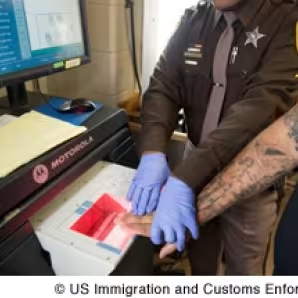
Unanswered Questions Surround ICE's Secure Communities Program
The U.S. Secure Communities program operated in 1,080 jurisdictions in 2011.
Executive Action on Immigration: Six Ways to Make the System Work Better
Six executive actions could improve U.S. border control, integration, legal admissions, and fairness in enforcement without new laws.

Quiet Demise of the Virtual Fence
After more than $1 billion in funding, the United States’ virtual border fence program was cancelled in January 2011.

Delegation and Divergence: 287(g) State and Local Immigration Enforcement
MPI Report release with authors MPI's Randy Capps and Muzaffar Chishti examining step localities are taking in enforcing immigration law and the possible impacts on communities. Jerry Gonzalez, Executive Director, Georgia Association of Latino Elected Officials, and Captain LeRoy Kirkegard, Las Vegas Metropolitan Police Department, provided comments.
The Evolution of Border Controls as a Mechanism to Prevent Illegal Immigration
Modern border controls combine technology and risk profiling. But without legal channels, they often displace rather than deter irregular migration.
E-Verify: Strengths, Weaknesses, and Proposals for Reform
E-Verify’s gains in speed and coverage are undercut by data errors, identity fraud, and gaps in worker protections.
States Assert New Activist Immigration Role in Altered Political Landscape
The 2010 U.S. elections spurred more than 20 states to pursue efforts modeled after Arizona’s SB 1070 and a coordinated push to challenge birthright citizenship.
Does Low-Skilled Immigration Hurt the U.S. Economy? Assessing the Evidence
Report release and discussion on the impacts of low-skilled immigration on the U.S. economy, with author Harry Holzer, Professor, Georgetown Public Policy Institute; Darrell M. West, Vice President and Director of Governance Studies, and Founding Director, Center for Technology Innovation, Brookings Institution; and MPI's Demetrios G. Papademetriou, Doris Meissner, and Michael Fix.

Immigration Policy and Less-Skilled Workers in the United States: Reflections on Future Directions for Reform
The mixed impacts of less-skilled immigration suggest the need for legal channels, flexible visa numbers, and job portability reforms to build a more adaptive system.
Delegation and Divergence: 287(g) State and Local Immigration Enforcement
A study of the 287(g) program found that local police often used their delegated immigration powers to hold people for minor offenses, raising concerns about racial profiling.
- General Inquiries
- Media Inquiries
-
Michelle Mittelstadt
202 266 1910 [email protected]