A woman reviews a chart. (Photo: iStock.com/Meeko Media)
Taking on what it describes as a “de facto amnesty” program, the Trump administration has sought to all but eliminate the use of Temporary Protected Status (TPS) for noncitizens in the United States whose homelands have experienced natural or man-made disaster. Since returning to office, the administration has sought to end protections for nearly all TPS recipients, including those from troubled Haiti and Venezuela.
There were nearly 1.3 million TPS holders in the United States as of March 2025, but that number could drop to zero by the end of November. The administration has moved to terminate 13 of the 17 TPS country designations that were active when President Donald Trump returned to the White House.
The administration is pursuing its case to terminate TPS for Haiti and Syria before the Supreme Court, which heard oral arguments in April and is expected to rule in the coming weeks. The White House has pledged to veto a House bill seeking to keep TPS alive for more than 330,000 Haitians, which also faces stiff Republican opposition in the Senate.
Created by Congress in 1990, TPS grants nationals of designated countries a temporary safeguard from deportation and eligibility for a work permit. TPS does not offer a pathway to permanent residence. Twenty-eight countries overall have been designated for TPS since the program’s creation 36 years ago.
Over the years, TPS grew to become an integral feature of the U.S. immigration system, used by Democratic and Republican administrations alike to protect noncitizens present in the United States who could not return to their country because of political, economic, or environmental upheaval. Critics, however, contend the word “temporary” has been stretched beyond recognition, with some current-day designations issued well more than a quarter-century ago.
The contemporary TPS population, from 17 countries, represents nearly one-tenth of the 13.7 million unauthorized immigrants in the United States, according to Migration Policy Institute (MPI) mid-2023 estimates. The scale the TPS program has reached and the way in which the program has evolved have made it a political lightning rod and diplomatic bargaining chip.
The administration’s targeting of TPS is of a piece with its broader enforcement strategy and its focus on inducing unauthorized immigrants to leave the country. Yet recent developments have demonstrated the obstacles it faces in lifting TPS protections from beneficiaries, some of whom have held the status for more than two decades. In mid-April, a bipartisan group of House lawmakers bypassed Republican leadership, using a rare discharge petition, to approve a bill extending TPS for Haiti. While unlikely to become law, the bill nonetheless highlights bipartisan interest in keeping TPS in place—at least for one vulnerable population.
Meanwhile, two weeks after the House vote, the Supreme Court heard oral arguments in a challenge by TPS holders to the administration’s terminations for Haiti and Syria. Though other cases involving TPS recipients have reached the high court during the second Trump term, this is the first time the court has considered such a case on its merits.
The legal and political pushback to the Trump administration actions reflects the entrenched nature of TPS. Its beneficiaries have grown settled in U.S. communities, raised families, started businesses, and built their lives with the expectation that they would be able to stay. The socioeconomic consequences of ending TPS, especially for people who have developed firm roots in the country over many years, could be far-reaching—not only for TPS holders but for their families, their communities, and their countries of origin.
This article examines the origins and growth of the TPS program, as well as the actions by the Trump administration to terminate these protections.
TPS was created by Congress through the Immigration Act of 1990. This is unlike some other liminal status (also known as “twilight”) programs that were created by the executive branch to provide temporary protection from deportation and eligibility for work authorization, including the Deferred Action for Childhood Arrivals (DACA) program and a since-discontinued Biden administration parole program for Cubans, Haitians, Nicarguans, and Venezuelans (CHNV).
The statute allows the Department of Homeland Security (DHS) to issue a TPS designation by proclaiming a country unsafe for nationals to return to because of extraordinary conditions created by armed conflict, an epidemic, or a natural disaster. Notably, the designation can be renewed indefinitely in increments of up to 18 months, if DHS determines country conditions continue to make immigrants’ return unsafe.
To ensure the temporary designation did not lead to permanent status, the Immigration Act of 1990 explicitly made TPS holders ineligible for any future legalization law, unless three-fifths of the Senate voted in favor (see Box 1). However, many individual TPS beneficiaries can apply to adjust their status through other existing pathways.
Reasons for TPS Grants
The earliest TPS designations came in response to civil wars, earthquakes, and other devastating conditions, mostly in Central America. More recent designations have cited health epidemics and environmental disasters, including heightened climate pressures, across other world regions.
Some designations were short-lived; others have lasted decades. Amid a brutal civil war and devastating earthquakes that displaced more than 1 million people, El Salvador was designated for TPS by Congress as part of the 1990 law, lasting until 1992. This was the only designation to have been made by Congress. After several years without a TPS designation, El Salvador was designated again in 2001, this time by the executive branch, which has extended the designation repeatedly since. The current designation, which is set to expire in September, is one of only four that the Trump administration has not sought to end, alongside Lebanon, Sudan, and Ukraine.
While the 2001 Salvadoran designation is currently the longest single designation, it is not the only country to be designated multiple times. Somalia was first designated for TPS in 1991 and was redesignated or extended multiple times until the Trump administration sought to terminate it earlier this year (litigation remains ongoing). Honduras and Nepal both received TPS designations in 1998, which lasted until 2025. The designations for Haiti and Syria have lasted more than 14 years.
In fact, most TPS designations have been extended at least once, although some have been relatively short-lived. For instance, 2014 designations for Guinea, Liberia, and Sierra Leone, amid an Ebola outbreak, ended in 2017. Only two designations never received extensions: the 1991 designation for Kuwait and the 1999 designation for Guinea-Bissau.
Recent Tensions and Current Beneficiaries
During its first term, the Trump administration tried to terminate several TPS designations, triggering legal challenges that were not concluded by the time it left office. The Biden administration subsequently rescinded these terminations, expanded some existing designations, and designated six additional countries. Amid record border pressures that spurred intense political headwinds, the administration used executive authority to extend multiple forms of legal protection, including TPS. As a result, the number of TPS beneficiaries ballooned to nearly 1.3 million by March 2025, of whom more than 600,000 were Venezuelans (see Figure 1). Shortly before the end of its term, the Biden administration pre-emptively extended TPS for multiple countries with soon-to-expire designations.
Figure 1. Temporary Protected Status Recipients, by Nationality, 2015-25
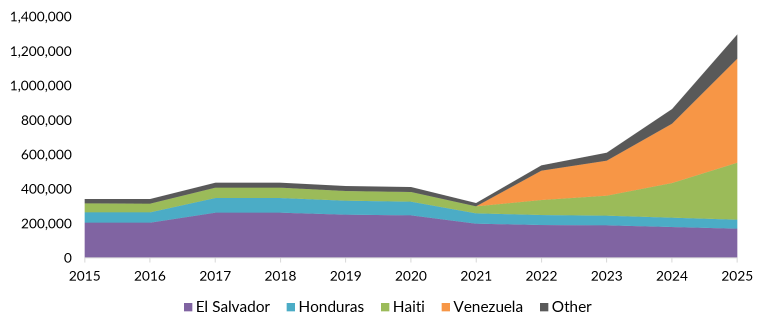
Notes: Figure is based on Congressional Research Service (CRS) data. A change in CRS methodology between 2016 and 2017 generated an increase in estimates; another change between 2020 and 2021 generated a decrease. Prior to 2021, CRS estimates included lawful permanent residents (LPRs) as TPS holders, but subsequent estimates have excluded them.
Sources: Lisa Seghetti, Karma Ester, and Ruth Ellen Wasem, Temporary Protected Status: Current Immigration Policy and Issues (Washington, DC: CRS, 2015), available online; Name redacted, Temporary Protected Status: Current Immigration Policy and Issues (Washington, DC: CRS, 2016), available online; Name redacted, Temporary Protected Status: Overview and Current Issues (Washington, DC: CRS, 2017), available online; Name redacted, Temporary Protected Status: Overview and Current Issues (Washington, DC: CRS, 2018), available online; Jill H. Wilson, Temporary Protected Status: Overview and Current Issues (Washington, DC: CRS, 2019), available online; Jill H. Wilson, Temporary Protected Status: Overview and Current Issues (Washington, DC: CRS, 2020), available online; Jill H. Wilson, Temporary Protected Status and Deferred Enforced Departure (Washington, DC: CRS, 2021), available online; Jill H. Wilson, Temporary Protected Status and Deferred Enforced Departure (Washington, DC: CRS, 2022), available online; Jill H. Wilson, Temporary Protected Status and Deferred Enforced Departure (Washington, DC: CRS, 2023), available online; Jill H. Wilson, Temporary Protected Status and Deferred Enforced Departure (Washington, DC: CRS, 2024), available online; Jill H. Wilson, Temporary Protected Status and Deferred Enforced Departure (Washington, DC: CRS, 2025), available online.
The Trump administration’s hostility to TPS continued when it returned in January 2025. Since the start of its second term, it sought to end most existing designations, regardless of how long they had been active, contending in October that “previous administrations abused, exploited, and mangled TPS into a de facto amnesty program.” Among others, in 2025 it terminated the two longest lasting designations—Honduras and Nicaragua, which were established in 1999—and may also terminate El Salvador’s 2001 designation, which expires this September.
As of this writing, only four of the 17 country designations remained active, affecting approximately 273,000 beneficiaries; terminations of seven other designations were suspended by court orders. By late November, there could be zero active designations.
Table 1. Status of U.S. Designations for Temporary Protected Status, May 2026
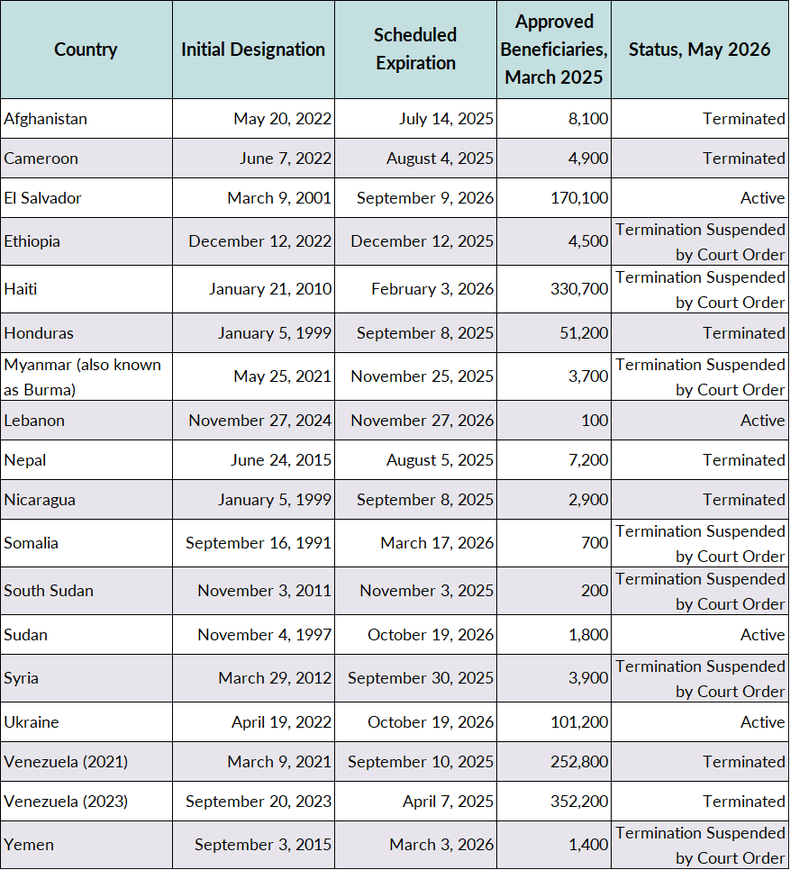
Note: Data may include individuals who left the country or died since their last approval for Temporary Protected Status (TPS).
Sources: Wilson, Temporary Protected Status and Deferred Enforced Departure, 2025; American Immigration Council, “Temporary Protected Status (TPS): An Overview,” March 13, 2026, available online; Drishti Pillai, Nambi Ndugga, and Samantha Artiga, “Recent Changes to Temporary Protected Status Designations: Potential Impacts on Health and Health Care,” KFF, May 1, 2026, available online; U.S. Citizenship and Immigration Services (USCIS), “Extension of Lebanon Designation for Temporary Protected Status,” Federal Register document 2026-10704, scheduled for publication on May 29, 2026, available online.
Domestic and International Pressure
Designating, redesignating, or terminating TPS is a decision made by DHS in consultation with the State Department. Over the years, this has become a complex process involving increasing political and diplomatic considerations (see Box 2).
As TPS beneficiaries have become more numerous and embedded in U.S. communities, they have formed strong constituencies, with the recent House vote to extend TPS for Haitians one byproduct of this development. Rep. Ayanna Pressley (D-Mass.), who spearheaded the maneuver, cited a longtime TPS holder in her district and others whom she said were “living in the United States and building a future that will help all of us.”
Some terminations have also touched on broader controversies about immigration and race. Advocates and plaintiffs have linked the termination of Haiti’s designation to disparaging remarks about Haitian immigrants by Trump and other administration officials. And the administration’s ostensible argument for terminating Haitian TPS—that on-the-ground conditions in Haiti have improved—have been challenged by advocates who point to gangs’ control of large swaths of the country and the government’s inability to govern or provide basic services. The administration also made derogatory comments about Somali immigrants and linked them to widespread fraud leading up to the termination of that country’s TPS designation, which has so far been suspended by a court.
Foreign Lobbying
Foreign governments also regularly lobby to keep existing designations or establish new ones. Indeed, the law allows a foreign government to officially request a TPS designation. Such requests may be counterintuitive: By advocating for TPS protections, governments are admitting their inability to recover from disasters or sufficiently improve conditions to receive and reintegrate their own citizens. At the same time, their economies benefit, in some cases quite significantly, from remittances sent by their nationals in the United States, including TPS beneficiaries. Governments understand that removing immigrants’ employment authorization and protections against deportation could significantly reduce those remittances. This is particularly true for countries with sizable emigrant populations in the United States that have had TPS designations for many years, and for which remittances make up large shares of their economies. For instance, roughly one-quarter of the gross domestic product (GDP) of Nicaragua, Honduras, and El Salvador comes from remittances, as did 16 percent of Haiti’s GDP in 2024.
Foreign government requests for new or extended TPS designations for their citizens in the United States have had mixed success.
On the one hand, there are examples of success: After Hurricane Mitch in 1998, the Honduran government requested and was granted a TPS designation by the Clinton administration. El Salvador requested a designation after two earthquakes in 2001, which was granted by the Bush administration. Similarly, the Obama administration issued TPS designations to earthquake-hit Haiti and Nepal after lobbying by those governments in 2010 and 2015. Notably, diaspora groups and activists from these countries played active and crucial roles in the requests.
Other requests have been rejected. The Guatemalan government, for instance, unsuccessfully made multiple formal requests—including in 2016, 2018, 2020, and 2021—seeking TPS for its citizens while it improved capacity to receive them. In 2017, the Trump administration rejected a request by the Haitian government to extend its TPS designation and instead implemented an 18-month period to wind it down. The request by Honduras for redesignation in 2020, after two hurricanes devasted the country’s infrastructure, was similarly denied by the Trump administration. So too was the Colombian government’s 2022 request to the Biden administration, which cited humanitarian conditions.
Given its long history with TPS, the success of requests by the Salvadoran government stands out. Salvadoran President Nayib Bukele is a steadfast ally of the Trump administration. His government argued in 2019 that while El Salvador was capable of receiving its citizens, deporting them would break up families of law-abiding TPS beneficiaries. The Salvadoran government signed agreements to collaborate with Washington on border and security issues as part of its request for TPS redesignation. As a result of these agreements and a district court halting the administration’s effort to immediately terminate TPS, DHS extended El Salvador’s designation through January 2021 and provided beneficiaries an additional year to self-deport if the courts allowed the administration’s termination to proceed. The Biden administration rescinded the termination and extended TPS through September 2026. As of this writing, Bukele had not publicly requested the country’s designation be extended.
The Battle Over Haitian and Syrian TPS
Opposition to the termination of Haiti’s TPS designation and, to a lesser extent, Syria’s illustrates the heightened questions around the status. Both the political and legal framework for challenging TPS designations has shifted, as made clear by events at the Supreme Court and in Congress.
The central questions before the high court are whether an administration’s decision to terminate TPS is reviewable by the judiciary and, if it is, whether certain steps must be followed for the termination, including a detailed review of country conditions and consultation with the State Department. Critics argue that terminations during the second Trump term have not followed these protocols. The Supreme Court has previously ruled twice, through emergency orders, in favor of the Trump administration’s TPS moves, temporarily allowing the termination of one TPS designation for Venezuelans while the regular appeal process was ongoing.
The challenge to the Trump actions filed by Haitian and Syrian TPS holders marks the first time that the Supreme Court will rule on the merits of a TPS termination. Challengers had filed similar litigation during the first Trump term but the cases never reached the Supreme Court. This marked a shift; previously, opponents would have assumed that any termination of TPS was the purview of the administration and immune from legal challenge. In fact, the TPS statute makes clear that designations, terminations, and extensions of TPS are not judicially reviewable. But under Trump, the political appetite for challenging immigration policies increased, and lawyers found novel theories to contest terminations. Although the TPS statute bars judicial review, legal challenges targeted other areas such as the Administrative Procedure Act, which dictates the process for administrative rulemaking, and on broader constitutional grounds.
The Supreme Court’s ruling is expected in late June or early July. Even if the court rules the administration did not follow the proper process, the victory for some 335,000 Haitian and Syrian TPS beneficiaries could be short lived. DHS could initiate a more formal review and consultation, and still decide to terminate TPS for these groups. A ruling in favor of the administration, meanwhile, could fast-track the termination of other TPS designations that are currently suspended amid litigation, although each would still require individual court rulings.
Haitian TPS beneficiaries could draw some hope from the recent, narrowly bipartisan House measure to extend their TPS designation through April 2029. Some Republican supporters pointed to unsafe conditions in Haiti, while others were concerned about how U.S. workforce shortages would be affected by the loss of TPS-holding workers, particularly in health care. Yet a leading Senate Republican voice on immigration called the measure “dead on arrival” in the chamber and the White House has vowed to veto it.
Hundreds of thousands of immigrants have already lost their TPS protection and, unless the courts suspend other terminations, hundreds of thousands more will also by the end of November become subject to deportation. Some may be able to qualify for another immigration status, such as a temporary visa or an established pathway to obtain a green card. Others may not be able to use these pathways because of statutory bars, which in some cases can be waived.
Even if all TPS designations are ended, however, it is unlikely that the automatic result will be deportation of all 1.3 million. Each person must still go through an individualized removal process which, given the massive backlog in immigration courts, could take many years. The administration has tried to incentivize unauthorized immigrants to self-deport, and some former TPS holders may choose this route. But so far there has been no evidence that TPS terminations increase voluntary returns, suggesting that many former beneficiaries will stay and work without permission, despite increasingly stifling conditions facing unauthorized immigrants.
At the same time, the consequences of ending TPS spread well beyond the program’s beneficiaries. Many have established deep roots after living in the United States for decades. Losing protections can have significant impact on their families, including U.S. citizens, as well as their communities and employers. Ending TPS designations could also have a major fiscal impact on the U.S. economy: The American Immigration Council estimated that the households with TPS recipients paid $1.3 billion in federal taxes and $966.5 million in state and local taxes in 2021. The sum could be significantly higher now, given the increase in the TPS population since then.
Terminating these designations and deporting former TPS holders can also have consequences on their countries of origin. A loss of remittances could stymie economic development, not only taking away a lifeline from families but also aggravating economic instability. The Trump administration itself acknowledged in 2019 that large-scale deportations of former TPS beneficiaries to countries that were not prepared to receive them could “spark another mass migration to the U.S. and reinvigorate the crisis at the southern border.”
The Trump actions on TPS underscore a decades-long debate about the nature, intention, and expectations behind “temporary” status programs. Termination of every designation—leaving no TPS protections operating for the first time since 1990—would stand out among the long list of consequential immigration policy changes undertaken by the Trump administration.
In the absence of Congress acting to legalize what has become a long-settled unauthorized immigrant population, Republican and Democratic administrations, lawmakers, immigrants, and foreign governments had come to tacitly rely on TPS despite its nominally temporary nature.
Now, its potential end may wipe away a semblance of certainty that hundreds of thousands of TPS beneficiaries came to expect. The repercussions will be felt widely, both in the United States and abroad.
Sources
Aho, Karen. 2023. Spotlight on the Economic Contributions of TPS Holders. American Immigration Council blog post, October 23, 2023. Available online.
American Immigration Council. 2026. Temporary Protected Status (TPS): An Overview. March 13, 2026. Available online.
Bipartisan Policy Center. 2018. Temporary Protected Status (TPS): An Explainer. December 21, 2018. Available online.
Bolton, Alexander. 2026. GOP Sen. Katie Britt: House-Passed Bill to Extend Haitian Refugee Status DOA in Senate. The Hill, April 17, 2026. Available online.
Castillo, Andrea. 2026. Supreme Court Will Hear Trump’s Bid to End Legal Protection for Up to 1.3 Million Immigrants. The Los Angeles Times, April 28, 2026. Available online.
Chishti, Muzaffar, Jessica Bolter, and Sarah Pierce. 2017. Tens of Thousands in United States Face Uncertain Future, as Temporary Protected Status Deadlines Loom. Migration Information Source, December 1, 2017. Available online.
Chishti, Muzaffar and Kathleen Bush-Joseph. 2023. In the Twilight Zone: Record Number of U.S. Immigrants Are in Limbo Statuses. Migration Information Source, August 2, 2023. Available online.
Dickinson, Daniel. 2026. Haiti Explained: Why the Crisis Is Deepening — and What Comes Next. UN News, January 21, 2026. Available online.
Ley, Ana and Ashley Ahn. 2026. Federal Judge Blocks Plan to End Deportation Protections for Yemenis. The New York Times, May 1, 2026. Available online.
Lind, Dara. 2025. Biden Keeps Nearly 1 Million People from Losing Legal Status Under Trump—Until Fall 2026. American Immigration Council blog post, January 15, 2025. Available online.
Martin, David A. 2005. Twilight Statuses: A Closer Examination of the Unauthorized Population. Washington, DC: Migration Policy Institute (MPI). Available online.
Messick, Madeline and Claire Bergeron. 2014. Temporary Protected Status in the United States: A Grant of Humanitarian Relief that Is Less than Permanent. Migration Information Source, July 2, 2014. Available online.
National Immigration Forum. 2026. Temporary Protected Status (TPS): Fact Sheet. Washington, DC: National Immigration Forum. Available online.
National TPS Alliance. N.d. BREAKING: Ninth Circuit Court Allows Termination of TPS to Proceed for 60,000 Long-Term Residents from Nepal, Honduras and Nicaragua. Press release, accessed May 27, 2026. Available online.
Pillai, Drishti, Nambi Ndugga, and Samantha Artiga. 2026. Recent Changes to Temporary Protected Status Designations: Potential Impacts on Health and Health Care. KFF, May 1, 2026. Available online.
Salomon, Gisela. 2026. Haitians, Syrians Aren’t the Only Immigrants Watching US Supreme Court Arguments on Temporary Status. Associated Press, April 27, 2026. Available online.
Ulloa, Jazmine and Miriam Jordan. 2026. Trump Push to End Key Humanitarian Protection Reaches Supreme Court. The New York Times, April 28, 2026. Available online.
U.S. Citizenship and Immigration Services (USCIS). 2026. Extension of Lebanon Designation for Temporary Protected Status, Federal Register 2026-10704. Scheduled for publication May 29, 2026. Available online.
U.S. Department of Homeland Security (DHS). 2019. U.S. and El Salvador Sign Arrangements on Security & Information Sharing; Give Salvadorans with TPS More Time. Press release, October 28, 2019. Available online.
Wilson, Jill H. 2025. Temporary Protected Status and Deferred Enforced Departure. Washington, DC: Congressional Research Service (CRS). Available online.