


A university student in Thailand studying English. (Photo: Gerhard Jörén/World Bank)
Immigrants with at least a university degree make up a substantial proportion of the foreign born in many economically advanced countries. In fact, on average, immigrants in the generally high-income countries of the Organization for Economic Cooperation and Development (OECD) tend to have more education than their native-born peers. Often, these highly skilled immigrants work in essential sectors with substantial workforce shortages, including health care and education, which also typically require some sort of credential or license.
But factors including undervaluing of their education and professional credentials, language skills, legal status, and discrimination can often lead to underemployment or unemployment (a phenomenon referred to as “brain waste”). While many native-born workers are also overqualified for the jobs they hold, rates tend to be much higher among immigrants. As of 2021, approximately one-third of highly educated immigrants in the OECD countries and EU Member States were overqualified for their jobs, according to the OECD, with the highest rates in South Korea (73 percent), Canada (57 percent), and Costa Rica (56 percent).
The repercussions of these barriers are wide-ranging. For many individuals and families, underemployment (for example someone with a college education working in a job that requires no more than a high school degree) means a lower income as well as less productive or stimulating work. For communities and regions, it can mean slower economic growth. For governments, it leads to lower tax contributions. In the United States, underemployed highly skilled immigrants lost out on a combined $40 billion in annual income in 2016, according to Migration Policy Institute (MPI) estimates, depriving federal, state, and local governments of an estimated $10 billion in tax receipts.
Over the last five years, however, changing global circumstances, increasing access to online education at various levels, and the COVID-19 pandemic’s wide-ranging impacts on sectors such as health care all created new opportunities for governments and licensing boards to chip away at these barriers. Some systems have become more flexible, governments and licensing bodies have shown a willingness to innovate, and the rise of microcredentials has made it easier for immigrants and others to prove their skills. Focusing on the United States, where changes have occurred in multiple states and across a range of professional fields, this article explores challenges faced by highly skilled immigrants and the impact of changing work credential transfer and recognition procedures following the pandemic.
Highly Skilled Immigrants by the Numbers
The shares of immigrants with high levels of educational attainment vary significantly by country. Those with a tertiary degree (including associate and bachelor’s degrees) accounted for 66 percent of working-age immigrants (ages 15-64) in Canada but just 12 percent in Italy as of 2021 (see Figure 1).
Figure 1. Share of Immigrant Population (ages 15-64) with Tertiary Degree and Share Overqualified for their Job, by Select Country, 2021
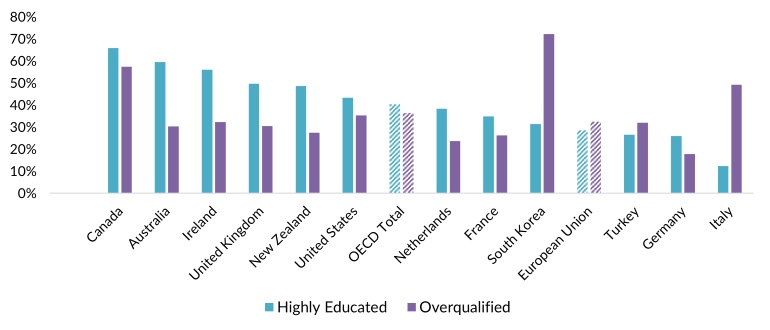
Note: Highly Educated refers to those with a tertiary degree, including associate-level degrees and higher. Overqualified refers to the shares of immigrants with a tertiary degree working in a job classified as low- or medium-skilled. The phenomenon is sometimes referred to as “brain waste,” though the Migration Policy Institute (MPI) definition also includes highly skilled workers who are unemployed.
Source: Organization for Economic Cooperation and Development (OECD) and European Commission, “Indicators of Immigrant Integration,” accessed October 31, 2024, available online.
In the United States, 35 percent of all 40.7 million immigrant adults (ages 25 and older) in the country as of 2022 held a bachelor's degree or higher, according to U.S. Census Bureau data, with the largest numbers coming from India (14 percent), China and Hong Kong (8 percent), the Philippines (7 percent), and Mexico (6 percent). According to MPI analysis, 2.1 million of these college-educated immigrant adults were unemployed or employed in jobs requiring at most a high school degree in 2022. Because the U.S. foreign-born population is larger than that of any other country, so too is its college-educated immigrant population, according to the Pew Research Center.
One reason why the educational attainment of countries’ foreign-born populations varies is the structure of their immigration systems. Countries including Australia, Canada, and New Zealand have points-based systems designed to favor the admission of immigrants with certain professional characteristics that align with labor-market needs, while mitigating the impact of aging populations and decreasing birth rates. These may include points for language skills, professional certifications, educational attainment, and age. Often, these systems prioritize workers in the health-care; science, technology, engineering, and math (STEM); and education sectors.
The Landscape of Credential Transfer
Skilled workers can only find jobs consistent with their qualifications if their educational and professional abilities are recognized—a hurdle in particular when those skills have been learned in a country other than the one in which they live. Licensure and credential regulations established by governments and professional organizations affect how many workers are recruited and from which countries. Places such as the Philippines, where leaders have long used emigration as a means to drive economic growth, have training programs specifically designed for exporting labor in sectors such as nursing, making it easier to earn a license abroad. The country’s academic system is heavily influenced by the United States in particular. Worldwide, more foreign-born registered nurses are from the Philippines than any other country; many are in the United States, where they account for about 27 percent of immigrant nurses. Other countries producing a substantial export of nurses working abroad include India and Poland. The largest number of international doctors, meanwhile, comes from India, where many medical schools are designed for students planning to emigrate.
In other sectors, governing bodies often have processes for recognizing credentials from elsewhere within regional blocs, such as within the European Union or the Caribbean Community (CARICOM), or by international professional organizations. One of the strongest systems exists in the European Union, which has uniform licensure requirements across the bloc for architecture, education, pharmacy, and other fields, allowing professionals to move and work freely across Member States. Additional credential recognition agreements are often found among countries with historical ties or colonial relationships, such as a recently signed agreement for architecture between the boards of Australia, New Zealand, and the United Kingdom. When writing agreements, many countries rely on recommendations from international trade groups to establish a baseline for professional education and licensure requirements that can be transferable across countries.
Historical Challenges with Credential Recognition and Brain Waste
Still, many highly skilled immigrants struggle to work in their fields of training. Some barriers are explicit and intentional, such as requirements for language proficiency, an immigrant’s ability to obtain or transfer credentials or take new exams, or their legal status and work authorization. Others are less visible, such as cultural differences, lack of social capital, or stigmas against foreign-earned education. Both kinds of barriers tend to be associated with lower wages and less upward mobility.
Underemployment is also associated with stress and other mental and physical health concerns, even years following immigrants’ arrival. In the United States, immigrants with college degrees were less likely to have health insurance than their native-born peers, with recent immigrants more than four times less likely to have insurance as of 2021, according to KFF analysis. Being insured, which may result from working in a lower-skilled job that does not offer health insurance, may explain the propensity for some of these health concerns.
In the wake of the pandemic, the credential transfer process in various sectors has undergone significant transformation.
The global health crisis exposed urgent needs to fill shortages in areas including medicine and nursing. While the United States and other countries were already struggling with a shortage of health-care workers, the need only increased during the pandemic. In addition to the uptick in patients needing care, many health-care workers died of COVID-19-related illnesses, while others quit their jobs or retired due to workplace stress. U.S. federal and state governments and regulatory bodies expedited recognition of internationally earned qualifications and streamlined licensing processes to rapidly address shortages for certain occupations in health care.
While many emergency mandates expired once the public-health crisis eased, Tennessee was among the states that created permanent new licensing pathways for foreign-trained doctors. A new state law eliminated the requirement that these doctors undergo a U.S.-based medical residency, which is often redundant for international medical graduates and can come with heavy financial costs. By eliminating this requirement and substituting it with a demand that internationally trained physicians be supervised for two years by a state-licensed physician, these immigrant workers may have an easier time finding employment, and the state is able to address health-care sector shortages without compromising quality of care. Because the law went into effect in July 2024, data about its impact are not yet available. Still, the trend is growing; as of August, eight U.S. states had passed similar laws.
The U.S. education sector has also struggled. During the pandemic, to address teacher shortages and prevent staffing reductions while new university graduates waited to take the general teacher licensure test, many states temporarily eased requirements. Some states subsequently changed their education licensure processes permanently. Virginia offers a provisional license to eligible internationally licensed educators, while Nebraska eliminated use of the basic skills test altogether, streamlining the licensure process for foreign- and U.S.-trained educators alike.
Overall, however, significant teacher shortages continue to affect public schools across the United States. During the 2023-24 academic year, 86 percent of K-12 public schools reported challenges hiring teachers, especially general elementary school teachers (a problem cited by 71 percent of public schools) and special education teachers (cited by 70 percent of public schools), according to the federal Department of Education. Foreign-born teachers continue to be under-represented. While 17 percent of all U.S. workers were foreign born in 2019, only about 10 percent of K-12 teachers were immigrants. Existing shortages present an opportunity for highly skilled immigrants to get licensed and work in their field of training.
Expansion of Microcredentials and Certificate Programs
The offering of microcredentials and certificates has expanded in recent years to provide rapid credentials for workers with particularly needed skills. Microcredentials are typically short, nondegree, certified learning courses that lead to a certificate or badge and, with additional credentials or courses, may lead to a larger credential. While microcredentials and online certificate programs existed prior to the pandemic, the transition to online learning and microcredentials accelerated dramatically, with online course enrollment tripling globally from 2019 to 2020, as platforms such as Coursera and edX witnessed a surge in users seeking flexible learning options from home. As the world has returned to in-person opportunities, microcredentials have remained a fixture of up-skilling systems that provide a means for individuals to rapidly build skills for particular jobs without completing entire degree programs. Microcredentials also allow highly skilled immigrants to obtain host-country credentials quickly and affordably, therefore gaining certifications that are easily recognizable to employers. While available to native- and foreign-born workers alike, some microcredential programs such as Google’s Career Certificate Program, which offers short-term certificates in high-growth and in-demand fields, have been specifically targeted to immigrants among others.
Internationally, 72 percent of hiring managers across 11 countries said they were more likely to consider candidates with microcredentials, according to a 2023 Coursera report, reflecting a shift away from exclusively traditional educational credentials. This approach allows immigrants to validate and rapidly build on their skills and experience in ways that resonate with prospective employers, improving their chances of securing relevant employment. As destination countries continue to invest in skills-based employment opportunities for both immigrants and the native born, this shift reflects the growing demand for specific skills and highlights the opportunity for highly skilled immigrants—particularly those in the fields of data, technology, and project management—to supplement their formal education and be more competitive.
Looking Forward
The landscape for highly skilled immigrants continues to evolve. With recent innovative policies, a growing emphasis on microcredentials, and streamlined credential recognition processes, immigrants have new opportunities to overcome entrenched barriers to skills recognition and, as a result, upward mobility. Significant workforce shortages in sectors such as health care and education have prompted changes to licensure processes, creating opportunities for skilled immigrants to contribute meaningfully to the economy. This shift addresses immediate labor-market needs and acknowledges the valuable expertise that highly skilled immigrants bring to the workforce.
By investing in programs that facilitate the recognition of international credentials, the United States and other countries can more fully harness the potential of immigrant workforces while mitigating the impact of worker shortages in key sectors of the economy. As the demand for skilled labor grows, particularly in technology and health care, equipping highly skilled immigrants and other professionals with the necessary tools and support increases their opportunities to obtain a better-paying job, boosting their contributions to the economy, and diversifying the workforce. Immigrants in particular may offer multilingual skills, cultural competence, and new perspectives and experiences, contributions that can boost innovation, inclusion, and reach. Ultimately, a concerted effort to integrate highly skilled immigrants more fully into labor market can lead to a more robust and resilient economy.
Sources
American Hospital Association (AHA). 2021. Data Brief: Health Care Workforce Challenges Threaten Hospitals’ Ability to Care for Patients. AHA brief, Chicago, October 2021. Available online.
Argue, Andrew J. and Thijs A. Velema. 2022. University Prestige, Cultural Distance of the Place of Education, and Wage Differences between High-Skilled US Immigrants with Foreign and Domestic Credentials. Research in Social Stratification and Mobility 77: 100650. Available online.
Bacher-Hicks, Andrew, Olivia L. Chi, and Alexis Orellana. 2023. Two Years Later: How COVID-19 Has Shaped the Teacher Workforce. Educational Researcher 52 (4): 219-29.
Bailey, Ajay and Clara H. Mulder. 20217. Highly Skilled Migration between the Global North and South: Gender, Life Courses and Institutions. Journal of Ethnic and Migration Studies 43 (16): 2689-703. Available online.
Batalova, Jeanne. 2023. Immigrant Health-Care Workers in the United States. Migration Information Source, April 7, 2023. Available online.
---. 2024. College-Educated Immigrants in the United States. Migration Information Source, September 12, 2024. Available online.
Batalova, Jeanne and Michael Fix. 2021. Leaving Money on the Table: The Persistence of Brain Waste among College-Educated Immigrants. Washington, DC: Migration Policy Institute (MPI). Available online.
Batalova, Jeanne, Michael Fix, and James D. Bachmeier. 2016. Untapped Talent: The Costs of Brain Waste among Highly Skilled Immigrants in the United States. Washington, DC: MPI. Available online.
Bell, Donnie L. and Mitchell H. Katz. 2021. Modernize Medical Licensing, and Credentialing, Too—Lessons from the COVID-19 Pandemic. JAMA Internal Medicine 181 (3): 312-5. Available online.
Commonwealth Association of Architects. 2024. Making Mutual Recognition Agreements Work. Accessed October 28, 2024. Available online.
Eugenio, Laurinne Jamie. 2024. From US Reign to Brain Drain: The Mass Emigration of Filipino Nurses to the United States. Harvard International Review, October 21, 2024. Available online.
European Commission. 2020. A European Approach to Micro-Credentials: Output of the Micro-Credentials Higher Education Consultation Group. Luxembourg: EU Publications. Available online.
Federation of State Medical Boards (FSMB). 2024. States with Enacted and Proposed Additional IMG Licensure Pathways: State-by-State Overview. FSMB fact sheet, Euless, Texas, August 2024. Available online.
Masselink, Leah E. and Shoou-Yih Daniel Lee. 2010. Nurses, Inc.: Expansion and Commercialization of Nursing Education in the Philippines. Social Science & Medicine 71 (1): 166-72. Available online.
Migration Policy Institute (MPI), Migration Data Hub. N.d. State Immigration Data Profiles – Workforce: Brain Waste. Accessed November 4, 2024. Available online.
Moslimani, Mohamad and Jeffrey S. Passel. 2024. What the Data Says about Immigrants in the U.S. Pew Research Center, September 27, 2024. Available online.
Nagarajan, Kiran Koushik, Atul Bali, Srikrishna Varun Malayala, and Ramesh Adhikari. 2020. Prevalence of US-trained International Medical Graduates (IMG) Physicians Awaiting Permanent Residency: A Quantitative Analysis. Journal of Community Hospital Internal Medicine Perspectives 10 (6): 537-41. Available online.
New American Economy Research Fund. 2021. Immigrants and the U.S. Educational System. Washington, DC: New American Economy Research Fund. Available online.
Oleribe, Obinna Ositadimma and Rodrigo Amo de la Fuente. 2022. Migration of Highly-Skilled Workers: Personal Perspectives. Pan African Medical Journal 41 (1). Available online.
Organization for Economic Cooperation and Development (OECD). 2022. The Contribution of Migration to Regional Development. Paris: OECD Publishing, Paris. Available online.
---. 2024. Bridging Talent Shortages in Tech: Skills-First Hiring, Micro-Credentials and Inclusive Outreach. Paris: OECD. Available online.
---. 2024. Micro-Credentials for Lifelong Learning and Employability. Paris: OECD. Available online.
Organization for Economic Cooperation and Development (OECD) and European Commission. 2023. Indicators of Immigrant Integration 2023: Settling In. Paris: OECD Publishing. Available online.
Pillai, Drishti and Samantha Artiga. 2023. Employment among Immigrants and Implications for Health and Health Care. KFF issue brief, San Francisco, June 2023. Available online.
Ramesh, Tarun, Marcela Horvitz-Lennon, and Hao Yu. 2023. Opening the Door Wider to International Medical Graduates: The Significance of a New Law in Tennessee. The New England Journal of Medicine 389 (21): 1925. Available online.
Reid, Alison. 2012. Under‐Use of Migrants' Employment Skills Linked to Poorer Mental Health. Australian and New Zealand Journal of Public Health 36 (2): 120-5. Available online.
Ruiz, Neil G. and Phillip Connor. 2019. Majority of U.S. Public Supports High-Skilled Immigration. Washington, DC: Pew Research Center. Available online.
Shireman, Scott. 2023. New Coursera Survey Shows High Demand for Industry Micro-Credentials from Students and Employers in Tight Labor Market. Coursera blog post, February 2, 2023. Available online.
Sumption, Madeleine and Peter William Walsh. 2023. “The Points System Is Dead. Long Live the Points System!” Why Immigration Policymakers in the UK Are Never Quite Happy with Their Points Systems. Journal of Immigrant and Refugee Studies 21 (1): 89-103. Available online.
Torres, Natalie. 2022. Policy Roundup: State Efforts to Advance the Economic Inclusion of Immigrants and Refugees. World Education Services, September 15, 2022. Available online.
U.S. Department of Education, Institute of Education Sciences (IES), National Center for Education Statistics (NCES). 2023. Most Public Schools Face Challenges in Hiring Teachers and Other Personnel Entering the 2023-24 Academic Year. Press release, October 17, 2023. Available online.
Wagner, Lauren. 2023. Nebraska Repeals Basic Skills Test Requirement for Teachers after Years of Debate. Omaha World-Herald, May 16, 2023. Available online.
Wood, Johnny. 2022. These 3 Charts Show the Global Growth in Online Learning. World Economic Forum, January 27, 2022. Available online.
World Education Services (WES) Global Talent Bridge. 2022. Opening Pathways to Practice for Internationally Trained Physicians. Updated June 12, 2022. Available online
---. 2024. Amplifying the Impact: Bridging the Gap for New Americans. Policy brief, WES Global Talent Bridge, New York. Available online.
Yeomans, Neville D. 2022. Demographics and Distribution of Australia's Medical Immigrant Workforce. Journal of Migration and Health 5: 100109. Available online.