T. Alexander Aleinikoff

T. Alexander Aleinikoff, the former United Nations Deputy High Commissioner for Refugees, is a Nonresident Fellow at MPI, where he works with the U.S. and International programs on asylum and migration and development topics. He is also University Professor at The New School, where he serves as Director of the Zolberg Institute on Migration and Mobility.
Mr. Aleinikoff served as the United Nations Deputy High Commissioner for Refugees in Geneva from 2010 to mid-2015, and from July-December 2015 was on assignment with the U.N. Secretariat in New York. Prior to his service with the United Nations, Mr. Aleinikoff was a professor at Georgetown University Law Center (1997-2010), where he also served as Dean and as Executive Vice President of Georgetown University (2004-10). He was a professor of law at the University of Michigan Law School from 1981 to 1997. And he served as General Counsel, and then Executive Associate Commissioner for Programs, at the U.S. Immigration and Naturalization Service (INS) from 1994-97. He was Co-Chair of the Immigration Task Force for President Obama's transition team.
A leading scholar in immigration and refugee law, Mr. Aleinikoff has published numerous books and articles in the areas of immigration law policy, refugee law, citizenship, race, statutory interpretation, and constitutional law.
He is a graduate of Swarthmore College and the Yale Law School.
Explore Content by T. Alexander Aleinikoff
Showing 1-10 of 10 total results
The Reverse of Climate Migration: Should There Be a Right Not to Be Displaced amid Climate Change?
When the legal frameworks designed to protect displaced people were written, climate change was not among the harms they anticipated — so what comes next?
19th Annual Immigration Law and Policy Conference
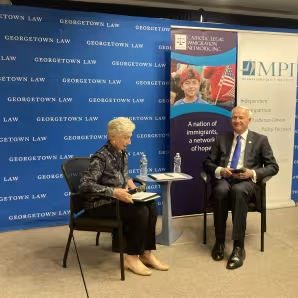
This conference examined the Biden administration's immigration record, border and asylum policy, litigation trends, and humanitarian protection developments.
The U.S. Asylum System in Crisis: Charting a Way Forward
The U.S. asylum system's growing backlog demands administrative reforms and necessary funding, not just enforcement restrictions, to restore timely, fair protection.

The Supreme Court’s Opinion on the Revised Trump Executive Order: What Does It Mean For Refugees?
Overlooked in the Supreme Court’s 2017 opinion allowing aspects of the Trump travel ban to take effect was its support for refugees coming in via resettlement.
A Global Broadband Plan for Refugees
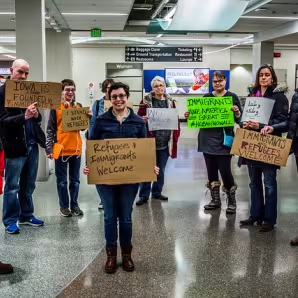
Significant broadband gaps leave refugees less connected than host populations and isolated from key services, which a global broadband plan could resolve.

The U.S. Refugee Resettlement Program Is an Unsuitable Target
President Donald Trump's first-term order cutting refugee resettlement misidentifies risk: no resettled refugee has ever killed anyone in a U.S. terrorist attack.

The UN Refugee Summit: What Can Be Achieved?
Ahead of the September 2016 UN summit, a draft outcome document reaffirms key refugee rights but falls short on responsibility sharing, root causes, and binding commitments.
From Dependence to Self-Reliance: Changing the Paradigm in Protracted Refugee Situations
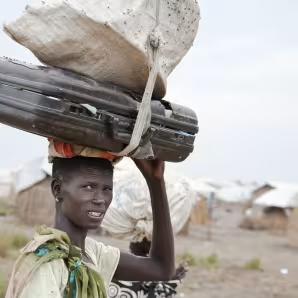
Protracted refugee dependency is neither inevitable nor acceptable. Self-reliance demands work rights, better livelihoods programs, and development actor engagement.

The Department of Homeland Security's First Year: A Report Card on Immigration
One year in, the Department of Homeland Security showed real gains in border and interior enforcement. But its promise was hampered by case backlogs and poor internal coordination.

Citizenship Policies for an Age of Migration
This book offers concrete recommendations on how to effectively structure national citizenship laws, in part to foster immigrant inclusion and integration.