Mark Greenberg
Mark Greenberg was a Senior Fellow and Director of MPI's Human Services Initiative, where his work focused on the intersections of migration policy with human services and social welfare policies.
From 2009-17, Mr. Greenberg worked at the Administration for Children and Families (ACF) in the U.S. Department of Health and Human Services. He served as ACF Deputy Assistant Secretary for Policy from 2009-13; Acting Commissioner for the Administration for Children, Youth, and Families from 2013-15; and Acting Assistant Secretary from 2013-17. ACF includes the Office of Refugee Resettlement, which has responsibility for the refugee resettlement and unaccompanied children program.
Previously, Mr. Greenberg was Executive Director of the Georgetown Center on Poverty, Inequality, and Public Policy, a joint initiative of the Georgetown Law Center and Georgetown Public Policy Institute. In addition, he previously was Executive Director of the Center for American Progress’ Task Force on Poverty, and the Director of Policy for the Center for Law and Social Policy (CLASP).
He is a graduate of Harvard College and Harvard Law School, and was a legal services lawyer in Florida and California for ten years after graduating law school.
Explore Content by Mark Greenberg
Showing 1-10 of 18 total results
El relanzamiento del Programa de Menores Centroamericanos: Oportunidades para realzar la protección infantil y la reunificación familiar
El relanzamiento del Programa para Menores Centroamericanos en 2021 expandió el acceso a la reunificación familiar, pero aún requiere más financiamiento localizado, procesamientos más sencillos y mayor apoyo a la integración.

Relaunching the Central American Minors Program: Opportunities to Enhance Child Safety and Family Reunification
The Central American Minors Program relaunch in 2021 expanded family reunification access. But it needs dedicated funding, simpler processing, and stronger integration support to succeed.

How the Child Welfare System Can Better Respond to Needs of Children from Immigrant Families
One out of four U.S. children has an immigrant parent. Explore the intersections between immigration and child welfare systems, along with promising local practices that child welfare agencies can take to improve their interactions with these families.

Medicaid Access and Participation: A Data Profile of Eligible and Ineligible Immigrant Adults
In 2019, 4.3 million income-eligible immigrants were barred from Medicaid by status restrictions, with wide state variation in eligibility and participation.

Different Statuses, Different Benefits: Determining Federal Assistance for Afghan Evacuees
Afghans evacuated to the United States are entering with a range of legal statuses, with important implications for their ability to access benefits and services that will help them settle into their new communities. This commentary outlines the different statuses and resulting consequences for eligibility for assistance, based on whether the arrivals are recognized as refugees, Special Immigrant Visa (SIV) recipients, or parolees.
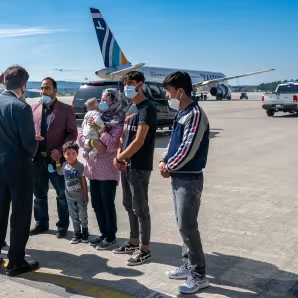
A Solvable Challenge: Improving Asylee Access to Health and Other Benefits
While asylees are eligible for many of the same public benefits and services as resettled refugees, including health care and employment assistance, there is no system to inform them of their eligibility and to help connect them to resources. MPI estimates that fewer than 20 percent of those granted asylum in recent years received Office of Refugee Resettlement benefits during their first year. The U.S. government could address this gap with a few simple measures.

Strengthening Services for Unaccompanied Children in U.S. Communities
Tens of thousands of unaccompanied children arrive in U.S. communities each year with critical legal and service needs that local systems are ill-equipped to meet.

U.S. Government Makes Significant Strides in Receiving Unaccompanied Children but Major Challenges Remain
The federal government has made notable progress since March 2021 in getting unaccompanied children arriving at the U.S.-Mexico border out of Border Patrol facilities and into Office of Refugee Resettlement (ORR) custody, and then releasing them to parents or other sponsors. Yet there are serious concerns about standards of care and conditions in a new type of ORR facility: emergency intake sites, as this commentary explores.
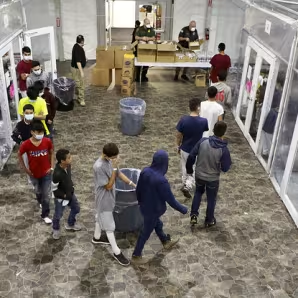
Hampered by the Pandemic: Unaccompanied Child Arrivals Increase as Earlier Preparedness Shortfalls Limit the Response
The increase in unaccompanied child arrivals at the U.S.-Mexico border in February and March has led to backups and overcrowding at U.S. Customs and Border Protection facilities ill-suited to house children, in part due to earlier significant reductions in Office of Refugee Resettlement shelter capacity during 2020. This commentary explores preparedness shortfalls and the options the Biden administration has moving forward.
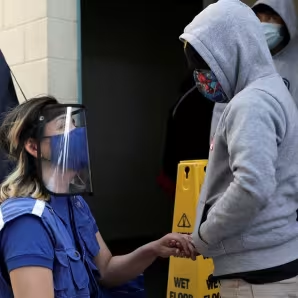
The Public-Charge Rule: Broad Impacts, But Few Will Be Denied Green Cards Based on Actual Benefits Use
While the Trump administration public-charge rule is likely to vastly reshape legal immigration based on its test to assess if a person might ever use public benefits in the future, the universe of noncitizens who could be denied a green card based on current benefits use is quite small. That's because very few benefit programs are open to noncitizens who do not hold a green card. This commentary offers estimates of who might be affected.
