The Overlooked Impact of Immigration on the Size of the Future U.S. Workforce

Immigrant-origin individuals have been the driving force behind U.S. demographic growth in the United States over the past two decades—and likely will be for years to come.
Immigration has been a flashpoint in the 2024 U.S. elections in ways unseen in decades, driven by record levels of encounters at the U.S.-Mexico border and divisive politics. Where there once was a broad consensus across political affiliations that immigration overall was a positive force for the United States, today that sentiment no longer holds for significant swaths of the American public. A Gallup poll in July showed that 55 percent of Americans want to see lower levels of immigration—the highest such result since 2001 and up from 41 percent just a year earlier. At the same time, proponents of immigration can point to influential Congressional Budget Office estimates showing that increased immigration expected over the 2021-2026 period will drive economic growth and contribute to reduced federal deficits and inflation over the next decade. Yet the arrival of large numbers of newcomers has also strained public services in communities across the United States.
Fears of uncontrolled migration and arguments about its perceived costs bear an uncanny resemblance to the nativist backlash of the late 1910s and early 1920s, which were a response to high immigration flows. The restrictive National Origins Quotas Acts of 1921 and 1924 reshaped U.S. migration flows for nearly half a century. Whether the United States will head down an immigration-narrowing path again will owe in large measure to power brokers at the White House and in a Congress that has failed to significantly update the legal immigration system since 1990.
Yet one large—but often underappreciated—difference between the United States a century ago and today is the country's shifting demographics. Over the past few decades, U.S. birthrates have declined as lifespans have lengthened, a phenomenon also seen in other advanced industrialized societies. The old-age dependency ratio—the proportion of the senior population (65 and over) relative to the working-age cohort (18-64)—was 29 percent in 2023, up from 20 percent in 2000. This share is projected to rise to 37 percent by 2040. In stark contrast, the old-age dependency ratio stood at just 8 percent in 1920. In plain terms: While there may be a rhetorical similarity between now and a century ago, the reality is that the stakes are greater today in terms of immigration levels because of intensifying pressure on a smaller number of workers to support a growing number of retirees.
How does immigration address these worrying demographic trends? Because most immigrants arrive when they are younger, they expand the pool of new workers and lower the age-dependency ratio in the immediate term. Importantly, the country also benefits from immigration in the longer term when the U.S.-born children of immigrants—the second generation—join the workforce. In 2023, immigrants and their U.S.-born children accounted for nearly 91 million people, or 27 percent of the total civilian noninstitutionalized U.S. population—up from 20 percent in 2000 (see Box 1 for definitions of immigrant generation).
In the new analysis detailed here, Migration Policy Institute (MPI) researchers provide first-ever projections of the U.S. working-age population by immigrant generation, building on the U.S. Census Bureau’s recent population projections by nativity. The results shed light on future population trends and their implications for the size of the U.S. working-age population by 2040. The results underscore the large and often overlooked impact of the growing working-age population of the U.S.-born offspring of immigrants in offsetting the declines in U.S. workers brought about by aging and lower fertility rates.
Box 1. Definitions
The immigrant-origin population consists of two groups:
1) immigrants (i.e., the first generation) are persons who were not U.S. citizens at birth. Immigrants include naturalized U.S. citizens, lawful permanent residents (also called green-card holders), refugees and asylees, certain legal nonimmigrants (including those on student, work, or other temporary visas), and persons residing in the country without authorization.
2) U.S.-born individuals with one or more immigrant parents (i.e., the second generation).
U.S.-born individuals with both U.S.-born parents (i.e., the third-and-higher generation) consists of persons born in the United States to parents who are U.S. born.
Modeling Changes to the Future Working-Age Population Based on Various Immigration Scenarios
The Census Bureau developed four scenarios that assume differing levels of net international migration (the difference between the number of both foreign and U.S.-born individuals arriving and leaving the United States per year). The total number of working-age immigrant adults in the United States will vary greatly depending on the direction of future immigration policy (see data tool). The number of working-age immigrants, which stood at 35.4 million in 2020, would change by 2040 as follows under the four scenarios: Zero immigration (sharp drop to 18.5 million), low immigration, as seen during the latter Trump administration (31 million), current immigration (37.3 million), and high immigration (46.7 million).
Data Tool. Immigrant Working-Age (18-64) Population in the United States between 2000-20 and Projected to 2040

The significant variation in the projected number of immigrants of working age—with the gap as large as 28 million between the high and low immigration scenarios—highlights the potential of immigration to affect the old-age dependency ratio in the next 15 years. The higher the number of working-age immigrants, the greater the impact of immigration policy on lowering the ratio.
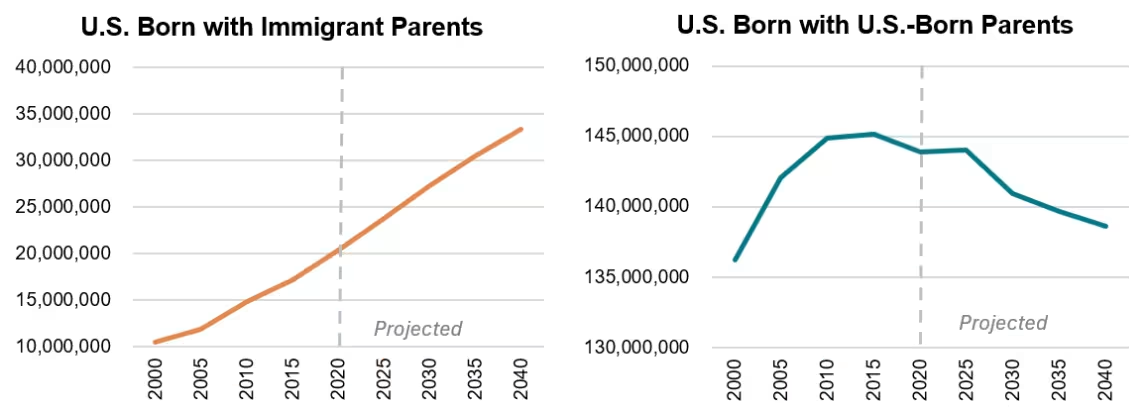
Looking to the nation’s economic future, the entry of the U.S.-born children of today’s immigrants into the U.S. workforce will play a critical, often overlooked role. Regardless of future immigration policy directions, the growth in the second-generation adult population will continue (see Figure 1, left panel). MPI estimates that between 2020 and 2040, the working-age adult second generation will increase 64 percent, from 20.4 million to 33.4 million. At the same time, the third-and-higher generation (U.S.-born adults of working age from U.S.-born families) is projected to decline from 143.9 million in 2020 to 138.6 million in 2040, reaching the level of the early 2000s (see Figure 1, right panel). Thus, without the second generation, the U.S.-born working-age population would be smaller by 33 million or 20 percent, while the ratio of older to younger adults would be substantially higher.
Figure 1. U.S.-Born Working-Age (18-64) Population by Immigrant Generation, 2000 to 2040
A Return to the Past? A Nation at the Crossroads
Earlier MPI research showed that immigrant-origin adults have already been the primary engine of demographic growth in the United States in the past two decades: Without immigrant-origin individuals, the U.S. child population would have shrunk by more than 5 million between 2000 and 2023, while the prime working-age population would have fallen by more than 8 million over the same period. During that period, immigrant-origin adults accounted for all net growth in the U.S. working-age population. Their impact on demographic change is set to continue in the future. While the future scale and composition of immigration may hinge to an extent on the outcome of the 2024 presidential and congressional elections, the U.S.-born children of today's immigrants will increasingly populate K-12 classrooms, higher education institutions, and U.S. workplaces. This growth is notable in part because its members are U.S. citizens with full rights and privileges to U.S. and state education, training, health, and other benefits.
The drastic reduction in immigration following the National Origin Quota Acts of 1921 and 1924, compounded by the Great Depression and World War II, effectively halted new immigration to the United States for four decades. The immigrant population shrank from its 1930 peak of 14.2 million to just 9.6 million by 1970.
In the context of today’s declining birth rates and population aging, significantly limiting immigration would rapidly shrink the U.S. labor pool, with effects on productivity, the health of programs such as Social Security and Medicare, and more. Limits on immigration in turn would translate into fewer U.S.-born children in immigrant families, and thus would have potent negative downstream effects on the size of the future workforce. These effects would be particularly strongly felt in states where the working-age and youth populations are already rapidly declining (Rust Belt states such as Michigan and Pennsylvania, for example).
The demographic trends highlighted in this analysis point to two key policy challenges that have received insufficient attention from policymakers. While politicians have been preoccupied with the degree to which immigration should be restricted, what is missing is a thoughtful discussion about aligning the admissions system with the country's economic and demographic needs. A forward-looking reform of the number and characteristics of immigrants admitted is long overdue, especially given ongoing demographic shifts. At the same time, national and state policymakers need to consider the contexts that these immigrants—and their second-generation offspring—will encounter. The opportunities and barriers that immigrants and their children, who are set to be a critical source of the future American workforce, will face will be pivotal in determining how effectively they contribute to the vitality of the U.S. economy and society.
About the U.S. Immigration Policy Program
The U.S. Immigration Policy Program provides analysis of U.S. immigration pathways, the impacts of enforcement and other policies, and the characteristics of immigrant populations.
About the National Center on Immigrant Integration Policy
The Center is a national hub connecting policymakers, educators, community leaders, and service providers with evidence-informed policy research, technical assistance, and data to advance effective immigrant integration at U.S., state, and local levels.


Related Content


