How Europe Was Transformed by the 2015-16 Migration and Refugee Crisis
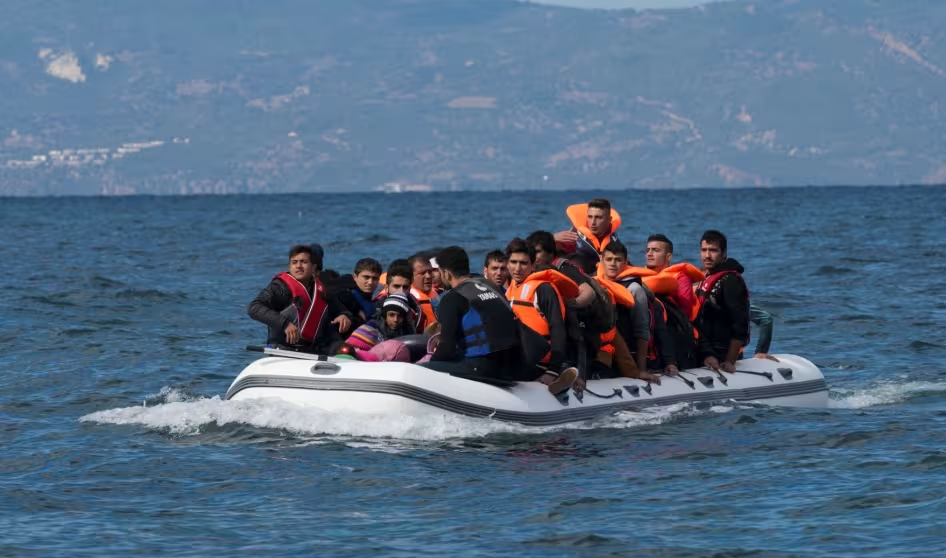
Migrants in an inflatable boat approach the Greek island of Lesvos in 2015.
Credit: Joel Carillet/iStock.com
Highlights
Ten years after the 2015-16 migration and refugee crisis, the European Union has reshaped its process for dividing up asylum claims and controlling external borders. Many systems are stronger and newcomers have integrated into their new countries, but tensions remain and key questions are unresolved.
- More than 1 million refugees and other migrants arrived irregularly in the European Union in 2015 and 2016, straining processing systems across the bloc.
- Despite intense pressures, Europe’s free-movement Schengen area and its common asylum framework have persisted, but internal border checks and disputes over responsibility-sharing continue to linger.
- EU policymakers have tightened access to asylum and prioritized enforcement, growing the budget of the EU border agency, Frontex, more than eightfold from 2015 to 2026.
- The 2015-16 period also propelled far-right politicians into unprecedented positions of influence.
In 2015, the European Union’s asylum system buckled as more than 1 million refugees and other migrants arrived without warning, chiefly from Syria but also many other nationalities. An increase in shipwrecks and deaths at sea, combined with chaotic scenes in reception centers and train stations, pushed migration to the top of the public agenda. On the Greek islands, screening centers were overcrowded and thousands of people slept on beaches, on streets, or in abandoned hotels.1 Tensions spread as migrants moved inland. Governments erected fences, reinstated border controls, and deployed armies to secure their borders,2 posing a major test to the Schengen zone and raising existential questions about the future of the European Union.
"In many ways, the repercussions are only now becoming clear, a decade on."
Although the crisis eventually subsided after 2016, this period etched lasting grooves into the European Union’s political identity, border-free model, and asylum architecture. It also shook public confidence in government. In many ways, the repercussions are only now becoming clear, a decade on.
The immediate demands were practical: Municipalities needed beds3 and asylum offices raced to process people quickly. “Wir schaffen das”—we can manage this—German Chancellor Angela Merkel famously said in 2015.4 Yet the situation soon devolved into an EU political crisis as governments struggled to share responsibility and the system for determining which country should examine an asylum claim broke down. Countries such as Germany and Sweden that had initially welcomed large numbers of asylum seekers soon encountered constraints to their capacity and public support5—limits that were further tested when millions of Ukrainians were displaced following Russia’s 2022 invasion. Eventually, this opened the door to once-taboo debates about restricting asylum. Meanwhile, Hungary’s government, which opposed becoming a country of immigration, began testing the outer limits of EU and international law.6
A decade later, EU migration policy has become almost exclusively focused on curbing arrivals at the borders, at considerable human, political, and financial cost. National asylum agencies have increased capacity, while policymakers have reshaped operations to make returns more efficient. Meanwhile, many refugees have established themselves in their new homes. But scars remain. EU policies have focused on restricting access to asylum, at times in ways that critics contend expose people to danger, and the future of responsibility-sharing still hangs in the balance. Trust between Member States on migration issues remains frayed and some segments of the public remain sensitive to even small changes in arrival numbers. Migration diplomacy has also become more transactional, as countries outside Europe, particularly Turkey, moved to the center of the EU response. In turn, EU neighbors became more aware of their leverage and have extracted billions of euros for support.
Meanwhile, far-right populist parties rode public frustration to new levels of electoral success, winning over voters by challenging established parties and promising to restore a sense of control to those who felt left behind. Even when outside government, radical-right parties poll well enough to shape policy in places including France, Germany, Portugal, and Sweden.
"A decade later, EU migration policy has become almost exclusively focused on curbing arrivals at the borders, at considerable human, political, and financial cost."
This article explores the legacy of the 2015-16 migration and refugee crisis a decade later. It examines the changes to EU asylum and integration policy, reshaped migration routes, effects on refugees’ lives, and politics across the European Union.
Figure 1. Irregular Arrivals in the European Union, 2014-25
Box 1. Was It a Crisis?
The description of the 2015-16 episode as a crisis has been criticized, as other countries host comparable or larger numbers of refugees than those received in the European Union at the time. However, the unexpected significant increase in new arrivals overwhelmed the reception and asylum systems of many EU Member States, which were not designed to manage such large fluctuations in flows. It also propelled Germany to become the third-largest host country of people displaced internationally by 2019.
This reality had humanitarian implications, as governments struggled to provide food and shelter to new arrivals. And it became a political crisis, as EU and national leaders could not agree on how to respond and which country was responsible. The situation also exposed the extent of dysfunction in the Common European Asylum System and the broader architecture’s vulnerability to collapse.
Sources: Elizabeth Collett and Camille Le Coz, After the Storm: Learning from the EU Response to the Migration Crisis (Brussels: MPI Europe, 2018); UN High Commissioner for Refugees (UNHCR), Global Trends: Forced Displacement in 2019 (Geneva: UNHCR, 2020).
How Asylum and Borders Changed
Since the crisis, the European Union has grappled with the challenge of how to make national asylum systems function within a border-free area. Under the so-called Dublin rules, responsibility for an asylum claim usually fell to the first country in the bloc that the applicant entered. Countries at the periphery have, however, never fully enforced these rules and, at times, either waved people through without registration or were slow to take back those who had engaged in secondary movements. In 2015-16, hundreds of thousands eventually ended up in just a few countries, including Germany and Sweden, which became responsible for receiving and integrating them. Governments across the bloc complained: Countries of first arrival argued they were taking more than their fair share, while northern destination countries worried they were becoming magnets for new arrivals because border countries were not doing their duty.
Ten years on, the Schengen zone has largely survived. However, free movement now coexists with mistrust about neighboring countries’ ability or willingness to manage arrivals. The once-exceptional practice of reinstating internal border controls during emergencies has become standard: France, Germany, and six other countries employed internal border checks as of this writing, citing migration and security concerns.7
The Pact on Migration and Asylum, which became applicable in 2026, seeks to resolve these tensions and deter newcomers from lodging unfounded asylum claims. The pact sets new requirements for screening and registering asylum seekers at external borders and accelerates processing and return procedures. It also includes a mandatory solidarity mechanism requiring interior Member States to either relocate asylum seekers from border states or provide financial support to host countries.8 Negotiations are ongoing over how this works in practice; several Member States have proposed assuming responsibility for asylum seekers who have already moved onward into their territory, rather than relocating new arrivals from border states. This highlights the unresolved tensions and the risk of continuing tit-for-tat responses that could undermine the system.
At the same time, the pact established a new governance model built around annual needs assessments, a more operational role for the European Commission, and stronger EU agencies. In the past decade, the EU Agency for Asylum has grown its on-the-ground presence, working with 12 Member States as of July 2026 to support asylum procedures, promote common standards, and monitor national systems.9
Meanwhile, Frontex has become an operational powerhouse, with ambitions to expand to 30,000 staff and combine border management with a stronger role as the EU return agency. Its budget increased more than eightfold, from 143 million euros in 2015 to about 1.2 billion euros in 2026 (see Figure 2), and the European Commission has proposed an 11.8-billion-euro funding allocation for 2028-34.10 Frontex has gained an expanded role in border surveillance and also helped governments return migrants lacking a right to stay. But the agency has also faced reports of being complicit in unlawful pushbacks and interceptions that deny people access to asylum, as well as criticism of its response to boats in distress.11
Figure 2. Frontex Budget, 2010-26
Another major shift is how nearby non-EU countries have become central partners for migration policy. A pivotal agreement was the March 2016 EU-Turkey statement that enlisted Ankara to help stop irregular crossings and return eligible migrants from Greece, in exchange for a range of financial and diplomatic incentives.12 The European Union offered 6 billion euros for refugee support in Turkey; additionally, for each Syrian returned from the Greek islands, another was to be resettled from Turkey to the European Union. Turkey suspended returns from Greece in 2020, amid the COVID-19 pandemic, but EU funding for refugees and resettlement continued.13 The arrangement reinforced an approach of delivering support closer to refugees’ countries of origin and along migration routes, rather than after their irregular arrival in Europe. It also demonstrated EU governments’ willingness to use a large toolbox to secure migration cooperation. Subsequent partnerships have involved countries such as Egypt, Mauritania, and Tunisia, often prompting concerns about human-rights abuses and unlawful pushbacks.14
Despite the promise of these changes, the new system has yet to be challenged on the scale of the 2015-16 crisis, in which officials had to provide individual status adjudications to arrivals from a dozen different countries. Thus, it remains unclear whether it could withstand 1 million new spontaneous irregular arrivals with varying protection needs.
Russia’s invasion of Ukraine offered a test. EU countries activated the Temporary Protection Directive—which was created in 2001 following conflicts in the former Yugoslavia but never previously activated15—to offer displaced Ukrainians quick permission to live and work without having to go through the asylum process. This avoided many of the processing delays of 2015-16, although it did not remove substantial pressures on housing and public services. It is unclear if EU leaders would offer temporary protection again in a situation with less geopolitical significance or farther from Europe’s borders.
How Migration Patterns Changed
Governments’ responses in 2015-16 limited irregular migration in the Eastern Mediterranean and Western Balkans, especially after the EU-Turkey deal and the closure of the Western Balkan corridor. Data from the UN High Commissioner for Refugees (UNHCR) show that the combined sea arrivals in Greece and Italy fell from more than 1 million in 2015 to about 150,000 in 2017 (see Figure 3).16
Figure 3. Irregular Sea Arrivals to Greece, Italy, and Spain, 2014-25
But fewer arrivals in some countries did not mean a uniform decline. Greece was the largest destination in 2015, but Italy surpassed it the following year.17 This reflects a change in underlying trends rather than people shifting to different routes. Most people arriving in Greece in 2015 were Syrian, followed by Afghans and Iraqis, while the Central Mediterranean route to Italy was used primarily by Nigerians, Eritreans, and other Africans. Later, Spain rose in popularity, with more than 63,800 irregular sea arrivals in 2024 (mostly to the Canary Islands), up from 5,300 in 2015.18
Figure 4. Asylum Applications Registered in EU Member States, 2010-25
Irregular journeys have also become more dangerous. Beginning in 2014, with the end of Italy’s Mare Nostrum search-and-rescue operation, the European Union and its Member States slowly drew down naval resources that had helped rescues in the Mediterranean. The final mission, Operation Sophia, ended in 2019.19 Moreover, heightened border enforcement has pushed many migrants to rely on longer sea crossings in precarious vessels facilitated by smugglers who adapt quickly to changing controls. Authorities also prosecuted groups seeking to rescue migrants at sea, claiming they facilitated irregular migration.
"Irregular journeys have also become more dangerous."
As a result of these and other changes, deaths at sea have risen. More than 35,500 migrants are estimated to have died or gone missing in the Mediterranean between 2015 and 2025.20 More recently, increasing numbers of children have arrived in Europe unaccompanied; two-thirds of minors who sought asylum in EU nations in 2025 arrived without a parent or guardian.21
Shifting policies and trends have also led to changes in the smuggling economy. Smuggling networks have professionalized and adjusted their services, prices, logistics, and communication methods in response to enforcement. For instance, networks increasingly divide tasks across countries, use digital platforms such as TikTok and WhatsApp to recruit customers and coordinate journeys, and combine aboveboard travel (such as legally purchased airline tickets) with illicit services to evade detection.22 This suggests that tougher enforcement can disrupt particular journeys while failing to remove the underlying demand or business model for intermediaries who make movement possible.
The main nationalities seeking protection have also changed. In 2025, Venezuelans overtook Syrians as the largest group of first-time asylum applicants, as Spain registered more first-time claims than Germany.23 These migrants have been less visible than earlier sea arrivals, in part because many are Latin Americans who can enter Spain legally without a visa for a short stay. People who speak Spanish and share cultural ties may also have an easier time finding work, including informally. These changes show that migration patterns are constantly shifting; while governments can influence the scale and location of arrivals, their control over underlying drivers is ultimately limited.
How Societies and Newcomers Changed
What happened to the refugees and other migrants themselves? Of the main nationalities claiming asylum in 2015-16, most received protection, though rates declined over time: Almost all Syrians received positive first-instance decisions (97 percent in 2015 and 98 percent in 2016), approval rates declined for Afghans (from 70 percent in 2015 to 57 percent in 2016) and Iraqis (from 89 percent to 65 percent).24
Evidence points to significant progress on integration, although results are uneven. In Germany, at least 64 percent of working-age refugees who arrived in 2015 were employed by 2024, only slightly below the rate of at least 70 percent for the overall working-age population.25 These successes did not happen overnight and required substantial public spending on integration programs alongside housing and other benefits.26 In the Netherlands, a study following people granted asylum residence permits in 2015 found that 53 percent were in work nine years later, although 31 percent were still receiving benefits.27
Yet positive headlines obscure the extent to which integration trends have differed for various groups. In Germany, the employment rate for women who arrived in 2015 was 35 percent as of 2024, compared with 76 percent for men, and women were more likely to work part-time.28 Arrival time also made a difference, since earlier arrivals especially from Syria tended to have more education.
Economic indicators do not tell the whole story. The rapid pace of population change had wide-ranging impacts on host societies, exacerbating some strains on services and infrastructure that played a role in eventually eroding public support. Some issues—notably housing scarcity—have become major flashpoints. However, it is difficult to disentangle migration’s role from structural causes, as many areas have faced decades of underinvestment. It is nonetheless clear that when policies fail to keep up with needs, immigrants can become targets.
The crisis also ushered in a new era of community mobilization, changing who helped support newcomers and how communities organized that support. It gave rise to a wave of innovation, including co-housing (in which young refugees share accommodation with the native born) and “local tables” (where newcomers and long-term residents meet to address neighborhood problems).29 Some of this energy dissipated but nonetheless laid the groundwork for future crisis response, by fostering partnerships between municipalities, civil-society groups, and residents, or establishing volunteer-management systems that were later mobilized for other causes.30 In many cases, newcomers also provided support to their host communities, such as when Syrian refugees led initiatives in Berlin during the COVID-19 pandemic.31
How Politics Changed
Even as irregular migration has fallen, the political salience of the issue has not. Irregular arrivals have fueled far-right politicians’ arguments that established parties had lost control over borders and, by extension, national identity. Immigration is not the only topic on which the far right has gained momentum, but politicians have often linked the issue to an array of economic and social grievances, from scarce housing to declining welfare to competition for jobs. The narrative has persisted, as made vivid in July 2026 when tens of thousands of migrants swam in one day to Ceuta, the Spanish enclave, stoking EU migration politics anew.
Far-right parties now access the levers of power in countries across Europe. In Italy, Giorgia Meloni’s far-right Brothers of Italy has led the government since 2022, and other radical-right populists have seen historic victories. Before 2015, the fact that these parties rarely garnered enough votes to enter government was thought to constrain their power, but it is now clear that outright political victories are not necessary to destabilize politics or dominate the political agenda. Meanwhile, artificial constraints such as the so-called cordon sanitaire keeping right-wing parties out of government, regardless of their vote tallies, are fraying. Although these parties have largely failed to enact the most severe immigration restrictions, they have dramatically restricted integration supports and have shifted the discourse to bring once-off-limits ideas into the mainstream.
Upcoming elections may bring further milestones. The Alternative for Germany (AfD) won 21 percent in the February 2025 federal election and in 2026 secured a plurality in the state of Saxony-Anhalt, leading to the first AfD speaker of a state legislature.32 And in France, the National Rally (RN) is the largest party in the National Assembly and Marine Le Pen is the presidential front-runner heading into April 2027 elections.33 While immigration is only one element of these parties’ platforms, it is a key one.
The sum of these victories has been an undeniable shift in how much and what kind of immigration Europeans are willing to accept. The result is a changed conception of what qualifies as mainstream; many center-right and center-left politicians have embraced more restriction, opening the door to policies such as return hubs (where authorities could send unsuccessful asylum seekers from other countries), acceptance of conspiracy theories and white nationalist rhetoric (most notably the “Great Replacement” theory), and cultural restrictions including bans on headscarves.
Resilience Without Resolution
Since 2015, migration has been catapulted to the center of European politics, dominating agendas and repeatedly straining relations among Member States. This attention has both driven reform and constrained it, with each move subjected to intense scrutiny and politicization. Against the odds, the European Union has preserved the Common European Asylum System and the Schengen area—at least for now—and adopted a new framework for migration and asylum that marks a further step towards a more Europeanized system. The bloc has also strengthened its technical capacity to support integration and mobilized to respond to displacement from Ukraine.
But achievements have come with costly compromises. Legal commitments to asylum and the Schengen system have been honored, but their interpretation has been stretched. The focus on curbing irregular arrivals has led governments to deprioritize legal pathways at a time when the European Union urgently needs more workers. And while European countries continue investing in integration, budgets are being slashed and political focus has often shifted to demanding more cost-sharing from newcomers. And, of course, many dynamics remain outside the European Union’s control, including foreign conflicts and the lack of economic opportunities elsewhere.
"Against the odds, the European Union has preserved the Common European Asylum System and the Schengen area—at least for now."
Does the system work? The reforms born of crisis have kept European governments within a common framework, but at the cost of extraordinary complexity. Additional funding and personnel are intended to improve asylum processing, yet teams on the ground must now navigate tight deadlines while upholding international law and human-rights obligations. Solidarity has been enshrined in the framework, but through intricate calculations that provide a more objective basis for contributions without removing politics from their implementation—or the need to explain outcomes to the public. Cooperation with external partners has helped reduce arrivals, but at considerable cost and with diminishing attention to the unresolved drivers of migration and onward movement from countries of first asylum. Meanwhile, Member States are seeking to externalize more procedures—starting with return—through increasingly transactional deals.
The clearest lesson is that there are no shortcuts to building a common migration system. In a decade, the European Union has strengthened its technical ability to administer and restrict movement, but more political questions around how to distribute obligations and sustain public trust have proven thornier. The next question will be whether it can use that greater capacity to provide protection predictably, resolve claims fairly, and support receiving communities. Ultimately, the depth of cooperation among its 27 Member States makes the European Union a defining test case for what responsibility-sharing can look like.
Sources
Agence France-Presse (AFP). 2015. Austria Draws on Army in Migrant Crisis. AFP, August 15, 2015.
---. 2015. Refugee Crisis: Slovenia Calls in Army to Help Patrol Borders. AFP, October 21, 2015.
Amnesty International. 2024. EU/Egypt: Put Human Rights at the Centre of All Cooperation. March 15, 2024.
Baczynska, Gabriela and Sara Ledwith. 2016. The Walls Go Up in Europe. Reuters, April 4, 2016.
Bremer Institut für Arbeitsmarktforschung und Jugendberufshilfe (BIAJ). 2026. Integrationskurse im Bundeshaushalt 2026: 20 Prozent weniger Mittel (Soll) als 2025 ausgegeben wurden. Updated March 26, 2026.
Chaves-González, Diego and Anna Terrón Cusí. 2026. Spain and Latin America Take Diverging Paths on Regularization. Migration Information Source, July 2, 2026.
Collett, Elizabeth. 2026. The Paradox of the EU-Turkey Refugee Deal. MPI Europe commentary, March 2026.
Collett, Elizabeth and Camille Le Coz. 2018. After the Storm: Learning from the EU Response to the Migration Crisis. Brussels: MPI Europe.
Council of the European Union. 2019. EUNAVFOR MED Operation Sophia: Mandate Extended until 30 September 2019. Press release, March 29, 2019.
Coutant, Isabelle. 2018. Les migrants en bas de chez soi. Paris: Éditions du Seuil.
Delcker, Janosch. 2016. The Phrase that Haunts Angela Merkel. Politico, August 19, 2016.
Easton-Calabria, Evan and Yahya Alaous. 2022. Belonging in Berlin: An Exploration of Syrian Refugee-Led Organisations and Volunteerism during COVID-19. Democracy & Belonging Forum, February 2, 2022.
European Border and Coast Guard Agency (Frontex). 2015. Final Adoption of the Amending Budget No. 1 of the European Border and Coast Guard Agency for the Financial Year 2015. Official Journal of the European Union, C 110/113.
---. 2026. Final Adoption of the Budget of the European Border and Coast Guard Agency for the Financial Year 2026. Official Journal of the European Union, C/2026/2577.
European Commission. 2016. Questions & Answers: A Coordinated EU Approach for Temporary Internal Border Controls. September 27, 2016.
---. 2021. Joint Communication to the European Council: State of Play of EU-Turkey Political, Economic and Trade Relations. Brussels: European Commission.
---. 2026. Pact on Migration and Asylum. Updated June 11, 2026.
---. N.d. Temporary Reintroduction of Border Control. Accessed October 13, 2026.
European Commission, Migration and Home Affairs. 2026. Temporary Protection. August 18, 2026.
European Council and Council of the European Union. 2026. Yearly Irregular Arrivals and Fatalities (2014-2026). Updated October 13, 2026.
European Ombudsman. 2024. Ombudsman Calls for Changes to EU Search and Rescue Rules and a Public Inquiry into Deaths in Mediterranean. Press release, February 28, 2024.
European Parliament. 2025. Answer Given by Ms Kos on Behalf of the European Commission. Updated April 22, 2025.
European Union Agency for Asylum (EUAA). 2025. Syria: Updated EUAA Country Guidance Outlines Changing International Protection Needs. Press release, December 3, 2025.
Europol. 2025. 2025 European Migrant Smuggling Centre: Yearly Activity Overview, 9th Annual Report. Luxembourg: Publications Office of the European Union.
Europol and Interpol. 2016. Migrant Smuggling Networks. The Hague: Europol and Interpol.
Eurostat. 2026. Asylum Applications—Annual Statistics. Updated March 16, 2026.
---. 2026. Asylum Decisions at First Instance by Type of Decision - % of Total Decisions at First Instance - Annual Data. Updated August 24, 2026.
France 24. 2026. Poll Shows French Far-Right Leader Marine Le Pen Widening Lead Ahead of 2027 Presidential Vote. September 28, 2026.
Finnish Red Cross. 2026. Finland: Localization Case Study, Local Leadership in Action. Helsinki: Finnish Red Cross.
German Federal Ministry of Finance. 2025. Finanzbericht 2026. Berlin: Federal Ministry of Finance.
German Institute for Employment Research. 2025. 10 Jahre Fluchtmigration: Beschäftigungsquote von Geflüchteten nähert sich dem Durchschnitt in Deutschland an. Press release, August 25, 2025.
Goździak, Elżbieta M. 2019. Using Fear of the “Other,” Orbán Reshapes Migration Policy in a Hungary Built on Cultural Diversity. Migration Information Source, October 10, 2019.
Human Rights Watch. 2022. EU: Frontex Complicit in Abuse in Libya. December 12, 2022.
---. 2025. “They Accused Me of Trying to Go to Europe:” Migration Control Abuses and EU Externalization in Mauritania. New York: Human Rights Watch.
International Organization for Migration (IOM). N.d. 35705 Missing Migrants Recorded in Mediterranean since 2014. Accessed November 2, 2026.
Jones, Timothy. 2026. Germany News: Saxony-Anhalt Elects AfD Parliamentary Speaker. Deutsche Welle, October 6, 2026.
Kingsley, Patrick. 2015. Migrant Crisis: Hungary Closes Main Budapest Station. The Guardian, September 1, 2015.
Le Poidevin, Olivia. 2026. More Unaccompanied Children Are Taking Dangerous Crossings to Europe, UN Says. Reuters, October 7, 2026.
Papademetriou, Demetrios G. and Susan Fratzke. 2016. Dawn of New Migration Reality Brings Focus on Borders, Returns, and Integration. Migration Information Source, December 20, 2016.
Patuzzi, Liam. 2020. European Cities on the Front Line: New and Emerging Governance Models for Migrant Inclusion. Brussels: MPI Europe.
Rooduijn, Matthijs et al. 2026. The PopuList. Updated May 2026.
Spindler, William. 2015. UNHCR Calls for Urgent European Support for Greece amid Worsening Conditions for Refugees. UN High Commissioner for Refugees (UNHCR), August 7, 2015.
Statistics Netherlands (CBS). 2026. Dashboard asiel en integratie. Updated May 7, 2026.
UN High Commissioner for Refugees (UNHCR). 2016. Refugees and Migrants Face Heightened Risks while Trying to Reach Europe. Press release, April 20, 2016.
---. 2025. 10 Years On from the Largest Loss of Life in the Mediterranean, UNHCR Urges Decisive Action to Save Lives. Press release, April 18, 2025.
---. 2026. Operational Data Portal: Europe Sea Arrivals | Greece. Updated October 18, 2026.
---. 2026. Operational Data Portal: Europe Sea Arrivals | Italy. Updated October 18, 2026.
---. 2026. Operational Data Portal: Europe Sea Arrivals | Spain. Updated October 15, 2026.
Von Herbert Brücker, Philipp Jaschke and Yuliya Kosyakova. 2025. 10 Jahre Fluchtmigration 2015: Haben wir es geschafft? Eine Analyse aus Sicht des Arbeitsmarktes. German Institute for Employment Research brief no. 17, August 2025, Nuremberg.
About the Global Program
The Global Program bridges policy advice, research, and candid dialogue to design effective migration policies, drawing on global evidence and anticipating the forces reshaping how people move.
Notes
-
1
William Spindler, “UNHCR Calls for Urgent European Support for Greece amid Worsening Conditions for Refugees,” UN High Commissioner for Refugees (UNHCR), August 7, 2015.
-
2
See for instance Gabriela Baczynska and Sara Ledwith, “The Walls Go Up in Europe,” Reuters, April 4, 2016; Patrick Kingsley, The New Odyssey: The Story of Europe’s Refugee Crisis (London: Guardian Faber Publishing, 2016); Agence France-Presse (AFP), “Refugee Crisis: Slovenia Calls in Army to Help Patrol Borders,” October 21, 2015; AFP, “Austria Draws on Army in Migrant Crisis,” August 15, 2015.
-
3
Isabelle Coutant, Les migrants en bas de chez soi (Paris: Éditions du Seuil, 2018).
-
4
Janosch Delcker, “The Phrase that Haunts Angela Merkel,” Politico, August 19, 2016.
-
5
Demetrios G. Papademetriou and Susan Fratzke, “Dawn of New Migration Reality Brings Focus on Borders, Returns, and Integration,” Migration Information Source, December 20, 2016.
-
6
Elżbieta M. Goździak, “Using Fear of the ‘Other,’ Orbán Reshapes Migration Policy in a Hungary Built on Cultural Diversity,” Migration Information Source, October 10, 2019.
-
7
European Commission, “Temporary Reintroduction of Border Control,” accessed October 13, 2026.
-
8
European Commission, “Pact on Migration and Asylum,” updated June 11, 2026.
-
9
European Union Agency for Asylum (EUAA), “EUAA Renews Operational Support to Member States as Pact Implementation Advances” (press release, July 15, 2026).
-
10
European Border and Coast Guard Agency (Frontex), Frontex: Amended Budget 2015 N3 (Warsaw: Frontex, 2015; Frontex, “Final Adoption of the Budget of the European Border and Coast Guard Agency for the Financial Year 2026,” Official Journal of the European Union, 2026; European Commission, “Commission Proposes a Stronger Frontex: More Resources, a Greater Role on Returns and Effective Crisis Response,” October 27, 2026.
-
11
Human Rights Watch, “EU: Frontex Complicit in Abuse in Libya,” December 12, 2022; European Ombudsman, “Ombudsman Calls for Changes to EU Search and Rescue Rules and a Public Inquiry into Deaths in Mediterranean” (press release no. 1/2024, February 28, 2024).
-
12
Elizabeth Collett, “The Paradox of the EU-Turkey Refugee Deal” (MPI Europe commentary, March 2016).
-
13
European Commission, Joint Communication to the European Council: State of Play of EU-Turkey Political, Economic and Trade Relations (Brussels: European Commission, 2021); European Parliament, “Answer Given by Ms. Kos on Behalf of the European Commission,” updated April 22, 2025.
-
14
Human Rights Watch, “EU: Tunisia Migration Deal Worsening Human Rights Violations,” July 16, 2026; Amnesty International, “EU/Egypt: Put Human Rights at the Centre of All Cooperation,” March 15, 2024; Human Rights Watch, “They Accused Me of Trying to Go to Europe:” Migration Control Abuses and EU Externalization in Mauritania (New York: Human Rights Watch, 2025).
-
15
European Commission, Migration and Home Affairs, “Temporary Protection,” August 18, 2026.
-
16
UN High Commissioner for Refugees (UNHCR), “Operational Data Portal: Europe Sea Arrivals | Greece,” updated October 18, 2026; UNHCR, “Operational Data Portal: Europe Sea Arrivals | Italy,” updated October 18, 2026.
-
17
UN High Commissioner for Refugees (UNHCR), “Refugees and Migrants Face Heightened Risks While Trying to Reach Europe” (press release, April 20, 2016).
-
18
UN High Commissioner for Refugees (UNHCR), “Operational Data Portal: Europe Sea Arrivals | Spain,” updated October 15, 2026.
-
19
Council of the European Union, “EUNAVFOR MED Operation Sophia: Mandate Extended until 30 September 2019” (press release, March 29, 2019).
-
20
International Organization for Migration (IOM), "35705 Missing Migrants Recorded in Mediterranean since 2014," accessed November 2, 2026.
-
21
Olivia Le Poidevin, “More Unaccompanied Children Are Taking Dangerous Crossings to Europe, UN Says,” Reuters, October 7, 2026.
-
22
Europol and Interpol, Migrant Smuggling Networks (The Hague: Europol and Interpol, 2016); Europol, 2025 European Migrant Smuggling Centre: Yearly Activity Overview, 9th Annual Report (Luxembourg: Publications Office of the European Union, 2025).
-
23
Eurostat, “Asylum Applications—Annual Statistics,” updated March 16, 2026.
-
24
Eurostat, “Asylum Decisions at First Instance by Type of Decision - % of Total Decisions at First Instance - Annual Data,” updated August 24, 2026.
-
25
German Institute for Employment Research, “10 Jahre Fluchtmigration: Beschäftigungsquote von Geflüchteten nähert sich dem Durchschnitt in Deutschland an” (press release, August 25, 2025).
-
26
German Federal Ministry of Finance, Finanzbericht 2026 (Berlin: Federal Ministry of Finance, 2025); Bremer Institut für Arbeitsmarktforschung und Jugendberufshilfe (BIAJ), “Integrationskurse im Bundeshaushalt 2026: 20 Prozent weniger Mittel (Soll) als 2025 ausgegeben wurden,“ updated March 26, 2026.
-
27
Statistics Netherlands (CBS), “Dashboard asiel en integratie,” updated May 7, 2026.
-
28
Philipp Jaschke von Herbert Brücker and Yuliya Kosyakova, “10 Jahre Fluchtmigration 2015: Haben wir es geschafft? Eine Analyse aus Sicht des Arbeitsmarktes“ (German Institute for Employment Research brief no. 17, August 2025 Nuremberg).
-
29
See for example Liam Patuzzi, European Cities on the Front Line: New and Emerging Governance Models for Migrant Inclusion (Brussels: MPI Europe, 2020).
-
30
See for example Finnish Red Cross, Finland: Localization Case Study, Local Leadership in Action (Helsinki: Finnish Red Cross, 2026).
-
31
Evan Easton-Calabria and Yahya Alaous, “Belonging in Berlin: An Exploration of Syrian Refugee-Led Organisations and Volunteerism during COVID-19,” Democracy & Belonging Forum, February 2, 2022.
-
32
Timothy Jones, “Germany News: Saxony-Anhalt Elects AfD Parliamentary Speaker,” Deutsche Welle, October 6, 2026.
-
33
France 24, “Poll Shows French Far-Right Leader Marine Le Pen Widening Lead Ahead of 2027 Presidential Vote,” September 28, 2026.


Related Content


