As the Gulf Region Seeks a Pivot, Reforms to Its Oft-Criticized Immigration Policies Remain a Work in Progress

The Dubai skyline. (Photo: Muhammad Zulkifal/iStock.com)
Highlights
Gulf Cooperation Council states are reforming the kafala system and opening residency paths for wealthy and skilled migrants, but low-wage workers remain largely excluded.
- The six states of the Gulf Cooperation Council (GCC) host 30 million foreign nationals—11 percent of all migrants globally as of 2020—comprising more than half of the region's total population.
- The kafala sponsorship system ties migrants to their employers, giving sponsors control over workers' passports, mobility, and job changes.
- Gulf states have introduced "golden visas," long-term residency, and naturalization schemes for investors and skilled workers. This occurred even as the number of foreign laborers dropped by nearly one-fifth from 2015 to 2021 amid fee hikes and deportations.
- Highly skilled foreign workers in Saudi Arabia's private sector grew 48 percent from early 2022 to mid-2024, yet their share has held steady at just 16 percent of all foreign private-sector employees.
Countries of the Gulf Cooperation Council (GCC) are undergoing deep socioeconomic reforms as they seek to transition from oil-based, rentier economies to diversified, knowledge-based development. As part of this process, these governments are looking to overhaul past labor and immigration policies, including the much-criticized kafala (sponsorship) system that binds millions of foreign-born workers to their employers. Longstanding barriers to immigrants’ integration have been progressively lifted, and new pathways to long-term stay and naturalization have begun to open.
However, these reforms are very selectively targeted and the largest benefits have fallen to foreign investors and white-collar workers, leaving behind those with lower skill levels who often come from countries in South Asia and sub-Saharan Africa. Ultimately, changes may widen the rights and inclusion gaps between highly skilled foreign nationals and other migrants.
Collectively, the six GCC Member States—Bahrain, Kuwait, Oman, Qatar, Saudi Arabia, and the United Arab Emirates—form one of the world’s largest immigration hubs, home to 11 percent of all migrants globally as of 2020, according to UN data. The 30 million foreign nationals in the region made up more than half of the total resident population. Ranging from 40 percent in Oman in 2022, to 88 percent in Qatar, immigrants’ share of the population of these countries is among the highest in the world.
Such high levels of immigration, however, have combined with exceptional exclusion of migrants from local societies and citizenries. Until recently, Gulf states did not conceive of themselves as immigration countries, and they still designate noncitizens as temporary expatriate workers (wafidîn). This is in contrast to places such as the European Union and North America, where immigrants are generally able to integrate into host societies and, depending on their legal status, eventually become citizens.
This article examines the socioeconomic reforms occurring across GCC Member States and the impact of those changes on immigration.
Table 1. Population of GCC Countries, by Nationality, Mid-2022
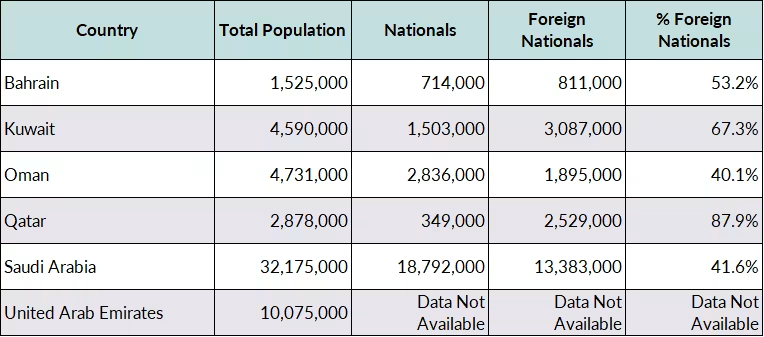
Note: Nationality data for Qatar are estimates based on Planning and Statistics Authority data.
Source: Gulf Research Center, Gulf Labour Markets, Migration, and Population Program (GLMM), “GCC: Total Population and Percentage of Nationals and Non-Nationals in GCC Countries (National Statistics, Mid-2022),” updated December 2023, available online.
Migration and the Kafala System
The policy of nonintegration of migrants into Gulf societies and citizenries is rooted in the nearly century-old development of large-scale oil exploitation and the progressive accumulation of oil profits, some of which have been passed on to citizens. Nation-building processes needed to define who would be entitled to a share of this oil rent, creating a firm division between nationals—mostly defined by blood descent or ancestral connection—and “foreigners” who are excluded from the redistribution process. Rulers secured political allegiance from citizens in part by guaranteeing them income (especially via well-paid government jobs), state services, and various subsidies. This dynamic, described as the rentier social contract, endowed citizenship with specific material privileges and sociopolitical distinction; access to it was therefore progressively restrained to protect its value, in a context of large-scale immigration.
During decades of oil wealth, the kafala policy has played a structural role safeguarding this dynamic by circumscribing migrants’ access to citizenship. Originally a product of the British colonial era, the set of kafala practices was progressively shaped to control and regulate labor migration. After Gulf states achieved independence during the 20th century, the sponsoring of foreign workers was delegated to citizens or citizen-owned companies and became the legal basis for all foreign nationals’ residency and employment, regardless of their skill level.
Under this system, foreign workers depend on a local sponsor (kafeel; usually the employer) who issues an employment contract and is supposed to bear full economic, social, and legal responsibility for them during the contract period. The system thus places the foreign laborer in a position of dependence and subordination to their sponsoring national. The system controls migrants politically by severely restricting opportunities for naturalization and sets a different standard of rights. The sponsor moreover, by virtue of holding the foreign worker’s passport and other documents, controls a migrant’s mobility within the country and their ability to exit the territory, which is widely described as an infringement on basic human rights.
The sponsor also oversees a migrant’s employment conditions and professional mobility, since changing jobs often means changing sponsors, which is conditional on obtaining a “no-objection” certificate from the current employer. Consequently, dual, two-tiered labor markets have developed in Gulf states. Foreign-born men have tended to work in the private sector, while females are almost exclusively employed in the domestic work sector. Under the kafala system, immigrants have no leverage over their salaries and working conditions, keeping both modest. By contrast, nationals have mostly occupied governmental jobs; they have also enjoyed preference in private-sector employment and have been entitled to higher salaries and generous welfare packages. In 2012, for instance, salaries of Saudi men were on average two to seven times higher than those of male foreign workers in the same occupation category.
However, there are costs to accommodating ever-growing numbers of young nationals in largely unproductive government jobs. Meanwhile, the segregation between foreign and citizen workers and the latter’s entitlement to better salaries kept nationals out of a functioning labor market involving direct competition with expatriate workers. This impaired labor productivity and sustained employers’ preference for cheaper foreign workers. By delegating management of the workforce to citizen employers, the kafala system also undermined governments’ ambitions to take control of economic development.
“Updating the Social Contract”
Due to historical high fertility and increasing education, growing numbers of young nationals have entered Gulf countries’ labor markets over the last several decades, just as these economies became more globalized (Gulf states joined the World Trade Organization in the 1990s and 2000s) and unstable oil prices forced governments to reduce public expenditures and government jobs. Nationals’ unemployment rates rose after the 2008 financial crisis, and some slipped into poverty. Clearly, the hydrocarbon-based social contract was ailing.
The contraction of oil wealth and the economic unsustainability of the kafala-based dual labor markets compelled governments to seek to diversify their economies. Their task was to update the region’s social contracts to push nationals into the private sector without jeopardizing regimes’ stability. Policymakers faced a three-fold challenge: create employment opportunities to alleviate nationals’ unemployment, make those opportunities attractive and rewarding, and ensure that nationals acquired necessary skills to perform the tasks.
Socioeconomic Reform: Towards Knowledge-Based Economies
The only way to attract nationals to productive work while also enhancing the status of local workers seemed to be to improve human capital and, more generally, foster sustainable growth through service-oriented and high-tech industries across the region.
Ambitious reform plans were launched during the 2010s, including Qatar National Vision 2030, Saudi Arabia’s Vision 2030, We the UAE 2031, Kuwait Vision 2035, and Oman Vision 2040. Like in other Gulf states, the Saudi Vision 2030 goal is to create a knowledge-based economy through investing in education and fostering innovative, high value-added industries, especially in information technology. Improving the education system and the country’s human capital are among policymakers’ top priorities. Qatar, the United Arab Emirates, and the other states streamlined the process for opening satellite branches of prominent Western universities (including Georgetown University, the University of Birmingham, and Sorbonne University) and have actively promoted study of science, technology, engineering, and mathematics (STEM) subjects, especially among women.
Saudization and Other Labor Nationalization Policies
These reforms aim to create more jobs for nationals, including by partially or totally phasing out foreign workers from certain positions and sectors. For instance, mid-level clerical positions and industries especially in the retail, hospitality, and tourism sectors were targeted as priorities in Saudi Arabia’s Nitaqat program launched in 2011. Except for Qatar and the United Arab Emirates, where there are too few citizens to replace all foreign workers, government work is generally reserved for nationals. Policies combine incentives to hire more nationals with sanctions for noncompliant companies. Quotas for nationals’ employment vary by profession, sector, and company size, while nationalization targets are constantly readjusted. Since 2020, nationals’ involvement in the private sector has increased (see Figure 1).
Figure 1. GCC Country Nationals Employed in the Private Sector, 2015-23
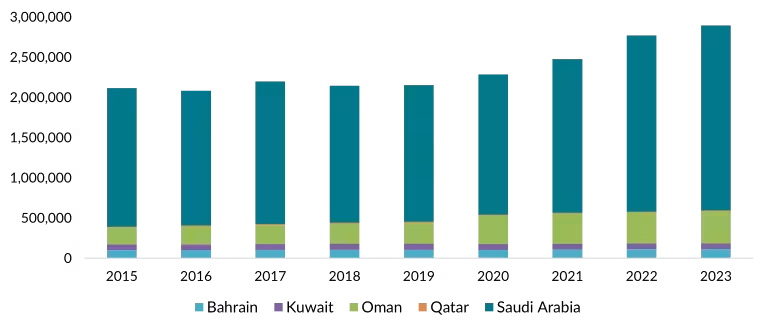
Note: Data disaggregated by nationality are not available for the United Arab Emirates.
Source: GLMM, “GCC: Employed Population and Percentage of Non-Naturals in Employed Population in GCC Countries (2015-2023) (Private Sector),” updated September 2, 2024, available online.
Differences remain in the labor costs and rights of citizens and foreign workers, leading many employers to prefer the latter. As such, the economic rationality of these policies is not yet proven. Still, labor nationalization policies play a political role. For one, they permit governments to assert some control over the labor force, which was previously in the hands of employers and business owners. Job localization policies also foster the political inclusion of young Gulf nationals by making private-sector employment a citizenship-based entitlement, thereby beefing up regimes’ wavering popular support.
Changing Policies and the “Demographic Imbalance”
In parallel to incorporating more nationals into the workforce, reforms may limit future opportunities for low-skilled foreign workers in labor-intensive sectors. Moreover, following a migration boom in the 2000s, the Arab Spring uprisings rattled the region beginning in 2011, leading to regime changes and conflicts in Syria and Yemen that raised security concerns about migrants. Migration policies became more security-oriented, with a tighter control over arrivals. The fact that noncitizens comprised a majority of the region’s population attracted public and policymaker attention.
There have been multiple measures to control immigration, including increasing costs for hiring foreign workers and securing migrants’ legal residence. Saudi Arabia quadrupled fees levied on foreign nationals and their dependents in 2017, forcing many families out of the kingdom. Oman’s foreign population decreased by 80 percent between mid-2017 and mid-2020. As a result of these and other policies—plus the onset of the COVID-19 pandemic, which limited migration of all kinds globally—the number of foreign workers in the region dropped by nearly one-fifth from 2015 to 2021, though there has since been a rebound (see Figure 2). Large-scale deportations of unauthorized residents and immigrants of certain nationalities are also reportedly routine in Saudi Arabia, Oman, and Kuwait. In 2022, more than 100,000 Ethiopians were returned from Saudi Arabia, following hundreds of thousands of deportations since 2013.
Figure 2. Foreign Workers Employed in GCC Countries’ Private Sectors, 2015-23
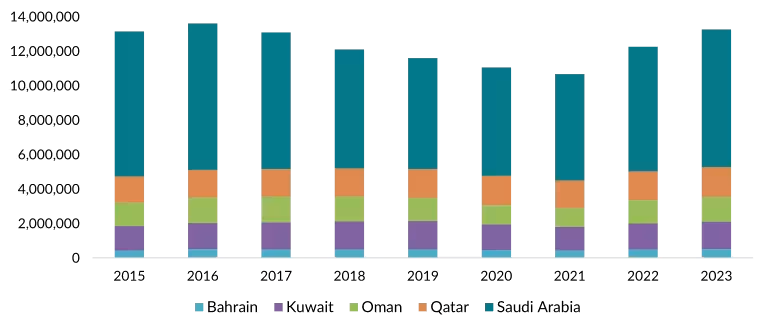
Note: Data disaggregated by nationality are not available for the United Arab Emirates.
Source: GLMM, “GCC: Employed Population and Percentage of Non-Naturals in Employed Population in GCC Countries (2015-2023) (Private Sector).”
Quotas capping the numbers of immigrants from a single country also aim to diversify the workforce and guarantee employers fresh supplies of cheaper laborers. These policies have helped stimulate the recruitment of workers from sub-Saharan Africa. They also intend to deflect allegations of rights abuses from well-established and large migrant communities, as well as sending countries.
Increasing Reforms to Improve Labor Supply, Productivity, and International Image
In the aftermath of the pandemic and subsequent economic downturn, workforce nationalization and other reform policies have notably accelerated. Governments have sought to stimulate sustained growth and foster a culture of entrepreneurship among nationals through top-down reforms that promote technological innovation and regional and international competition for ambitious infrastructure projects.
Reforms targeted the sponsorship system and its requirements for a “no-objection” certificate for a worker’s entry, exit, and job change, in order to enhance job mobility and flexibility, guarantee an available workforce, and boost the private sector’s productivity. Bahrain delegated monitoring of migration to a new public body, the Labor Market Regulation Authority, in 2009mandates for providing a no-objection certificate were removed in Bahrain and the United Arab Emirates. Qatar eventually followed suit with Law 21 of 2015 and Law 19 of 2020. These reforms apply to all workers in Qatar, including those in the domestic and agricultural sectors who are not covered by other labor laws in the region. Saudi Arabia’s Labor Market Initiative of 2021 provisioned free exit, re-entry, and final exit for migrant workers, and created a contractual relationship overseen by the government between employers and employees. The United Arab Emirates introduced a temporary visa for job seekers without requiring them to have a host or sponsor in the country.
Such measures occurred alongside changes in labor and domestic worker laws, such as generalization of wage protection systems, introduction of social security provisions, and mandatory health insurance schemes for local and foreign workers. Oman’s Social Protection Law of 2023 was one such manifestation of these changes that reshaped the national social protection system. Together, these types of policies signal increased compliance with international labor and workers’ rights regulations, amid global scrutiny over abuses around major international events (such as UAE Expo 2020, the 2022 FIFA World Cup in Qatar, and the 2034 World Cup in Saudi Arabia) which have damaged countries’ reputations. These measures also attempt to reduce the labor costs gap between national and foreign workers, to limit employers’ preference for the latter and encourage hiring of citizens.
Attracting Foreign Wealth and Talent
The upgrading and upskilling of the human capital inscribed in Gulf states’ development master plans entails a policy switch from importing large numbers of low-skilled, low-paid workers in labor-intensive activities to attracting smaller numbers of high-skilled foreign workers. However, GCC countries also need to find alternative income streams as they adjust to lower oil revenues, since resorting to taxation might harm citizens’ allegiance. This is why attracting and retaining increasing numbers of wealthy and highly skilled foreign nationals is now perceived by policymakers as an opportunity to increase foreign direct investment, research and development, and entrepreneurship. A very large number of mega projects have been planned to lure tourists, residents, and businesses to the region, the most famous of which is Saudi Arabia’s NEOM: an entirely new urban, tourist, leisure, and industrial complex in the northwest designed to feature a futuristic 170-kilometer-long (105-mile) city known as The Line.
Saudi Arabia and the United Arab Emirates—the emerging financial hubs of the Middle East—compete to offer high salaries and an expanding range of employment opportunities to attract highly skilled professionals to their buoyant labor markets, as well as investment opportunities to multinational businesses. Dubai, for example, has attracted record numbers of Russian businesspeople since 2022. Efforts to guarantee high standards of living and services are also part of this strategy to attract professionals and their families. The Saudi capital, Riyadh, is poised to be among the fastest-growing cities over the next ten years.
Long-Term Residency and Naturalization Schemes
To attract well-to-do immigrants, Gulf countries have also revised decades-old policies of sociopolitical closure and offered avenues for long-term residence and even naturalization to wealthy investors, individuals with unique skills and experiences, and others believed to contribute to knowledge and technology transfers.
For instance, long-term and permanent residency schemes were launched in Qatar and the United Arab Emirates in 2018. UAE Cabinet Resolution 56 of 2018 grants “golden visas” that are valid for five or ten years and renewed automatically to specific categories of applicants: investors, entrepreneurs, and “specialized talents” including researchers in certain fields, athletes, and certain “outstanding” students with promising scientific capabilities. Saudi Arabia in 2019 introduced the sponsor-free Premium Residency scheme, which offers permanent legal residence for 800,000 riyals (approximately U.S. $213,000) or a one-year renewable permit for 100,000 riyals (approximately U.S. $27,000). Since 2023, the kingdom’s Special Talent visa has been available to executives and professionals who specialize in health care, science, and research.
In 2019, Saudi Arabia announced naturalization schemes for distinguished scientists, innovators, and cultural professionals. Two years later, the United Arab Emirates approved amendments to its 1972 citizenship law allowing investors, professionals, “special talents,” and their families to acquire Emirati nationality under certain conditions, and also retain their original citizenship. One acquires Emirati citizenship after being nominated by rulers’ and crown princes’ courts, executive councils, and the cabinet.
Gulf States’ Socioeconomic Reforms: Where to?
Essential components of the sponsorship system remain in place in most GCC states, and several categories of low-wage employees (including domestic workers, those recruited in bulk, and agricultural workers) are little impacted by recent reforms. Labor agreements may include abusive clauses, such as the obligation to inform one’s employer before leaving Saudi Arabia and Qatar, or to complete a period of service before requesting a transfer to another employer. Indeed, sponsorship reform and labor flexibility measures mainly benefit the highly skilled. Therefore, it is doubtful that reforms will fully streamline the labor market so that immigrants can move seamlessly from one job to another. The impact of other factors such as artificial intelligence on job creation—and destruction—are little known so far.
Moreover, the goal of switching from large numbers of low-skilled and low-paid laborers to smaller numbers of high value-added foreign workers is only partially fulfilled. In Saudi Arabia, the largest Arab economy, the number of highly skilled foreign workers in the private sector increased by 48 percent from the start of 2022, following the COVID-19 crisis, to mid-2024; low-skilled employment only grew by 25 percent during the same period. However, the mega-projects policy necessitates large numbers of low- and middle-skilled workers, and the share of highly skilled has remained stable at around 16 percent of all foreign private sector employees (see Figure 3).
Figure 3. Foreign Workers in Saudi Arabia by Skill Level and Highly Skilled Share, by Quarter, 2021-24
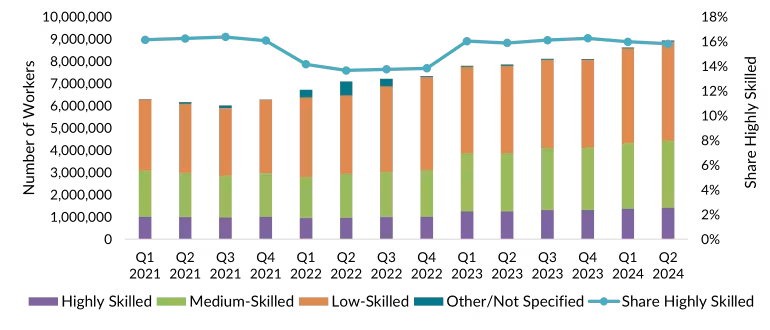
Notes: Figure is based on distribution of the employed population registered with the General Organization for Social Insurance (GOSI), by occupation category. Data for the second quarter of 2021 and the third quarter of 2022 are not available, so the figure shows an estimate by the author.
Source: GLMM, “Saudi Arabia: Non-Saudi Employed Population by Occupation Category (Q1 2021-Q2 2024),” updated October 5, 2024, available online.
Most Gulf states also remain dependent on oil revenues to finance their socioeconomic transitions. Even if the region is booming economically, lagging oil prices and subsequent economic deficits slow the pace of reforms and the transition to a post-oil future. Mega projects are being downsized, the most emblematic of which is Saudi Arabia’s The Line; the initial plan for 1.5 million residents by 2030 was reduced as of April 2024 to 300,000 inhabitants. Therefore, Gulf states are likely to continue attracting and retaining highly skilled foreign workers, as well as investors and other wealthy migrants who can tap into these new residents’ potential and expand the countries’ non-oil revenues.
Exceptional in the Gulf states, the increase of long-term stay and naturalization schemes could significantly overturn the standard generally forbidding settlement of non-nationals in Gulf countries and open opportunities for a kind of economic membership. Saudi Arabia and the United Arab Emirates in particular cite their cosmopolitanism, openness, and the coexistence of diverse communities, though this is partly a branding exercise and the region remains socially conservative. Nonetheless, these measures so far have affected only very specific types of immigrants, and may not fundamentally alter the two-tiered nature of Gulf societies. Rather, the demographic engineering at play in GCC countries and the tension created by the race to create growth may narrow the gap between nationals and in-demand highly skilled foreign workers, but widen inequalities with low- and middle-skilled workers.
Sources
Alshammari, Rawan Radwan Hebshi. 2020. Saudi Arabia’s Labor Reforms Seen as Big Boost for Private Sector. Arab News, November 5, 2020. Available online.
AlShehabi, Omar Hesham. 2019. Policing Labour in Empire: The Modern Origins of the Kafala Sponsorship System in the Gulf Arab States. British Journal of Middle Eastern Studies 48 (2): 291-310.
Beaugé, Gilbert. 1986. La kafala : un système de gestion transitoire de la main-d’œuvre et du capital dans les pays du Golfe. Revue européenne des Migrations internationales 2: 10-122. Available online.
Beaugrand, Claire. 2018. Stateless in the Gulf: Migration, Nationality and Society in Kuwait. London: I.B. Tauris.
Beblawi, Hazem. 1990. The Rentier State in the Arab World. In The Arab State, ed. Giacomo Luciani. London: Routledge.
De Bel-Air, Françoise. 2018. “Blocked” Youth: The Politics of Migration from South and East Mediterranean Countries Before and After the Arab Uprisings. The International Spectator 53 (2): 52-73.
Degif, Melaku. 2023. Repatriation of Ethiopian Migrants from Saudi Ends after 131,642 Citizens Returned Home. Fana Broadcasting Corporate, April 4, 2023. Available online.
Fargues, Philippe. 2011. Immigration without Inclusion: Non-Nationals in Nation-Building in the Gulf States. Asia and Pacific Migration Journal 20 (3-4): 273-92. Available online.
Fargues, Philippe and Françoise De Bel-Air. 2015. Migration to the Gulf States: The Political Economy of Exceptionalism. In Global Migration: Old Assumptions, New Dynamics, eds. Diego Acosta Arcarazo and Anja Wiesbrock. Santa Barbara, CA: ABC-Clio.
Forstenlechner, Ingo and Emilie Rutledge. 2010. Unemployment in the Gulf: Time to Update the “Social Contract.” Middle East Policy 17: 38-51.
---. 2011. The GCC’s “Demographic Imbalance”: Perceptions, Realities and Policy Options. Middle East Policy 18 (4): 25-43.
Government of Qatar. N.d. Qatar National Vision 2030. Accessed November 15, 2024. Available online.
Government of the Sultanate of Oman. N.d. Oman Vision 2040. Accessed November 14, 2024. Available online.
Gulf Research Center, Gulf Labour Markets, Migration, and Population Program (GLMM). N.d. Data and Documents. Accessed November 14, 2024. Available online.
Hertog, Steffen. 2018. Can We Saudize the Labor Market without Damaging the Private Sector? Riyadh: King Faisal Center for Research and Islamic Studies. Available online.
International Social Security Association (ISSA). 2024. Social Security Reforms in Arab Countries in the Middle East. October 29, 2024. Available online.
Kingdom of Saudi Arabia. N.d. Saudi Arabia Vision 2030. Accessed November 14, 2024. Available online.
Kuwait Ministry of Foreign Affairs. N.d. Kuwait Vision 2035. Accessed November 15, 2024. Available online.
Longva, Anh Nga. 1999. Keeping Migrant Workers in Check: The Kafala System in the Gulf. Middle East Report 211. Available online.
Lori, Noora. 2019. Offshore Citizens: Permanent Temporary Status in the Gulf. Cambridge, UK: Cambridge University Press.
Migrant Rights. 2023. Qatar’s Performance Reports on Labour Law Reforms Raises Concern of Regressing on Commitments. December 4, 2023. Available online.
Nair, Deepthi. 2024. Golden Visas: UAE 'Cancels Minimum Down Payment' for Property. The National, January 24, 2024. Available online.
Saudi Arabia Ministry of Human Resources and Social Development (MHRSD). 2024. Nitaqat Mutawar Program. May 17, 2024. Available online.
Saudi Arabia Premium Residency Center. N.d. Saudi Premium Residency. Accessed November 14, 2024. Available online.
Saudi Arabia Public Investment Fund (PIF). N.d. Giga Projects. Accessed November 15, 2024. Available online.
Thiollet, Helene. 2019. Immigrants, Markets, Brokers and States: The Politics of Illiberal Migration Governance in the Arab Gulf. International Migration Institute (IMI) working paper, November 2019, Amsterdam. Available online.
United Arab Emirates. N.d. Jobseeker Visit Visa. Accessed November 15, 2024. Available online.
---. N.d. We the UAE 2031. Accessed November 15, 2024. Available online.

Related Content