Climate Displacement Can Permanently Hamper Children’s Education and Imperil Future Prospects

A student at a school in Yemen attended by many displaced children. (Photo: IOM Yemen)
Highlights
Climate displacement is derailing education for millions of children worldwide, with lasting consequences for poverty and resilience.
- In 2021, just 1.5 percent of global climate finance went to education, and the climate-mobility-education nexus remains underdeveloped in major international frameworks.
- Children make up 40 percent of all forcibly displaced people globally, despite being 30 percent of the population. Of the 14.8 million school-age refugee children in 2022, 51 percent were out of school.
- From 2020 to 2023, climate shocks were blamed for around 13 million displacements of school-age children.
- Pakistan's 2022 floods disrupted schooling for 3.5 million children; research on a prior disaster found four weeks of school closures caused learning losses equivalent to 1.5 academic years without remedial intervention.
Around the world, climate disasters are increasingly intersecting with other crises and driving forcible displacement, especially of children. While children under age 18 comprise 30 percent of the world’s population, they make up 40 percent of all forcibly displaced people. For these children and their families, displacement compounds the negative effects of disasters and makes it harder for them to maintain healthy development and well-being, particularly in terms of education.
Extreme-weather events and other repercussions of climate change are causing and exacerbating pre-existing drivers of displacement, creating knock-on effects on education access and completion. There were around 13 million displacements of school-age children due to climate shocks in 27 vulnerable countries from 2020 to 2023, according to an Education Cannot Wait tally. On its own, climate change directly impacts educational attainment for vulnerable children by increasing the likelihood of disasters that destroy schools and other infrastructure or reducing family income and pushing children to start work at a younger age; ensuing forced displacement adds further complications.
Displaced children and youth face unique barriers to accessing and completing school. Many miss months or years of learning while engulfed in crisis and are therefore overage for their grade. Children displaced internationally may not have proficiency in the host-country language, lack documents that were lost or destroyed in displacement, struggle to secure reliable transportation, have concerns about their safety, face stigmatization, and struggle with destroyed infrastructure, among many other concerns. While not all displaced children cross an international border, internal displacement can lead to similar barriers. These effects indicate a clear climate-mobility-education nexus that is evident across climate-affected contexts.
While the full impact of children’s displacement and inability to attain an education is not fully understood, its effects can be seen today and pose potentially severe consequences for the future. In a climate-pessimistic scenario in which countries fail to cut greenhouse gas emissions, the World Bank projects that slow-onset climate disasters could drive internal displacement for as many as 216 million people by 2050. The World Bank refers to the education impacts of climate change as “an economic time bomb,” because disrupted education limits opportunities to move out of poverty, which tends to condemn people to worse health outcomes and reduce their ability to invest in protections against future climate risks, among other developments.
This article traces the connections between climate change, mobility, and the primary and secondary education of children. It illustrates how children displaced by environmental impacts are particularly likely to see their schooling halted, how education can aid mobility-linked adaptation strategies, and emerging global governance on the issue.
The Climate-Mobility-Education Nexus
No matter the exact cause of their forced movement, youth who are displaced see their educational prospects suffer. Of the 14.8 million school-age children who were refugees in 2022, 51 percent were out of school. While most disaster-related displacement is both short term and internal, the end of displacement by no means suggests a return to normalcy.
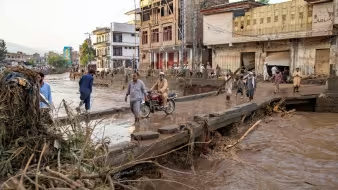
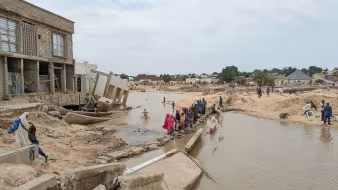
For instance, Pakistan was hit by devastating floods in 2022 that submerged about one-third of the country, displacing nearly 8 million people and disrupting the education of nearly 3.5 million children. Several months after the flooding started, more than 2 million children remained unable to reach their schools. In part this was because more than 7,000 schools were being used as shelters months later. The distance to access still-standing schools, education costs, and lack of learning supplies were the main obstacles for displaced children, community leaders told the International Organization for Migration (IOM) later. If not overcome, these kinds of barriers can solidify over time. After a previous disaster in Pakistan, an earthquake in 2005, evidence showed that only four weeks of school closures led to learning losses equivalent to 1.5 academic years, unless there had been targeted remedial education. Displacement-related disruptions can weaken or end a child’s formal education, with lifelong consequences.
One 13-year-old boy interviewed by Save the Children after being displaced by floods that submerged his village recounted his teacher turning him away from school three months later, because the building was not safe. Research shows that extended school closures lead to higher dropout rates. In fact, while 28 percent of affected Pakistani families one month after the floods said they believed their children would need to work instead of attend school, this number increased to 33 percent six months later. This example indicates how a climate disaster can lead to displacement, create obstacles to accessing education and derail education attainment entirely.
Other Types of Disasters Also Disrupt Schooling
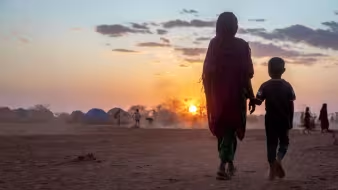
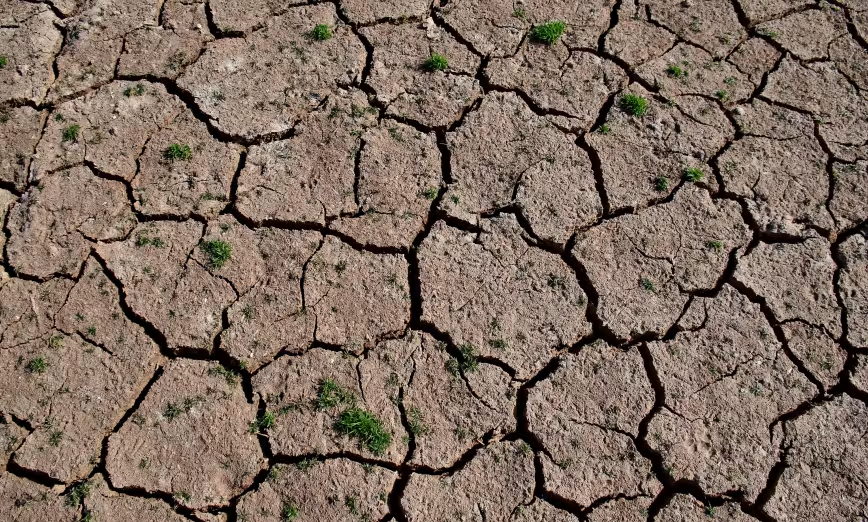
Slower-onset disasters can have similarly profound effects, especially when climate issues combine with other crises. For instance, an unprecedented drought in the Horn of Africa from 2020 to 2023 led to severe food insecurity and loss of livelihoods for pastoralists and others, spurring mass displacement on top of ongoing movement linked to regional conflict and instability. The drought caused concern that 3.6 million children might drop out of school due to climate displacement. More than 1 million people had been displaced in just the Somali region of Ethiopia due to drought as of late 2022 and early 2023. Meanwhile, 379 schools across the region were forced to close, leading approximately 81,600 students to drop out.
Elsewhere, Haiti has suffered hurricanes, extreme heat, and drought on top of political and socioeconomic risks linked to the government’s effective collapse, including food and economic insecurity, cholera epidemics, and gang violence. This situation has spurred migration typically towards urban centers, as well as internationally. In 2016, the Category 4 storm Hurricane Matthew displaced more than 175,000 Haitians. While many returned to their homes weeks later, others moved to less-damaged urban areas. However, Haiti’s urban centers can lack economic opportunities and access to education, among other necessities including food and water. Moreover, many internally displaced Haitians lacked legal documentation, according to the Internal Displacement Monitoring Centre (IDMC), which hampered children’s enrollment for school exams, among other effects.
While the situation in Haiti is particularly dire, it is an illustration of how even rural-urban climate-linked migration can hinder education access and thus attainment. Similarly, in Bangladesh, nearly 500,000 people move from rural to urban areas each year due to factors including natural disasters and environmental changes that destroy livelihoods and land. This migration tends to result in urban poverty; for children, this can mean poor living conditions, dropping out of school, repetition of grades, and child labor rates at three times the national average.
In many of these countries, rates of children not attending school are generally high, even in the absence of climate shocks. Yet these cases nonetheless highlight that when climate change-prompted mobility occurs, children’s education can be especially precarious.
Education Can Be an Adaptation Tool for Climate Mobility
While the impacts of climate change can exacerbate underlying reasons for mobility or cause it outright, education may also play a positive role in fostering climate resilience, by helping migrants adapt to their new environs and respond to the impacts of climate change on livelihoods.
For instance, in rural communities in Chiapas, Mexico, many young women have migrated to cities to access education, as agriculture-based livelihoods have been harmed by extreme storms and flooding. In this way, migration is not forced, but a voluntary decision to seek out education that can be a solution to environmental degradation.
Education can also be a preparatory measure for impending climate mobility, enabling people moving away from environmental challenges to do so with dignity and hope for a more comfortable future. For instance, World Bank President Ajay Banga noted during a 2024 visit to Tuvalu that young people would need training to help them move in response to climate change. Tuvalu, a low-lying, small island developing state that scientists predict will be partially inundated by rising sea levels by 2050, is one example of a country that has an almost guaranteed need for future climate migration. In 2023, the country struck a first-of-its-kind deal with Australia that allows up to 280 Tuvaluans to permanently move to Australia annually, offering a clear exit route in the event the island nation becomes uninhabitable. However, these migrant Tuvaluans could face challenges upon arrival if they do not have the skills necessary to succeed in Australia’s labor market. Seemingly partly for this reason, Australia as part of the diplomatic agreement increased development assistance for education and other sectors in Tuvalu. Thus, education can help fortify migration’s role as an adaptation mechanism amid climate change.
Recognition of this role is growing. Holistic approaches to climate migration such as Bangladesh’s embrace of climate-resilient, migrant-friendly towns and cities, which incorporate policies and planning that view climate migrants as assets in future economic and industrial growth, include focuses on education and upskilling to help new arrivals gain employment and mitigate possible challenges. In this way, Bangladeshi cities such as Mongla are seeking to create sustainable pathways for greater stability and migration management.
Existing Governance Landscape
In current international migration frameworks, education and climate change are often mentioned as priority areas. The Global Compact for Safe, Orderly, and Regular Migration, for instance, refers to education as a method to minimize the negative drivers of migration, increase the flexibility for regular migration, as well as a basic service, a form of children protection, and a vehicle for social inclusion. Climate change is mentioned in this document as a priority for addressing through the UN Sustainable Development Goals and as a migration driver requiring adept solutions including planned relocation and legal pathways. While the climate-mobility-education nexus is not explicit, the compact draws connections implicitly.
Still, questions about how climate-induced mobility specifically affects access to and continuity of education remain underdeveloped in policy terms. Education-focused interventions tend not to be integrated within climate mobility frameworks, particularly for displaced children and youth. Recognizing education as both a right and a resilience-building mechanism might help address these complex and overlapping challenges.
IOM’s ten-year Institutional Strategy on Migration, Environment, and Climate Change (2021-30) prioritizes policy, knowledge provision, operations, and convening. While the strategy emphasizes a comprehensive, rights-based approach to migration management, it does not explicitly address education for migrants within its core objectives. However, IOM commits to supporting the development of conditions that enable climate action, which can be linked to services such as education to enhance the resilience and well-being of migrants and their communities.
The 2023 Global Refugee Forum placed a significant focus on education as a way to advance refugees’ inclusion, self-reliance, and solutions. Climate change was identified as a compounding reason for global displacement and a critical area that governments and civil-society organizations pledged to address. While climate change’s direct role on mobility and thus on access to education was not mentioned, 18 of the 152 pledges made on education included references to climate change. This included pledges regarding climate resilience in education systems, education’s capacity to prepare for and mitigate the impacts of climate change, using climate data for decision-making for refugees, and funding for education in climate emergencies. These pledges showed a small but promising start to connecting climate change’s impact on migration with education.
Internationally, policies for climate-related displacement remain few, and include a smattering of bilateral treaties, updates to pre-existing policies to include climate considerations, free-movement protocols, protections against returns in the case of climate events, and more general humanitarian protection. However, education is not yet a well-developed component of these policies.
While policies and frameworks are just beginning to reference the climate-mobility-education nexus, future efforts are likely to be context-dependent. For instance, legal documentation for school enrollment may be less of a concern for internally displaced learners than for those displaced across international borders.
At the same time, insufficient data tracking of global climate mobility and its subsequent impacts on education are underlying challenges that affect the ability to understand the trends and adjust policy accordingly. Data gaps hinder targeted policy responses and risk making strategies reactive. Also, climate disasters often coincide with conflict and other crises spurring migration, making causality—and thus responses—difficult to deduce.
National and Community Responses on the Rise
At the grassroots level, some interventions are already tackling the intersecting issues. Drought-prone Samburu County in northern Kenya hosts a pastoralist community that frequently moves to find fresh water and pasture for livestock. Mobile schools were introduced in 2003 for pastoralist youth unable to attend traditional schools. While the solution was not made specifically for climate reasons, the curriculum’s inclusion of the nomadic community’s lifestyle was apt for responding to issues such as drought, which can force communities to migrate in new and changing patterns. However, these schools only go up to the fourth grade, and students remained affected by other drought-related impacts on their lives and education, such as losses to families’ wealth and livelihoods.
Separately, after Pakistan’s devastating floods, the government rolled out a National Distance Education Strategy (NDES) that leveraged distance-learning models to improve education and create an enabling environment. People harmed by the floods were not the only targets but were nonetheless included as the government sought to reach all marginalized learners. Each of Pakistan’s provinces and regions could implement the NDES as they saw fit, and the rollout included cross-sectoral collaboration to ensure solutions were well suited to Pakistanis’ needs at the time.
International funding for domestic and local climate-focused development and adaptation projects might be a means to bring these types of policies to other countries. However, climate financing targeting education or mobility has been limited. In 2021, just 1.5 percent of climate finance went to the education sector, and projects focusing on mobility tend to be new and small in scale. A dearth of financing in either sector poses a significant challenge to implementing solutions.
A Nexus Ignored at Great Peril
Climate change is exacerbating displacement, resulting in detrimental impacts on quality and attainment of education. This has knock-on effects on young migrants' lives and their ability to prepare for adulthood, negatively affecting their future livelihood prospects and overall well-being. With climate-induced mobility on the rise and several regions facing complex humanitarian crises, young learners are among the most vulnerable. On the other hand, education also emerges as a solution both pre- and post-climate mobility, widening this nexus and the solutions to climate-related challenges.
While the climate-mobility-education nexus is becoming increasingly evident, it remains under-researched and underfunded, limiting the creation and application of novel policies and interventions. Ultimately, addressing these issues has not just humanitarian implications but also affects long-term questions about future stability and prosperity in a climate-changed world. Ignoring this nexus—both the challenges of lost education and the promises of increased schooling—endangers displaced learners, perpetuates cycles of poverty, and misses an opportunity for proactive climate migration management.
Sources
ACAPS. 2023. Horn of Africa: Impact of Drought on Children. Geneva: ACAPS. Available online.
Ahmed, Nazneen, Gurchaten Sandhu, and Gady Saiovici. 2019. A Review of Social Safety-Net Programmes to Make Them More Responsive to the Needs of Child Labour in Bangladesh. Geneva: International Labor Organization (ILO). Available online.
Ayisi, John et al. 2019. Transformative Innovation Learning History: Nomadic Education in Kenya: A Case Study of Mobile Schools in Samburu County, as a Transformative Innovation Policy. Nairobi: Republic of Kenya Ministry of Education and National Commission for Science, Technology, and Innovation. Available online.
Chavez Villegas, Cirenia et al. 2023. Unlocking Potential: The Right to Education and Opportunity. Geneva: UN High Commissioner for Refugees (UNHCR). Available online.
Dahlin, Lauren and Juan D. Barón. 2023. Children and Their Families Six Months After Pakistan’s Floods. Washington, DC: World Bank. Available online.
Davies, Lizzy. 2022. Horn of Africa Drought Puts 3.6M Children at Risk of Dropping Out of School. The Guardian, September 22, 2022. Available online.
Education Cannot Wait. 2022. Increasing Number of Children Pushed Out of Education in Ethiopia Due to Severe Drought, Conflict and Forced Displacement. Press release, December 7, 2022. Available online.
Geneva Global Hub for Education in Emergencies. 2025. Education for All Children and Youth, Including in Climate-Vulnerable and Crisis-Affected Countries, in the Fund for Responding to Loss and Damage: A Critical Pathway to Resilience and Recovery. Geneva: Geneva Global Hub for Education in Emergencies. Available online.
Global Compact on Refugees. N.d. Multi-Stakeholder Pledge: Securing Sustainable Futures - Towards a Shared Responsibility to Uphold the Right to Education and Include Refugee Children in National Education Systems. Accessed April 9, 2025. Available online.
Global Refugee Forum Education Co-Sponsorship Alliance. 2019. Global Framework for Refugee Education. Geneva: UNHCR. Available online.
Government of Pakistan, Finance Division. N.d. Pakistan Floods 2022 Impact Assessment. Islamabad: Government of Pakistan, Finance Division. Available online.
Huang, Lawrence. 2023. Climate Migration 101: An Explainer. Migration Information Source, November 16, 2023. Available online.
Internal Displacement Monitoring Centre (IDMC). 2016. 2016 Global Report on Internal Displacement. Geneva: IDMC. Available online.
---. 2021. Global Report on Internal Displacement 2021. Geneva: IDMC. Available online.
International Organization for Migration (IOM), Displacement Tracking Matrix (DTM). 2023. Pakistan – Flood Response Community Needs Identification (CNI) Report Round 2 (Jan - Mar 2023). Geneva: IOM DTM. Available online.
Ionesco, Dina, Daria Mokhnacheva, and François Gemenne. 2016. The Atlas of Environmental Migration. Milton Park, UK: Routledge.
Ionesco, Dina, Mariam Traore Chazalnoël, and Ileana Sinziana Puscas. 2018. Mapping Human Mobility (Migration, Displacement and Planned Relocation) and Climate Change in International Processes, Policies and Legal Frameworks. Geneva: IOM. Available online.
Jungehülsing, Jenny. 2010. Women Who Go, Women Who Stay: Reactions to Climate Change—A Case Study on Migration and Gender in Chiapas. Mexico City: Heinrich Böll Stiftung. Available online.
Mazari, Haani, Sana Isa, Sam Wilson, Saqib Farooq, and Amal Hayat. 2023. Connecting EdTech Investment with Education Needs: Lessons from Pakistan’s National Distance Education Strategy. EdTech Hub blog post, September 27, 2023. Available online.
Mosello, Beatrice and Nina Schmelzer. 2023. Roots for Peace: Uncovering Climate Security Challenges in Haiti and What to Do about Them. Adelphi policy brief, Berlin, August 2023. Available online.
Needham, Kirsty. 2024. Exclusive: World Bank President in Tuvalu Says Youth Skills Key to Climate Change Plan. Reuters, September 7, 2024. Available online.
Pasricha, Himani. 2024. Climate-Induced Migration and the Opportunities for Youth. IOM blog post, June 5, 2024. Available online.
Perry, Freya, Juan D. Barón, and Lauren Dahlin. 2023. How Are the Children of Pakistan’s 2022 Floods Faring? World Bank End Poverty in South Asia blog post, July 26, 2023. Available online.
Rahman, Feisal and Laura Kuhl. 2021. Putting Mongla on the Map: The Curious Case of a Coastal Secondary City’s Transformation. UN Research Institute for Social Development (UNRISD), April 22, 2021. Available online.
Rigaud, Kanta Kumari et al. 2018. Groundswell: Preparing for Internal Climate Migration. Washington, DC: World Bank. Available online.
Save the Children. 2024. Pakistan: New Climate Resilient School Opens Where More than 2 Million Children Still Lack Adequate Classrooms after 2022 Floods. Press release, November 19, 2024. Available online.
UN General Assembly. 2019. Resolution Adopted by the General Assembly on 19 December 2018. A/RES/73/195. Available online.
UN High Commissioner for Refugees (UNHCR). 2024. Advancing Inclusion, Self-Reliance, and Solutions through Education for Refugees: A Spotlight on Education at the GRF 2023. Geneva: UNHCR. Available online.
---. 2024. Figures at a Glance. Updated June 13, 2024. Available online.
UNICEF. 2022. Pakistan Floods: Education Snapshot - 30 September 2022. New York: UNICEF. Available online.
---. 2022. Schools for More than 2 Million Children in Pakistan Remain Inaccessible Due to Devastating Floods – UNICEF. Press release, November 3, 2022. Available online.
---. 2023. Devastating Floods in Pakistan. Updated August 25, 2023. Available online.
Valenza, Matteo. 2023. Futures at Risk: Climate-Induced Shocks and Their Toll on Education for Crisis-Affected Children—Background Study for the ECW Climate Appeal. New York: Education Cannot Wait. Available online.
Venegas Marin, Sergio, Lara Schwarz, and Shwetlena Sabarwal. 2024. The Impact of Climate Change on Education and What to Do about It. Washington, DC: World Bank. Available online.

Related Content