East Africa’s Economic Powerhouse and Refugee Haven, Kenya Struggles with Security Concerns

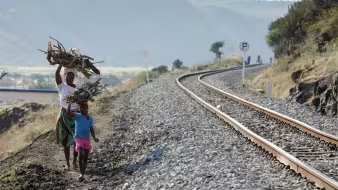
A pair of refugees in Kenya. (Photo: ©UNHCR/Charity Nzomo)
Highlights
Kenya is East Africa's largest economy and one of its biggest refugee hosts, but security fears have increasingly shaped a restrictive, encampment-based approach to Somali refugees.
- Kenya hosts more than 770,000 refugees and its Dadaab complex once held approximately 460,000 people, making it the world's largest refugee facility.
- Al-Shabaab attacks have been deadly and accelerated the government's securitization of Somali refugees and its repeated threats to close Dadaab.
- Kenya received a record $4.2 billion in remittances via formal channels in 2023—more than half from North America.
- The 2021 Refugee Act grants East African refugees the right to work and move freely, but its provisions have yet to be fully implemented.
Since attaining independence from the United Kingdom in 1963, Kenya has enjoyed relative peace and stability compared to its neighbors. This has made it a prime destination for refugees and asylum seekers from countries, mainly in the Horn of Africa and the Great Lakes region, experiencing civil war and political instability. For several years, Kenya’s Dadaab camps were the world’s largest.
As East Africa’s largest economy, Kenya is also a magnet for economic migrants from across Africa and has sought to deepen its integration with the rest of the continent. The more than 1 million immigrants living in Kenya in 2020 comprised 2 percent of the overall population, according to the International Organization for Migration (IOM). Most immigrants were from Somalia (44 percent), Uganda (30 percent), and South Sudan (13 percent), with other origins including the Democratic Republic of the Congo, Tanzania, Ethiopia, and Burundi. Forty-seven percent of these migrants were registered refugees.
At the same time, 535,000 Kenyans have emigrated, with most preferring Western countries. The largest number of Kenyan emigrants (157,000) lived in the United States as of 2020, followed by the United Kingdom (139,000); more than 80,000 were distributed across Canada, Germany, and other Western counties. Additionally, more than 98,000 lived elsewhere in sub-Saharan Africa, primarily Uganda, Mozambique, and Tanzania.
Kenya’s status as a major destination for refugees and other migrants has prompted concerns about security, given the regional instability and terror attacks carried out since 2013 in Kenya by Somali militants. The government has in various ways used a security-focused posture to respond to the refugee population amid different periods of influx, and more than once has threatened to close the Dadaab camps. This country profile provides an overview of historical and current migration trends in Kenya, particularly involving refugees.
Migration Trends through History
In Kenya, migration and displacement issues can be viewed through three broad historical perspectives. Before colonialism, the area that is now Kenya was in the middle of trade routes (including of enslaved people). The colonial period included restrictions on Africans’ movements internally and notable episodes of student migration to the West. And the era since independence has seen policies shaped alternatingly by regional integration and instability.
Precolonial Period (pre-1880s)
Due to its location along the Indian Ocean, the region that is now Kenya attracted migrants from China, India, and the Middle East from as early as AD 830. The earliest visitors were Swahili and European traders and explorers. These missions culminated in the European exploration of the interior areas of the region in the 19th century.
While early migration patterns into East Africa are well documented, little has been published about outbound migration of Kenyans and other Africans to overseas destinations, apart from those forcefully abducted as enslaved people. The enslavement of locals and forced movement to the Arab Gulf and Persia accounted for major population displacements. The lack of scholarly attention to other forms of migration does not, however, imply there was a total absence of travel from the region to other continents since long before European colonization of Africa. Some accounts have, for example, pointed out the possibility of Somalis and other Africans engaging in trading activities across the Indian Ocean long before the colonial period.
There was also significant movement of communities within the region. The Somali people’s precolonial history was, for example, characterized by nine centuries of migrations that dispersed them throughout what is now Somalia, northeastern Kenya, and other regions in the Horn of Africa, until this movement was halted by colonialism at the turn of the 20th century. These migration processes often displaced earlier occupants who moved to uninhabited areas to escape marauding conquerors.
Colonial Period (1880s-1963)
In East Africa, as elsewhere on the continent, concerns about territory, sovereignty, and citizenship rapidly gained traction following the Berlin Treaty of 1885 that partitioned Africa between European colonial powers. Colonialism was characterized by restrictive policies on migration, including internally. For example, all Africans were required to apply for a permit to travel to Nairobi. Colonial administrators also sought to curtail the mobility of ethnic groups that were deemed problematic. An example is Somalis in northeastern Kenya, whose region was declared a Closed District in 1926 and a Special District in 1934. Marginality of this group was strikingly apparent when inhabitants were required to carry passes or seek approval to enter other districts in Kenya.
Africans coming to Nairobi during the colonial period were often considered temporary residents with “real” homes in rural areas. Rather than discourage migration, however, this policy appears to have intensified movement between rural and urban areas, since people working in cities often remained attached to their rural origins. Although African migrants associated Nairobi with an improved standard of living, their employment was largely precarious, so they remained attached to villages for security and as places where they eventually hoped to retire. This trend has largely remained in place more than 60 years after independence.
By the 1950s, Africans were actively organizing against unfavorable colonial policies, including those limiting movement and maintaining poor working conditions. One of the most visible fronts for this struggle was the labor movement that attracted support from unions in the United States. At the heart of this relationship between U.S. and Kenyan trade unionists, which began in 1952, was what historian and intellectual Paul Tiyambe Zeleza has called the “struggle against the twin yokes of colonial oppression and communist subversion.” This collaboration paved the way for hundreds of young Kenyans to study in the United States, in what has popularly been referred to as the “American airlifts” or the “Kennedy airlifts,” due to the role of then-Senator and later President John F. Kennedy. Tom Mboya, a charismatic trade unionist who went on to become one of Kenya’s founding fathers, started visiting the United States in the mid-1950s to fundraise and champion African causes. The high point of this collaboration was when around 800 young men and women from East Africa were flown to American colleges and universities between 1959 and 1963. Among the beneficiaries were future Nobel Peace Prize winner Wangari Maathai and Barack Obama, Sr., the future U.S. president’s father.
Postcolonial Period (since 1963)
Apart from the American “airlift” discussed above, post-independence emigration of Kenyans was also shaped by Cold War politics that generated rifts between the new political elite who supported Western ideologies and those seeking closer ties with the Eastern Bloc. Notably, the alignment of Kenya’s first vice president, Jaramogi Odinga, with the East seemingly enabled hundreds of young Kenyans to travel to Russia, East Germany, and other socialist countries from 1959 to 1970 under the so-called Aeroflot scholarship program. This move was particularly fueled by the Eastern Bloc’s desire to compete with the West in offering scholarships to Kenyan students. The most notable among this cohort was Kenya’s current opposition leader and former prime minister, Raila Odinga, (who is also the son of the former vice president), who studied in East Germany in the 1960s. The number of Kenyans who traveled to the Eastern Bloc for these educational opportunities is unknown. The Western-leaning colonial and postcolonial governments refused to sanction travel for some students who wanted to take up these scholarships, forcing many potential beneficiaries to sneak into Soviet-aligned African countries—most notably Egypt and Sudan—before traveling to the Soviet Union and elsewhere.
The country’s first president, Jomo Kenyatta, who governed until his death in 1978, steered the country sharply towards the West, which enabled thousands of Kenyans to migrate to Western countries—a trend that is still evident today. Conversely, the significance of the Aeroflot scholarship initiative was consciously undermined in government circles, which contributed to downplaying the episode as a part of the country’s history. More significantly, the failure of the communist ideology to gain traction in Kenyan politics has historically resulted in comparatively reduced Kenyan migration to the former Soviet bloc. This failure was epitomized by the struggles of Kenyans who studied in communist countries to land jobs upon returning to Kenya—unlike their Western-educated counterparts who were sometimes offered employment in Kenya before they had even graduated.
That Russia’s influence in Kenya remains nominal—not in spite of the increasing alignment of other sub-Saharan African countries to the erstwhile power, but because of it—can also be discerned by recent political posturing that has seen Kenya tie itself closer to the United States. Apart from Kenya’s first president, all its subsequent presidents (Daniel Moi, Mwai Kibaki, Uhuru Kenyatta, and William Ruto) made state visits to the United States, in 1980, 2003, 2015, and 2024, respectively. These visits almost always coincided with significant political developments that portrayed Kenya as an important U.S. geopolitical ally. The hottest political issues during Moi’s visit were the civil war in Uganda, the independence struggle in Zimbabwe, the Iran-U.S. hostage crisis, and the Soviet Union’s invasion of Afghanistan that saw Nairobi side with Washington in boycotting the Olympics in Moscow that year. Kibaki’s state visit was significant in the context of how the terrorist attacks of September 11, 2001 echoed the 1998 bombing of the U.S. embassy in Nairobi by al Qaeda-linked militants and President George W. Bush’s drive to garner support for wars in Afghanistan and Iraq. Ruto’s recent visit is also widely viewed through this geopolitical lens, given the United States’ lobbying to isolate Russia over the war in Ukraine amid Russia’s diplomatic inroads in sub-Saharan Africa.
Kenya’s post-independence migration policies were largely shaped by pan-African and pro-business ideas, which have combined to make the country an attractive destination for tourists, investors, asylum seekers, and economic migrants. Soon after independence, the country in 1967 partnered with Tanzania and Uganda to form the East African Community, which sought to create a regional bloc with a common market, transport, communication corporations, and the East African Development Bank. The bloc temporarily broke up in 1977 due to political and economic differences, but Kenya was at the forefront of reviving it in 2000 and expanding membership to other neighboring countries, increasing the number of people able to move within the region. As of this writing, the East African Community includes Burundi, the Democratic Republic of the Congo, Rwanda, Somalia, and South Sudan (see Figure 1). Member State citizens can travel without a visa within the bloc and benefit from governments’ coordinated migration management. However, these measures have yet to benefit refugees residing in Kenyan camps, especially Somalis who continue to experience severe restrictions on their movements under the encampment policy.
Figure 1. Map of East African Community, 2024
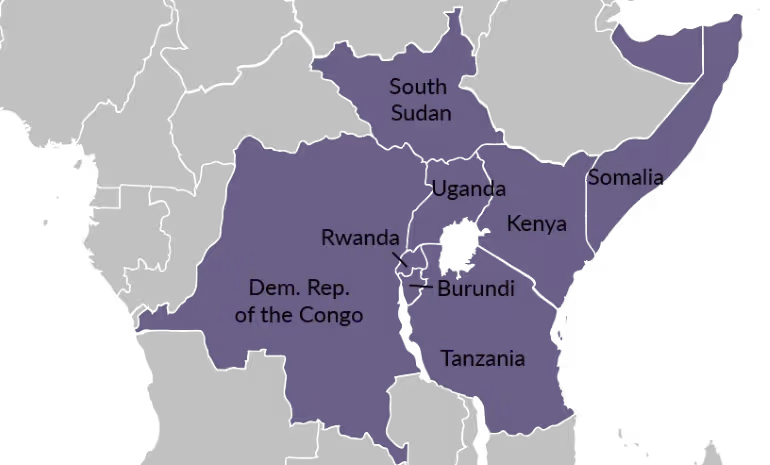
Source: MPI artist’s rendering.
Although the East African Community is based in Arusha, Tanzania, Kenya is the region’s largest economy and is often considered its most prominent member. It hosts the headquarters of the UN Environment Program, UN-Habitat, and a number of regional bodies, all of which have brought a substantial number of immigrants from the West and elsewhere. The country’s position as a popular tourist destination and regional economic hub was bolstered in early 2024 by the enactment of the Electronic Travel Authorization, a visa-free regime that aims to ease travel and attract more tourists from around the world.
Meanwhile, the legacy of emigration has manifested in increasing amounts of remittances sent back by Kenyans abroad and others with ties to the country. A record U.S. $4.2 billion was remitted via formal channels in 2023, more than half of it from North America (see Figure 2).
Figure 2. Remittances to Kenya, by Origin, 2007-24*

* Data for 2024 are through April.
Source: Central Bank of Kenya, Diaspora Remittances, accessed June 1, 2024, available online.
Increased migration has also posed challenges for the country. Back-and-forth movements across the Kenya-Somalia border have, for example, also enabled the entry of unregulated and untaxed goods and capital. This has fueled a so-called bandit economy, as goods and capital from piracy have harmed agricultural industries and real estate prices in Nairobi. More significant is how this migration has increasingly been linked to insecurity. For example, there have been periods of kidnappings by suspected Al-Shabaab militants from Somalia, especially of Western tourists and humanitarian workers, along Kenya’s coast and the Dadaab refugee camp areas near the border. Kenya’s decision to invade Somalia in 2011 was influenced by how these incidents were negatively impacting the country’s tourist-dependent economy.
Major Refugee Inflows
Scholars distinguish between two radically different eras when it comes to postcolonial policies on granting asylum to refugees and other migrants in Africa: the pre-1990 period and the more recent era.
The pre-1990 era coincided with what has been labelled as the “golden age of asylum” in Africa. This period was characterized by generous policies that allowed refugees to work, move freely, and integrate locally. As early as the 1960s, for example, the Kenyan government was welcoming refugees from other African countries who were deemed to be “freedom fighters” against colonialism. In the 1970s and 1980s, Kenya received a large number of refugees from Uganda who were fleeing political upheaval during President Idi Amin’s brutal rule (1971-79). Amin oversaw the expulsion of tens of thousands of people of Asian and African descent, many of whom sought refuge in Kenya. President Milton Obote’s rule, which followed Amin’s, resulted in additional displacement of Ugandans into Kenya.
Yet there were no large-scale refugee camps in Kenya at this time. The government also demonstrated its duty to care for refugees by taking charge of refugee management and status determination for asylum seekers residing at the Thika Reception Center just outside Nairobi.
Figure 3. Refugees and Asylum Seekers in Kenya, 1970-2023*

* Data for 2023 are as of the middle of the year.
Source: UN High Commissioner for Refugees (UNHCR), Refugee Data Finder, updated October 24, 2023, available online.
That changed in the early 1990s, when massive refugee influxes from Ethiopia, Somalia, and Sudan prompted the government to adopt the policy of encampment. The government located refugee camps in remote, isolated, and insecure areas of the country, particularly in the northeast and northwest. These camps have grown substantially, such as during the 2006-08 period when Al-Shabaab’s insurgency against Somalia’s government forced tens of thousands of Somali refugees into Kenya. A later period of Somali refugee arrivals in 2011 and 2012 was occasioned by a catastrophic drought in the Horn of Africa. For a time, the Dadaab refugee complex, which was established in 1991, hosted approximately 460,000 people, making it the largest such facility in the world. Today, most of Kenya’s 770,000 refugees continue to live in camps; most refugees are from Somalia or South Sudan (see Figure 4).
Figure 4. Refugees in Kenya, by Country of Origin, 2024

Source: UNHCR, “Kenya: Registered Refugees and Asylum-Seekers as of 30 April 2024,” (fact sheet, UNHCR, Nairobi, May 2024), available online.
The government has from time to time threatened to close the camps, in a bid to emphasize that its preferred option is for refugees to voluntarily return to their origin countries, among other motivations. The government has also abdicated responsibility for determining refugee status, so the UN High Commissioner for Refugees (UNHCR) has taken a lead in reviewing arrivals and ensuring their basic needs are met.
Migration Policies and Politics
The Immigration Act of 1967 outlined the general framework for migration management in Kenya, but until recent decades key questions were not resolved in law. Kenya’s constitution was most recently redrafted in 2010. Until then, the constitution did not provide a framework for direct implementation of international laws, treaties, or conventions on refugees unless an act of Parliament was enacted. This often forced the government to adopt an ad hoc approach in dealing with the problem of forced migration.
In 2006, the Kenyan government enacted the long-overdue Refugee Bill, largely yielding to international pressure to put in place a law governing refugees’ stay . This law, since replaced, outlined processes for refugee status, allowed refugees to seek a work permit, required them to live in camps unless they had other authorization, and created government institutions for managing refugees.
The 2013 tripartite agreement on voluntary repatriation between UNHCR, Kenya, and the fragile Somali government in Mogadishu emphasized Kenya’s preference for repatriating Somali refugees, in line with its rhetoric about closing the camps. Somali refugees are often viewed through a political lens in Kenya, and are often accused in media and government circles of posing a security threat.
The 2021 Refugee Act, which replaced the 2006 law, provides refugees from the East African region more rights, including the right to work and move freely. This law was in line with the pledges Kenya made as a signatory to the Comprehensive Refugee Response Framework (CRRF) to include refugees in national public services in order to integrate them socially, culturally, and economically. As a way of actualizing this commitment, UNHCR and the Kenyan government partnered to create the Kalobeyei refugee settlement in Turkana County, bordering South Sudan, in 2015. As of this writing this settlement was inhabited by approximately 60,000 refugees, mostly from South Sudan, plus approximately 20,000 Kenyan nationals (the settlement is integrated so that refugees and locals share social services to promote social cohesion and integration).
Although the Kalobeyei settlement has created some level of local self-reliance, the government has yet to agree to implement a similar model at the Dadaab camps, which are predominantly inhabited by Somali refugees. This is due to security concerns associated with this refugee group, and the government’s repeated claims that the Dadaab camps have been used for planning terrorist attacks in Kenya. As such, it seems that the CRRF’s provisions are yet to be implemented in full.
The Link between Refugees and Insecurity
Kenya has a history of securitizing refugees and other migrants. As early as the 1960s, the government was making distinctions between what it termed genuine and “fake” refugees, arguing that genuine refugees were freedom fighters from countries still under colonialism, while others were from countries that were already independent. This latter category was viewed with suspicion.
More recently, commentators have pointed out that the government located the Dadaab camps in the remote semi-arid area of the country’s northeast, which allows it to isolate and monitor Somalis, whom it often blames for the proliferation of firearms. UNHCR has had to intercede several times to prevent the expulsion of refugees, despite Kenya being a signatory to international protocols such as the 1951 Refugee Convention.
In Kenya, as in many other countries that have experienced terrorist attacks, suspicion towards migrants increased markedly following the September 11, 2001 attacks in the United States. The Kenyan government blamed Somali refugees for the 1998 attack on the U.S. embassy in Nairobi and has recently accused Somalia-based Al-Shabaab militants of infiltrating refugee camps to carry out attacks that killed more than 250 people combined at the Westgate shopping mall in 2013, Garissa University in 2015, and DusitD2 Hotel in Nairobi in 2019.
The government’s concerns are not without merit. Cases of banditry, rape, kidnappings, bombings, murder, and intercommunal strife have been common throughout the existence of Kenya’s refugee camps. But rights groups have expressed concerns that the government has appeared too willing to sacrifice its commitment to protect refugees to placate security fears. These days, the Dadaab camps are heavily securitized with a heavy police presence. Kenyan Somalis have also faced discrimination in Kenya, including in certain neighborhoods of Nairobi.
Future Issues
Over the last several decades, security considerations have played a key role in changing Kenya’s refugee policies from an open-door strategy to one of containment and securitization. Despite the signing of the CRRF and the introduction of more progressive refugee laws that echo Kenya’s longstanding reputation as a friendly place for immigrants and refugees, the failure to fully implement these plans for some refugees—particularly Somalis in camps—demonstrates how geopolitical realities drive policy and the country’s relationship with various groups. Even as the global war on terror appears to have waned, security concerns will therefore likely keep on playing a significant role in Kenya’s refugee policymaking.
But much as refugee policies seem to be growing more restrictive, there are policies in place to encourage other categories of visitors to immigrate to Kenya, such as the visa liberalization scheme and efforts for greater East African integration. If these policies seem inconsistent in terms of deterring and encouraging movement of different categories of people, it is worth remembering that the forced migration experience is very different from the seductive postmodern celebration of money-induced hypermobility. Kenya is far from the only country interested in encouraging business-based immigration and tourism but skeptical of humanitarian immigration. The fact that these tensions have existed throughout the country’s history make them all the more salient.
Sources
Agwanda, Billy. 2022. Securitization and Forced Migration in Kenya: A Policy Transition from Integration to Encampment. Population and Development Review 48 (3): 723-43. Available online.
Campbell, Elizabeth H. 2006. Economic Globalization from Below: Transnational Refugee Trade Networks in Nairobi. In Cities in Contemporary Africa, eds. M.J. Murray and G.A. Myers. New York: Palgrave.
Central Bank of Kenya. N.d. Diaspora Remittances. Accessed June 1, 2024. Available online.
Chittick, H. N. 1977. The East Coast, Madagascar, and the Indian Ocean. In The Cambridge History of Africa, Volume 3, eds. John Donnelly Fage and Roland Oliver. Cambridge, UK: Cambridge University Press.
Eken, Sena. 1979. Breakup of the East Africa Community: Problems of Regional Integration. International Monetary Fund 16 (4): 36-40.
Ikanda, Fred Nyongesa. 2008. Deteriorating Conditions of Hosting Refugees: A Case Study of the Dadaab Complex in Kenya. African Study Monographs 29 (1): 29-49. Available online.
---. 2014. Kinship, Hospitality and Humanitarianism: “Locals” and “Refugees” in Northeastern Kenya. Dissertation submitted in partial fulfillment of a degree for Doctor of Philosophy, University of Cambridge, Cambridge, UK.
---. 2022. Somali Kinship and Bureaucratic Governance at a Refugee Camp in Kenya. In Everyday State and Democracy in Africa, ed. Wale Adebanwi. Athens, OH: Ohio University Press.
International Organization for Migration (IOM). 2020. International Migration Snapshot (2016-2020). N.p.: IOM. Available online.
Lewis, Ioan M. 1965. The Modern History of Somaliland: From Nation to State. London: Weidenfeld and Nicolson.
Markakis, John. 1987. National and Class Conflict in the Horn of Africa. Cambridge, UK: Cambridge University Press.
Mutambo, Aggrey. 2024. What Happened during Moi and Kibaki’s State Visits to the US. Daily Nation, May 21, 2024. Available online.
Orwenyo, Jason Nyariki. 1974. The Soviet Union and Communism as Factors among Kenyan Intelligentsia in Kenya’s Internal Problems, 1957-1966. Dissertation submitted in partial fulfillment of a degree for Doctor of Philosophy, Georgetown University, Washington, DC. Available online.
Republic of Kenya. 2024. Kenya Gazette Supplement No. 1. January 2024. Available online.
Rutinwa, Bonaventure. 1999. The End to Asylum? The Changing Nature of Refugee Policies in Africa. New Issues in Refugee Research, UN High Commissioner for Refugees working paper No. 5, University of Dar es Salaam, Dar es Salaam. Available online.
Shachtman, Tom. 2009. Airlift to America: How Barack Obama, Sr., John F. Kennedy, Tom Mboya and 800 East African Students Changed Their World and Ours. New York: St. Martin’s Press.
UN High Commissioner for Refugees (UNHCR). 2024. Kenya: Registered Refugees and Asylum Seekers as of 30 April 2024. Fact sheet, UNHCR, Nairobi, May 2024. Available online.
Warigi, Gitau. 2013. Kenya Had to Move in and Stop Al-Shabaab’s “Bandit Economy.” Sunday Nation, October 12 ,2013. Available online.
World Bank. 2016. Migration and Remittances Factbook 2016. Washington, DC: World Bank. Available online.
Zeleza, Paul Tiyambe. 1987. Trade Union Imperialism: American Labour, the ICFTU and the Kenyan Labour Movement. Social and Economic Studies 36 (2): 145-70.