Morocco
Key Statistics
Data are 2024 UN data and may differ from national statistics agencies.
111000
Immigrant Population
0.3%
Immigrant Share of Total Population
3628000
Emigrant Population
All Content
Showing 1–10 of 37 results
Key Considerations for Future Temporary Protection and Regularization Programs in Latin America
Drawing on 11 country case studies, MPI finds that more than 24 temporary protection programs in Latin America have helped millions but often do not lead to permanent status.

Consideraciones clave para futuros programas de protección temporal y regularización en América Latina
Con base en 11 estudios de caso, el MPI concluye que más de 24 programas de protección temporal en América Latina han ayudado a millones, pero rara vez ofrecen vías hacia la permanencia.
Western Sahara’s Sahrawi Refugees Face an Uncertain Future after 50 Years of Exile
After 50 years in Algerian refugee camps with no political resolution in sight, Sahrawis are increasingly choosing diaspora life over an uncertain future in the Western Sahara.

Middle Eastern and North African Immigrants in the United States
U.S. immigrants from the Middle East and North Africa are among the most educated of any foreign-born group. Heavy reliance on humanitarian visas reflect the region's ongoing instability.

Competing for Talent: What Role Can Employment- and Skills-Based Mobility Projects Play?
Skills-based mobility projects face scale challenges. Better planning, private-sector buy-in, and longer timeframes are needed to match workers with jobs across borders.

Diverging Paths: The Impacts of COVID-19 on Migration in the Middle East and North Africa
COVID-19 sharpened divides in the MENA region: The mass departure of migrant workers allowed high-income Gulf states to pursue labor reforms, while North Africa and Lebanon faced compounding crises.
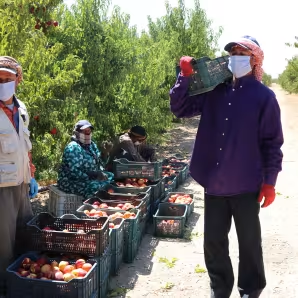
Tense Neighbors, Algeria and Morocco Have Divergent Migration Histories
Algeria and Morocco share a border and mutual desire to curb irregular migration, but their sharply divergent diaspora policies, EU ties, and bilateral rivalry keep cooperation out of reach.
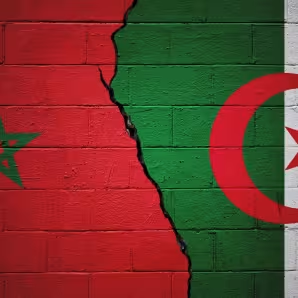
Who Represents the Country? A Short History of Foreign-Born Athletes in the World Cup
Foreign-born athletes have competed in every FIFA World Cup since 1930, reflecting how citizenship, migration, and national identity intersect in global sports.

The Challenge of Coordinating Border Management Assistance between Europe and the Maghreb
Europe-Maghreb border cooperation on migration yields limited results; diverging priorities, corruption, and structural gaps require more strategic approaches.

Middle Eastern and North African Immigrants in the United States
U.S. immigrants from the Middle East and North Africa tend to be highly educated but face high poverty rates and rely heavily on humanitarian and diversity visa pathways.