Title 42 Postmortem: U.S. Pandemic-Era Expulsions Policy Did Not Shut Down the Border

U.S. Border Patrol agents transporting migrants to the U.S.-Mexico border after the imposition of Title 42. (Photo: Jerry Glaser/CBP)
Highlights
Nearly 3 million migrant expulsions occurred under Title 42. Use of the authority to expel border arrivals, which bypassed U.S. asylum law, drove up recidivism and “gotaways.”
- Border encounters began rising less than two months after Title 42 took effect, and recidivism grew from 7 percent of Border Patrol encounters in fiscal year (FY) 2019 to 27 percent in FY 2021.
- With Title 42 short-circuiting the consequences imposed under formal removal, expelled migrants repeatedly attempted to cross; for Mexicans and northern Central Americans, recidivism reached 49 percent by May 2022.
- Gotaways peaked at nearly 73,500 in April 2023, the month before Title 42 ended; two months later the number had more than halved to 32,800.
Asylum seekers and other migrants arriving at U.S. borders without prior authorization to enter were expelled nearly 3 million times during the life of the Title 42 pandemic-era order, which was in effect from March 2020 until May 2023. The Trump administration’s activation of the once-obscure and rarely used health authority, which dates to 1944, marked an epochal period in U.S. immigration history, preventing vast numbers of people from seeking asylum.
One year after the use of Title 42 was ended and amid ongoing record encounters at the U.S.-Mexico border, some politicians are expressing nostalgia for the public-health authority. Former President Donald Trump, now the presumptive Republican presidential nominee, and his allies are arguing for the return of the policy, practically describing it as a magic wand that will restore order to the border. Even some congressional Democrats have pointed to the discontinuation of Title 42 as one reason for the current border morass.
Though COVID-19 is no longer a public-health emergency, indications from the Trump camp suggest that a second administration would re-invoke Title 42. Stephen Miller, a Trump senior advisor, told The New York Times a new order could be based on “severe strains of the flu, tuberculosis, scabies, other respiratory illnesses like RSV and so on, or just a general issue of mass migration being a public-health threat and conveying a variety of communicable diseases.”
Did Title 42 in fact lead to a better managed border?
The evidence indicates it was not the success its admirers contend in limiting irregular migration, and it may represent failed deterrence. During its use, the numbers of encounters surged and cases of migrants attempting unauthorized re-entry soared, as did the number of “gotaways”—the term used by U.S. Customs and Border Protection (CBP) for migrants who were not intercepted while crossing the border illegally. Because Title 42 short-circuited the careful series of consequences that CBP had put in place over earlier years, including criminal prosecution for illegal entry or re-entry, it created major churn at the border: Facing no formal consequences for their unauthorized entry, expelled migrants kept trying to cross until they succeeded.
There were exceptions to the Title 42 policy, such as when a federal judge exempted unaccompanied children from its application, which meant that some families split up before reaching the border to allow children to cross without adults. And by preventing migrants from even filing an asylum claim, Title 42 shifted the Overton window so that the right to seek asylum—a pillar of U.S. and international law—was no longer guaranteed in all cases. This precedent, set in motion by the Trump administration, likely informed President Joe Biden’s recent support for a now-abandoned bipartisan Senate bill that would have resumed expulsions once an average of 5,000 encounters occurred in a day.
Reimposition of Title 42 likely would do little to tackle the nature and scale of irregular migration to the U.S.-Mexico border today, given the fact that the size and increasing diversification of nationalities reaching the border have outpaced the U.S. government’s ability to process, detain, and remove vast numbers of border arrivals.
This article provides an overview of the scale, impact, and effectiveness of Title 42, ahead of the one-year anniversary of the order’s lifting in May 2023. While Title 42 was just one of many landmark and wide-ranging immigration restrictions imposed by the Trump administration, the public-health authority was both larger in scale and represented a more emblematic shift away from the United States’ historical openness to people seeking refuge. Continued into the Biden administration, which ultimately carried out more expulsions than the Trump administration, Title 42’s usage reframed the scope of border enforcement.
High-Profile but Questionable Results
While use of the World War II-era authority had been floated early in the Trump administration to limit the admission of border arrivals, Cabinet secretaries resisted invoking Title 42 due to lack of a public-health justification. The outbreak of COVID-19 changed that, though some officials still questioned the scientific basis for the restrictions. In March 2020, the federal Centers for Disease Control and Prevention (CDC) issued an order under Title 42 of the U.S. Code allowing for the quick expulsion of migrants because of “a serious danger of the introduction of COVID-19.”
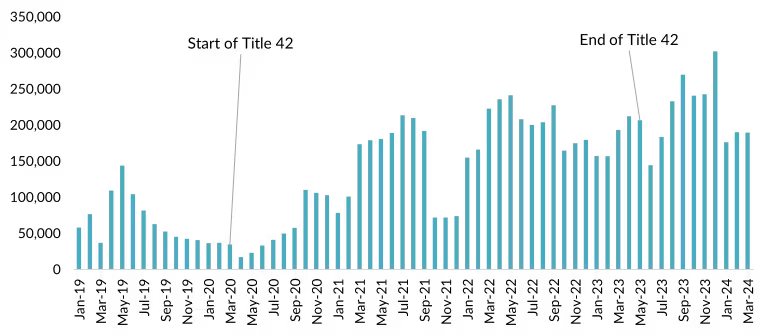
Under Title 42, migrants arriving at the border without authorization were subject to immediate expulsion, with limited humanitarian exceptions. Arrivals at the southwest border slowed in the early days of Title 42’s use, likely due to it acting as an early deterrent as well as general pandemic-related travel restrictions worldwide. However migrant encounters began increasing in May 2020, less than two months after the order’s imposition, and have remained high ever since (see Figure 1). If Title 42 was intended to deter unauthorized migration, it clearly did not succeed, even from early on.
Figure 1. Migrant Encounters at the U.S. Southwest Border, by Month, 2019-24
Sources: Migration Policy Institute (MPI) tabulation of data from U.S. Border Patrol, “Nationwide Encounters,” updated April 12, 2024, available online.
The scale of expulsions—which occurred overwhelmingly at the U.S.-Mexico border but also at the northern border—dwarfed other Trump administration measures such as the Migrant Protection Protocols (MPP, also known as Remain in Mexico), which required some asylum seekers to wait in Mexico while their case was processed in U.S. immigration court. Border officials expelled migrants more than 2,960,000 times under Title 42, compared to approximately 81,000 asylum seekers processed throughout MPP, in operation from 2019 to 2022.
It took CBP officials on average 15 minutes to process an encountered migrant under Title 42. Authorities usually did not screen migrants for protection claims, other than in exceptional cases. If they did not meet an exception, migrants were then expelled to Mexico at the closest port of entry, or their country of origin if possible. By contrast, it takes CBP agents anywhere from 30 minutes to a few hours to formally process an apprehension under Title 8, the traditional statutory authority used prior to the pandemic and since the lifting of Title 42.
Expulsions without Meaningful Enforcement
During the Title 42 era, expelled migrants often repeatedly tried to cross again. Unauthorized migrants formally processed under the standard Title 8 authority face a five-year bar on re-entry, with risk of prison time if they are apprehended again. But without these consequences under Title 42, migrants were effectively incentivized to repeat their attempts until they eventually succeeded in entering the United States. Recidivism, which is CBP’s term for the re-encounter within a year of a previously encountered migrant, surged under Title 42, rising from 7 percent of all encounters made by the Border Patrol in fiscal year (FY) 2019 to 27 percent in FY 2021. The recidivism rates were even higher for particular nationalities: for Mexicans and northern Central Americans, the rate surged from 20 percent in FY 2019 to 49 percent in May 2022. Border officials were processing some migrants multiple times.
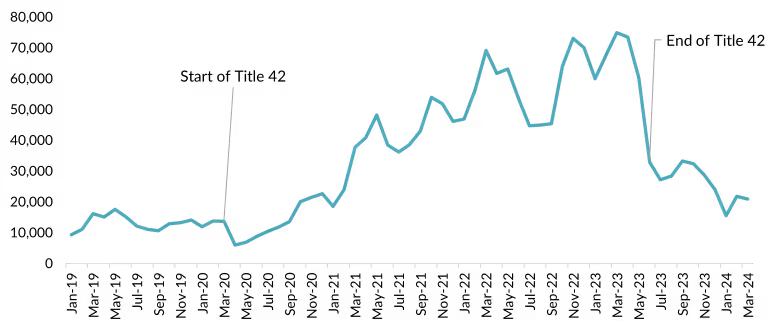
Beyond a hike in recidivism, the number of migrants crossing without being intercepted also soared. “Gotaways,” the term used by CBP for such migrants, increased dramatically during the Title 42 era and quickly declined after it ended. The month before the end of Title 42, in April 2023, there were nearly 73,500 gotaways, according to federal data obtained by the Cato Institute; two months later, the number had more than halved, to 32,800.
Figure 2. U.S. Border Patrol “Gotaways,” by Month, 2019-24
Source: David J. Bier, “Border Patrol: 70 Percent Drop in Successful Evasions Since Title 42 Ended,” Cato Institute blog post, March 4, 2024, available online.
Increasingly Limited Use of Title 42
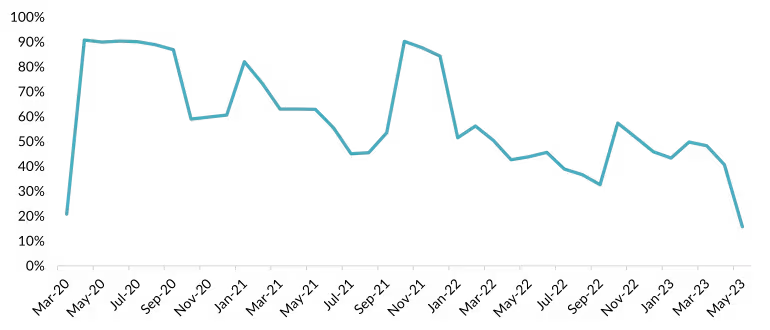
The use of Title 42 at the border was not uniform, and it diminished over time; just 41 percent of overall encounters while the order was in effect led to expulsions. This is largely because there were exceptions to the use of Title 42, including for unaccompanied children, and CBP officials used discretion to allow some migrants to enter the United States because of individual humanitarian concerns or other reasons.
The likelihood of expulsion depended on a migrant’s nationality and family profile. The policy was principally used to expel Mexicans and Central Americans, whom Mexico agreed to accept. Single adults from Mexico, El Salvador, Guatemala, and Honduras were expelled 89 percent of the time they were encountered, versus 8 percent of single adults from other countries. Logistical and diplomatic barriers prevent the United States from removing unauthorized migrants of certain nationalities—including China, Cuba, and Venezuela—which have posed a problem as more migrants from these and other nontraditional origin countries have been encountered crossing the border.
Unaccompanied children were excluded from expulsions starting in November 2020 due to a court order in P.J.E.S. v. Wolf. In 2021, Mexico began refusing to accept the return of families with children. As a result, CBP began processing children and families under Title 8, the standard immigration authority, releasing many into the United States to await deportation proceedings in immigration court. At ports of entry, CBP’s Office of Field Operations processed about 20,000 migrants per month under humanitarian exceptions to Title 42. CBP typically relied on nonprofit organizations along the U.S.-Mexico border to identify vulnerable migrants such as those with severe medical needs.
While migrants were not screened for asylum under Title 42, they could seek U.S. protection under the Convention Against Torture. Individuals invoking this protection had to affirmatively state a “reasonably believable” fear of torture if they were expelled. It is not clear how many migrants were screened or entered the United States on those grounds.
Declining Usage
When Title 42 began in March 2020, 7,200 migrants were processed under it, representing nearly 14 percent of the 52,000 encounters nationally that month. CBP averaged more than 75,900 expulsions per month over the course of the life of Title 42. Usage peaked in May 2021, when 57 percent of all encounters led to expulsions (113,800 out of a total of 198,500). The final full month that Title 42 was in place, April 2023, expulsions accounted for 32 percent of all encounters: 87,200 out of 276,000.
Figure 3. Share of U.S. Southwest Border Encounters Resulting in Title 42 Expulsions, by Month, 2020-23
Sources: MPI tabulation of data from U.S. Border Patrol, “Nationwide Encounters.”
Unintended Consequences
Title 42 also led to a form of family separation that was different from the widely criticized practice of detaining parents and children separately, as had occurred earlier in the Trump administration, but which yielded a similar result. After the November 2020 court ruling that authorities could no longer apply Title 42 to unaccompanied children, some parents separated themselves from their children, sending them unaccompanied across the border. In FY 2021, after the court order went into effect, the Border Patrol processed more than 12,200 unaccompanied minors who had previously been expelled under Title 42, according to data obtained by CBS News. In FY 2022, 153,000 unaccompanied children arrived at a U.S. border, the most in history.
A Stark Departure from Decades of Law on Asylum
Title 42’s blocking of access to asylum was a departure from decades of law and policy, as immigrant advocacy groups highlighted in lawsuits challenging the expulsions. In September 2021, a federal district court’s ruling in Huisha Huisha v. Mayorkas—later upheld by the U.S. Court of Appeals for the DC Circuit—prevented CBP from expelling families back to countries where they faced persecution or torture, citing the grave harm they could experience in their home countries and in Mexico due to factors such as cartel violence.
Against this backdrop, candidate Biden promised to end Title 42, among other Trump measures. However, upon taking office in January 2021, the Biden administration kept Title 42 in place, leading immigrant-rights advocates to allege that the Department of Homeland Security (DHS) was using the public-health policy as a border deterrent. In April 2022, the administration announced that it would end the use of Title 42, but legal challenges by some Republican-led states delayed those plans for more than a year. Following appeals that reached the Supreme Court, the administration on May 11, 2023 ended the public-health emergency that authorized Title 42, thus terminating the expulsions policy.
Post-Title 42: Still High Arrivals, but More Orderly
Leading up to the end of Title 42, many observers expected a surge of arrivals to the southwest border. In anticipation, Biden in January 2023 announced a post-Title 42 plan that involved a mix of disincentives and incentives to channel people away from irregular crossings and towards lawful entries. One year later, the new strategy has had mixed success.
To disincentivize illegal crossings, the Biden administration restricted access to asylum for migrants crossing without authorization and increased enforcement at the southwest border. DHS removed or returned 660,000 migrants between May 12, 2023 and April 3, 2024—the most since FY 2011, when there were more than 715,000 removals and returns. However, arrivals continue to outpace the government’s capacity; CBP recorded more than 2 million encounters at the southwest border from May 2023 to February 2024.
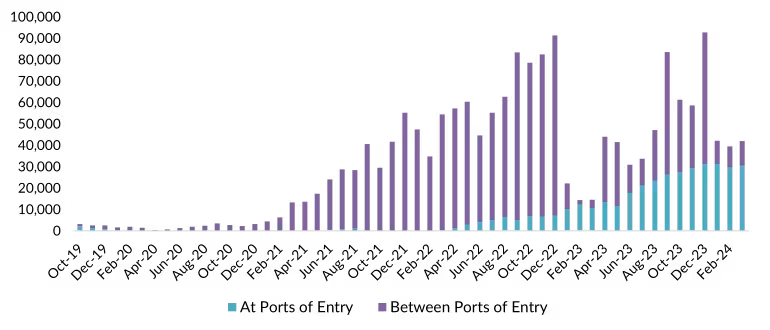
On the other hand, nearly 1 million arrivals have come through legal pathways, many of which are new. These pathways include expanded use of the CBP One app so migrants without prior authorization to enter can schedule appointments at a port of entry. Since Title 42 ended, migrants who schedule their arrival at a port of entry are allowed into the country and can apply for asylum. Through March, 547,000 individuals had scheduled CBP One appointments, the top nationalities being Venezuelan, Haitian, and Mexican. Combined with humanitarian parole programs for Cubans, Haitians, Nicaraguans, and Venezuelans, which began to roll out in October 2022, these policies have resulted in a decrease of arrivals without authorization of those nationalities. Through March, 404,000 Cubans, Haitians, Nicaraguans, and Venezuelans entered the United States via the humanitarian parole programs.
Figure 4. Border Arrivals of Cubans, Haitians, Nicaraguans, and Venezuelans, by Month and Place of Entry, 2019-24
Source: MPI tabulation of data from U.S. Border Patrol, “Nationwide Encounters.”
In addition to providing legal pathways through the country-specific parole programs, the Biden administration has also increased refugee resettlement from the Latin America and Caribbean region to record levels in part by working with the UN High Commissioner for Refugees (UNHCR) and the International Organization for Migration (IOM) to establish Safe Mobility Offices (SMOs) in Colombia, Costa Rica, Ecuador, and Guatemala. SMOs screen migrants and, if eligible, connect them to lawful pathways to migrate to the United States, Spain, or Canada. More than 8,500 refugees from the region were resettled in the United States during the first six months of FY 2024, more than any previous full fiscal year.
All the same, irregular migration to the U.S.-Mexico border has continued at a high level, causing ripple effects beyond the border, including unforeseen strains on major destination cities, especially New York, Chicago, and Denver, spurring calls from both Republicans and some Democrats to reimpose Title 42.
The combination of high numbers, vast diversification of nationalities, and family compositions of arrivals mean that even if the expulsions policy were reinstated, border arrivals would likely continue to overwhelm officials’ processing capacity. CBP is on track to record more than 1 million encounters of migrants arriving as “family units” (CBP’s term) in FY 2024—a group that both the Biden and Trump administrations were unable to expel either because of a court order or Mexico’s refusal to accept them.
While Title 42 offers a campaign-style slogan to shut down the border, the reality is that it never met that promise. And whatever outcomes it had came at the very sizeable cost of reneging on decades of U.S. commitments to guaranteeing humanitarian protection. The Biden administration is working closely with Mexico and other countries in the region on measures that seem to be stabilizing flows. Additionally, the administration is reportedly considering executive actions that could permit quick invocation of emergency authorities to halt asylum seeking between ports of entry should numbers rise in coming months.
Such efforts notwithstanding, current and future border control challenges are the result of global forces compelling heightened and different kinds of migration to the United States, combined with years of congressional inaction that have left the U.S. immigration enforcement and asylum systems with insufficient resources and outdated tools. Those challenges are here to stay, with or without Title 42.
Sources
Alvarez, Priscilla. 2020. Federal Judge Says US Can’t Turn Away Unaccompanied Migrant Children Using Public Health Law. CNN, November 18, 2020. Available online.
American Civil Liberties Union (ACLU). 2023. Huisha-Huisha v. Mayorkas. Updated May 10, 2023. Available online.
Barr, Luke and Quinn Owen. 2021. Mexico Stops Accepting Families Turned Away from the US/Mexico Border Due to Trump-Era COVID-19 Order. ABC News, February 4, 2021. Available online.
Bersin Alan, Nate Bruggeman, and Ben Rohrbaugh. 2024. Migration at the U.S.-Mexico Border: A Challenge Decades in the Making. Washington, DC: Migration Policy Institute (MPI). Available online.
Bier, David J. 2023. Ending Title 42 Halved Successful Covert Illegal Immigration. Cato Institute blog post, December 5, 2023. Available online.
---. 2023. Title 42 Failed. It Should Not Be Extended in Any Form. Cato Institute blog post, May 10, 2023. Available online.
---. 2024. Border Patrol: 70 Percent Drop in Successful Evasions Since Title 42 Ended. Cato Institute blog post, March 4, 2024. Available online.
Bolter, Jessica, Emma Israel, and Sarah Pierce. 2022. Four Years of Profound Change: Immigration Policy during the Trump Presidency. Washington, DC: MPI. Available online.
Bryant, Erica. 2022. Children Are Still Being Separated from Their Families at the Border. Vera Institute of Justice, June 23, 2022. Available online.
Chishti, Muzaffar and Jessica Bolter. 2022. Controversial U.S. Title 42 Expulsions Policy Is Coming to an End, Bringing New Border Challenges. Migration Information Source, March 31, 2022. Available online.
Chishti, Muzaffar and Kathleen Bush-Joseph. 2023. Federal Judges Step into the Void to Set U.S. Immigration Policy. Migration Information Source, March 30, 2023. Available online.
---. 2023. U.S. Border Asylum Policy Enters New Territory Post-Title 42. Migration Information Source, May 25, 2023. Available online.
Chishti, Muzaffar, Kathleen Bush-Joseph, and Colleen Putzel-Kavanaugh. 2024. Biden at the Three-Year Mark: The Most Active Immigration Presidency Yet Is Mired in Border Crisis Narrative. Migration Information Source, January 19, 2024. Available online.
Girten, Nicole. 2024. Gov. Gianforte Supports GOP Governors at the Border; Senators Divided on Federal Response. Daily Montanan, February 5, 2024. Available online.
Human Rights Watch. 2021. Q&A: US Title 42 Policy to Expel Migrants at the Border. April 8, 2021. Available online.
Liptak, Adam. 2023. Supreme Court Dismisses Case on Pandemic-Era Immigration Measure. The New York Times, May 18, 2023. Available online.
Mayorkas, Alejandro. 2024. Testimony of U.S. Secretary of Homeland Security before the Senate Appropriations Committee, Subcommittee on Homeland Security. 118th Cong., 2nd sess., April 10, 2024. Available online.
Montoya-Galvez, Camilo. 2022. 12,212 Migrant Children Reentered U.S. Border Custody Alone in 2021 After Being Expelled. CBS News, May 20, 2022. Available online.
Nancy Gimena Huisha-Huisha et al. v. Alejandro Mayorkas et al. 2021. No. 21-100(EGS). U.S. District Court for the District of Columbia, September 16, 2021. Available online.
Santamaria, Kelsey Y. 2022. COVID-Related Restrictions on Entry into the United States Under Title 42: Litigation and Legal Considerations. Washington, DC: Congressional Research Service (CRS). Available online.
Savage, Charlie, Maggie Haberman, and Jonathan Swan. 2023. Sweeping Raids, Giant Camps and Mass Deportations: Inside Trump’s 2025 Immigration Plans. The New York Times, November 11, 2023. Available online.
Singer, Audrey. 2021. U.S. Customs and Border Protection (CBP) COVID-19 Policies and Protocols at the Southwest Border. Washington, DC: CRS. Available online.
Transactional Records Access Clearinghouse (TRAC). 2022. MPP (Remain in Mexico) Deportation Proceedings—All Cases. Updated November 2022. Available online.
U.S. Centers for Disease Control and Prevention (CDC). 2022. Order Suspending Introduction of Certain Persons from Countries Where a Communicable Disease Exists. March 20, 2020. Available online.
U.S. Customs and Border Protection (CBP). 2024. CBP Enforcement Statistics. Updated April 17, 2024. Available online.
---. 2024. CBP Releases February 2024 Monthly Update. Press release, March 22, 2024. Available online.
---. 2024. CBP Releases March 2024 Monthly Update. Press release, April 12, 2024. Available online.
---. 2024. Nationwide Encounters. Updated April 12, 2024. Available online.
U.S. State Department, Bureau of Population, Refugees, and Migration. N.d. Refugee Processing Center – Admissions & Arrivals. Accessed April 10, 2024. Available online.
About the U.S. Immigration Policy Program
The U.S. Immigration Policy Program provides analysis of U.S. immigration pathways, the impacts of enforcement and other policies, and the characteristics of immigrant populations.


Related Content


