Comparing the Biden and Trump Deportation Records

Migrants in Texas being prepared for repatriation. (Photo: Jaime Rodriguez Sr./CBP)
Highlights
Despite an enforcement record that has surpassed that of the first Trump term, the Biden administration has relied heavily on border returns over interior removals.
- The Biden administration's nearly 4.4 million total repatriations through early 2024 exceeded any single presidential term since George W. Bush's second term.
- In the 12 months after Title 42 expulsions ended, the Biden administration removed or returned 775,000 unauthorized migrants and deported nationals to more than 170 countries.
- For the first time since fiscal year (FY) 2010, returns outnumbered interior removals in FY 2023, with 289,000 enforcement returns.
- The immigration court backlog stands at 3.7 million removal cases, while a bipartisan border bill that would have provided $19 billion for enforcement resources failed after former President Donald Trump opposed it.
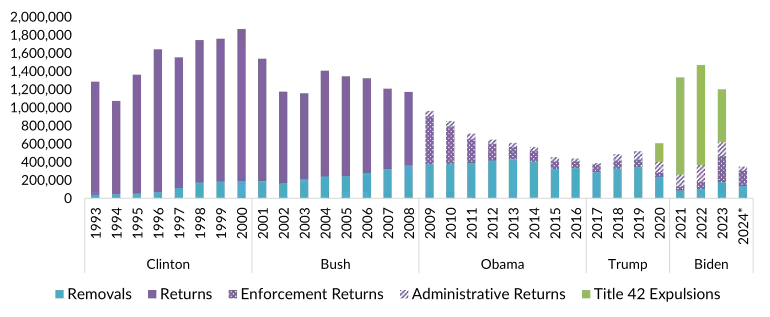
The Biden administration took office amid heightened debate in some circles over the merits and tactics of deportations, yet it is on track to carry out as many removals and returns as the Trump administration did. The 1.1 million deportations since the beginning of fiscal year (FY) 2021 through February 2024 (the most recent data available) are on pace to match the 1.5 million deportations carried out during the four years President Donald Trump was in office. These deportations are in addition to the 3 million expulsions of migrants crossing the border irregularly that occurred under the pandemic-era Title 42 order between March 2020 and May 2023—the vast majority of which occurred under the Biden administration. Combining deportations with expulsions and other actions to block migrants without permission to enter the United States, the Biden administration’s nearly 4.4 million repatriations are already more than any single presidential term since the George W. Bush administration (5 million in its second term).
In the 12 months after Title 42 ended, the Biden administration ramped up deportations under the standard U.S. immigration framework, Title 8, and removed or returned 775,000 unauthorized migrants—more than in any previous fiscal year since 2010. From May 2023 through March 2024, 316,000 migrants were processed via expedited removal, more than in any prior full fiscal year. And for the first time since FY 2010, in FY 2023 more migrants were returned directly across the border, mostly to Mexico, than were removed from the U.S. interior. Whereas President Barack Obama was labeled by some as the “deporter in chief,” this new trend may earn President Joe Biden the title of “returner in chief.” Notably, authorities have deported migrants to more than 170 countries during the current administration, which may be the most ever.
This enforcement record comes against the backdrop of an unprecedented scale and demographic shifts in migrant arrivals, as more are arriving as families and coming from all parts of the world. In FY 2023, more than half of U.S.-Mexico border encounters were of people from countries other than Mexico and northern Central America, up from just 3 percent in FY 2010 and 12 percent in FY 2020. For legal and logistical reasons, it is harder to deport families and nationals of far-flung countries than single adults from Mexico or northern Central America. And the sheer scale of arrivals is different. From FY 2021 through February 2024, authorities encountered unauthorized migrants about 9.4 million times, more than three times as many as under Trump (although many encounters were of migrants who had attempted to cross multiple times). Border officials must process people each time they are encountered, straining government resources. U.S. Immigration and Customs Enforcement (ICE), for example, has reported that its agents conducted fewer removals because they were deputized to process migrants at the U.S.-Mexico border after Title 42 took effect.
This article surveys the Biden administration’s deportations record. Although the number of interior removals has fallen sharply, immigration enforcement has shifted markedly to the border, carrying traces of a return to an earlier era. This transition is the result of a more narrowly targeted focus on removals from the U.S. interior and recent unauthorized arrivals at the border.
Box 1. Definition of Key Terms
Deportation: A non-legal term to describe immigration authorities’ removal or the enforcement return of a noncitizen from the United States.
Expulsion: The mandatory automatic departure out of the United States of a noncitizen arriving without authorization, carried out while the COVID-19-era Title 42 order was in place from March 2020 to May 2023. Unlike returns, expulsions did not allow migrants to request asylum or other humanitarian protection.
Removal: The mandatory departure of a noncitizen out of the United States based on a formal order of removal. Removals can happen from within the U.S. interior or at the border.
Repatriation: A term encompassing all departures by noncitizens from the United States, including removals, administrative and enforcement returns, and expulsions.
Return: The departure out of the United States of a noncitizen who has been granted voluntary departure or allowed to withdraw their application for admission at the border or at a lawful port of entry, such as an airport. Returns typically occur at a U.S. border. Returns can be either enforcement returns, such as of migrants crossing the border irregularly, or administrative returns, such as of migrants who withdraw their applications or foreign crewmembers lacking entry visas who are ordered to stay aboard their ships.
Efforts to Incentivize Legal Arrivals
The Biden administration has responded to record numbers of irregular border arrivals with a series of policies intended to encourage migrants to seek lawful pathways into the United States. It has allowed specific nationality groups such as Cubans, Haitians, Nicaraguans, and Venezuelans to enter under special humanitarian parole programs, which allow them a temporary right to stay and work in the United States. And it has sought to incentivize migrants seeking asylum to arrive at ports of entry after making an appointment through the CBP One app, and disincentivize them from arriving between ports of entry by severely restricting their access to asylum. It first did so through the Circumvention of Lawful Pathways federal rule issued in May 2023 in conjunction with the lifting of Title 42.
Still, the Department of Homeland Security (DHS) has not been able to keep up with the record pace of arrivals. In early June, Biden issued an emergency proclamation and rule barring most migrants arriving without authorization from applying for asylum, citing a lack of processing capacity. The regulation notes that from May 2023 to March 2024, 67 percent of unauthorized migrants encountered at the southwest border were released into the country to await their immigration court proceedings. This has helped contribute to an immigration court backlog that now stands at 3.7 million removal cases; it will be years before many migrants’ asylum claims can be adjudicated. The new policy is intended to limit the growth of this backlog and deter future irregular arrivals.
Figure 1. Repatriations of Unauthorized Migrants in the United States, by Type and Presidential Administration, FY 1993-2024*
* Fiscal year (FY) 2024 data are through February.
Notes: For FY 1993 through FY 2008, Department of Homeland Security (DHS) data did not distinguish between enforcement returns, which apply to irregularly arriving migrants, and administrative returns, which apply to migrants who withdraw their applications for admission and foreign crewmembers without visas ordered to stay aboard their ships, among others; for FY 2009 onward, enforcement returns and administrative returns are categorized separately. It is possible that administrative returns comprised only a small share of overall returns in the FY 1993-2007 period. Because enforcement data were not provided publicly by month for earlier administrations, the data here are organized by fiscal year rather than by actual month of each presidential administration, so that similar comparisons can be made across administrations.
Sources: U.S. Border Patrol, “Southwest Border Sectors: Total Encounters by Fiscal Year,” accessed June 24, 2024, available online; DHS, Office of Homeland Security Statistics (OHSS), “Immigration Enforcement and Legal Processes Monthly Tables — February 2024,” updated June 7, 2024, available online; DHS, OHSS, “Yearbook of Immigration Statistics,” updated May 3, 2024, available online.
Focus on Deporting Recent Arrivals and Other Targets
To deter migrants from arriving at the southwest border without authorization, the Biden administration has focused its deportation efforts on recent border arrivals. In September 2021, DHS released prosecutorial discretion guidelines instructing officials to prioritize removing migrants who pose threats to national security or public safety, or who are recent border crossers. Republican-led states challenged the guidance in court, but in June 2023, the Supreme Court upheld the guidelines, ruling that the executive branch “does not possess the resources necessary to arrest or remove” all removable noncitizens, and that five successive administrations had “determined that resource constraints necessitated prioritization in making immigration arrests.”
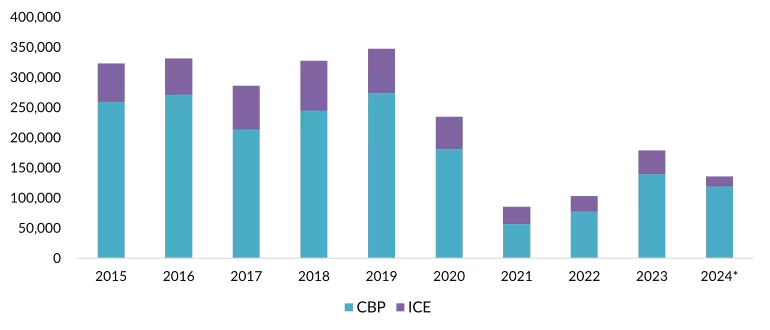
Under the guidelines, ICE has focused on removing from the interior noncitizens convicted or charged with crimes. However, since ICE has diverted agents to the southwest border, there have been fewer removals of individuals with criminal histories than during the previous administration.
Figure 2. U.S. Removals by Initial Arresting Agency, FY 2015-24*
* FY 2024 data are through February.
Notes: Figure shows removals and excludes administrative and enforcement returns. CBP is U.S. Customs and Border Protection, which enforces immigration laws at the border; ICE is U.S. Immigration and Customs Enforcement, which typically enforces immigration laws in the U.S. interior.
Source: DHS, OHSS, “Immigration Enforcement and Legal Processes Monthly Tables — February 2024.”
Returner in Chief
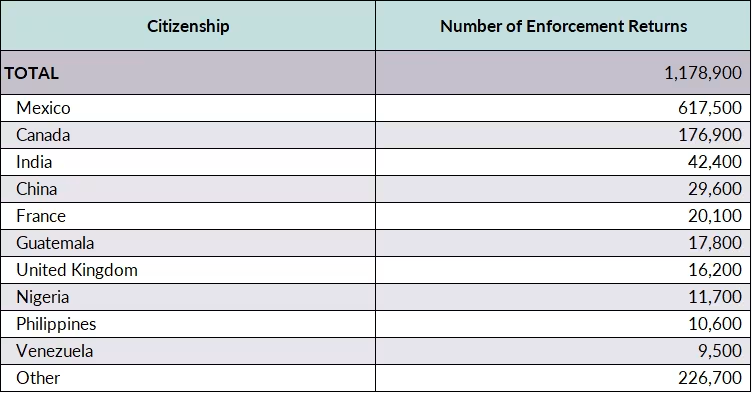
A defining trend of the Biden administration is that, for the first time since the early years of the Obama administration, most deportations have been returns, which require migrants to acknowledge they arrived in the United States unlawfully but allow them to voluntarily depart without receiving a formal removal order (see Box 1). Such returns are called enforcement returns. The 289,000 enforcement returns in FY 2023 were the most since FY 2010, when DHS carried out 410,000 returns of unauthorized migrants. Among those returned in FY 2023, 151,000 were Mexicans, dwarfing the second-highest returned nationality, Canadians (24,000). In 2023, the Biden administration also reached an agreement with Mexico to take back Cubans, Haitians, Nicaraguans, and Venezuelans whom for diplomatic and logistical reasons U.S. authorities had difficulty deporting, although data on these returns have not been released publicly. So far, approximately 591,000 of the 1.1 million deportations (54 percent) under the Biden administration have been enforcement returns.
Table 1. U.S. Enforcement Returns, by Citizenship, FY 2014-24*
* FY 2024 data are through February.
Note: Enforcement returns may occur at the southwest or northern land borders, a coastal border, or at airports.
Source: DHS, OHSS, “Immigration Enforcement and Legal Processes Monthly Tables — February 2024.”
Returns are easier and cheaper to carry out than removals from the U.S. interior. They do not require the issuance of a formal removal order and ICE agents do not need to locate and apprehend unauthorized immigrants in their homes, workplaces, or communities. Migrants are typically returned directly from custody along the border, although many returnees try to cross again, as was the case when DHS quickly expelled migrants under Title 42.
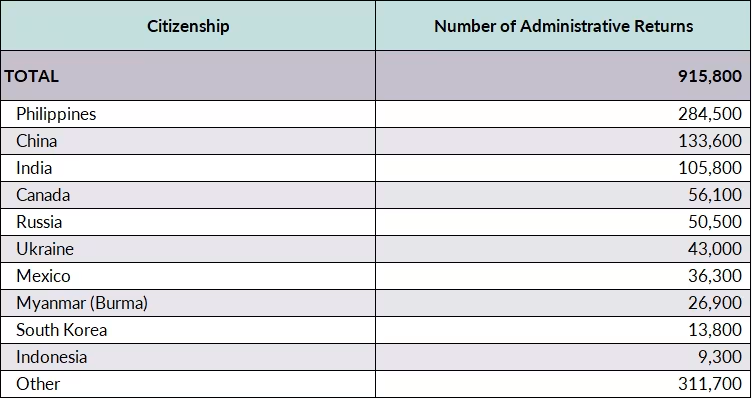
The Biden administration has also carried out the most administrative returns in at least 15 years—more than 505,000 from FY 2021 through February 2024. For comparison, nearly 685,000 migrants were administratively returned over the previous two administrations, from FY 2009 through FY 2020. Administrative returns differ from enforcement returns in that agents from the Office of Field Operations (OFO) within U.S. Customs and Border Protection (CBP) process cases when the migrant withdraws their application for admission and expedited removal or immigration court proceedings are not initiated. This can occur, for example, when ship crewmembers who lack visas attempt to disembark and are halted, or for some migrants who arrive at airports without authorization to enter. Migrants from the Philippines, China, India, Canada, and Russia make up the top nationalities administratively returned over the last decade (see Table 2).
Table 2. U.S. Administrative Returns, by Citizenship, FY 2014-24*
* FY 2024 data are through February.
Note: Administrative returns may occur at the southwest or northern land borders, a coastal border, or at airports.
Source: DHS, OHSS, “Immigration Enforcement and Legal Processes Monthly Tables — February 2024.”
The number of returns under the Biden administration marks a resumption of the approach taken by the Clinton and George W. Bush administrations, which amid high arrivals at the U.S.-Mexico border also returned far more migrants than were removed from the interior. During the Clinton administration’s two terms, 11.4 million of the total 12.3 million deportations (93 percent) were returns, although this number includes both enforcement and administrative returns. During Bush’s two terms, 8.3 million of the 10.3 million total deportations (81 percent) were returns (including enforcement and administrative returns). During both administrations, returns were predominantly to Mexico. In fact, until the Obama administration, most migrants apprehended at the southwest border were allowed to voluntarily return or withdraw their application for admission rather than face formal removal.
Diplomatic Breakthroughs and Resource Challenges Affect Removals
One way the Biden administration has carried out its deportations has been by negotiating with countries to accept their nationals who have been issued U.S. removal orders. Those negotiations facilitated deportations to more than 170 countries in FY 2023. U.S. government officials have also reached agreements with countries that previously refused to accept their deportees—known as recalcitrant countries or those at risk of noncompliance—such as China, Cuba, and Venezuela (although in some cases governments have resisted). Over the past year, ICE has averaged 29 repatriation flights per week. DHS said this month that the number of removal flights to certain countries has doubled or tripled, although it did not offer specific numbers.
While deportations to some countries continue to pose challenges, with many more migrants arriving without authorization than are removed, as is the case for Venezuelans, Nicaraguans, and Cubans, for example, the administration hopes to send a deterrence message to those intending to travel to the United States without authorization.
Table 3. U.S. Removals, by Citizenship, FY 2014-24*
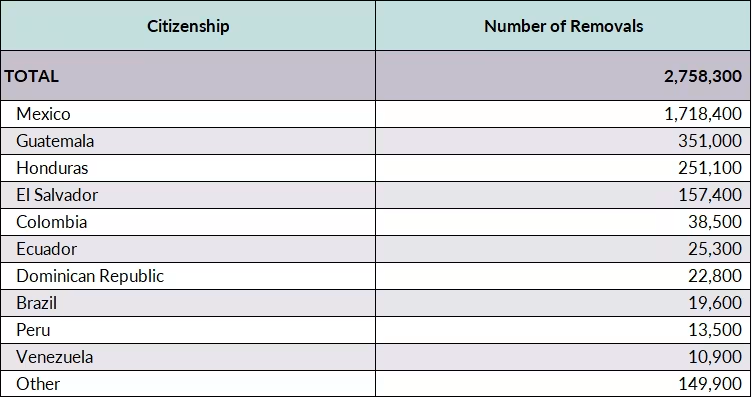
* FY 2024 data are through February.
Source: DHS, OHSS, “Immigration Enforcement and Legal Processes Monthly Tables — February 2024.”
Resource Challenges Continue to Limit Deportation Flights
Despite the diplomatic successes, DHS reports that a lack of resources has limited the number of deportations that it can carry out. Without enough agents to process migrants and asylum officers to screen them, officials end up releasing migrants who might have otherwise been quickly removed. This is because agencies’ budgets have not increased in tandem with the higher number of arrivals, nor are they sufficient for DHS to modernize its systems—agents still work with paper files that slow down processing, sometimes leading to the dismissal of cases scheduled at immigration courts.
To remedy that, a recent bipartisan border bill would have provided DHS with $19 billion for personnel, facilities, and repatriation resources, but these efforts failed after Trump, now the presumptive Republican presidential nominee, expressed disapproval at what seemed to be the prospect of losing a major campaign talking point.
The U.S. Government Accountability Office (GAO) has criticized ICE for underestimating its needs, pointing to repeated requests over the years for supplemental funds beyond its annual budgets. To increase efficiency, in 2023, DHS proposed creating a $4.7 billion Southwest Border Contingency Fund that would become available if irregular arrivals overwhelm capacity; Congress did not create the fund, but the administration has repeated the ask in its FY 2025 budget request.
Election’s Impact on Deportation Policies
Heading into the election in November, border security is a top concern for voters, with polls showing higher confidence in Republicans’ ability to manage the U.S.-Mexico border. Trump has also made the border a signature campaign issue, as he did in 2016.
In anticipation of the expected summer increase in border arrivals and under intense pressure to take tougher action on the border, on June 4 Biden issued a presidential proclamation and rule further restricting asylum. Triggered by a threshold number of arrivals at the southwest border, the measures restrict asylum access only to migrants who arrive at a port of entry with a scheduled appointment secured with the CBP One app. Migrants arriving between ports of entry will be ineligible for asylum, with limited exceptions. The Biden administration says the measures are necessary to better manage the border, as agencies cannot keep pace with record arrivals and asylum claims. As of March, more than 2.3 million asylum cases were pending at the immigration courts and U.S. Citizenship and Immigration Services (USCIS).
While in place, the proclamation and rule effectively cap asylum claims, as there are only about 1,450 CBP One appointments available per day. In the weeks following the announcement, authorities doubled the share of border removals, and the number of unauthorized border crossings fell to about 2,400 encounters per day, DHS said, the fewest since Biden took office in January 2021. However, migrants may be taking a wait-and-see approach to the new policy, and arrivals may surge again over the summer. Given increased Mexican enforcement, it is difficult to disentangle the role of the new rule in reducing arrivals. Federal courts in California and Washington, DC blocked a similar Trump administration effort, and rights groups have filed a lawsuit challenging the new rule. Even if the rule survives challenge, DHS maintains that without substantial new funding the operational situation at the U.S.-Mexico border will not improve. At worst, the administration predicts it will have to close facilities and cut staff positions at the immigration courts.
Trump’s stated plans have varied from a goal of 1 million deportations per year to deporting the entire unauthorized U.S. immigrant population. Trump surrogates, including many who served as senior officials in his administration, have described potentially reimposing Title 42, deploying the National Guard at the border and in the interior, and deputizing local law enforcement to round up unauthorized immigrants into camps.
Apart from the legal and constitutional concerns such policies would raise, they ignore the enormous operational challenges U.S. immigration agencies would face in attempting to carry out such plans. While Title 42 expulsions led to high total repatriation numbers, they did not reduce unauthorized immigration in a lasting way, and many migrants made repeated attempts to cross until they succeeded.
Importantly, implementation of Title 42 required Mexico’s cooperation, and the Biden administration’s subsequent reliance on returns there illustrates the country’s ongoing and critical role in the effectiveness of carrying out a ramped-up expulsion or deportation program. It is not clear what quid pro quo Mexico City would seek to continue cooperating with Washington, regardless of who wins the U.S. election. The same is true of other countries that have recently accepted flights carrying their deported nationals.
A second Biden term is likely to stick to its narrowed enforcement priorities in the U.S. interior and, at the border, rely on its combination of incentive-and-disincentive policies. Recent DHS guidance—which may receive increased focus in a second Biden administration—seeks to target enforcement on single adults of “easy-to-remove” nationalities—such as Mexicans and Central Americans, as well as Cubans, Haitians, Nicaraguans, and Venezuelans whom Mexico has agreed to take back. Using a combination of new expedited removal programs, DHS will likely also try to quickly process families from Mexico, Central America, and Colombia, holding some in custody along the border and screening others quickly in the interior.
In the few weeks since the government’s latest asylum-narrowing rule came out, deportations appear to be increasing. Whether this is sustainable will depend on resources available to DHS, the levels of irregular immigration ahead, and the outcome of the November election.
The authors thank Brandon Marrow for research assistance.
Sources
Ainsley, Julia. 2024. After a Week, Has Biden's Border Order Had an Effect? Migrant Numbers Are Down, but There Are Glitches. NBC News, June 12, 2024. Available online.
Bolter, Jessica, Emma Israel, and Sarah Pierce. 2022. Four Years of Profound Change: Immigration Policy during the Trump Presidency. Washington, DC: Migration Policy Institute (MPI). Available online.
Chishti, Muzaffar, Sarah Pierce, and Jessica Bolter. 2017. The Obama Record on Deportations: Deporter in Chief or Not? Migration Information Source, January 25, 2017. Available online.
Time Magazine Staff. 2024. Read the Full Transcripts of Donald Trump’s Interviews with TIME. Time magazine, April 30, 2024. Available online.
TRAC Immigration. 2024. Immigration Court Backlog. Updated May 2024. Available online.
U.S. Border Patrol. N.d. Southwest Border Sectors: Total Encounters by Fiscal Year. Accessed June 24, 2024. Available online.
U.S. Customs and Border Protection (CBP). 2024. CBP Releases May 2024 Monthly Update. Press release, June 20, 2024. Available online.
U.S. Department of Homeland Security (DHS). 2023. Fact Sheet: Update on DHS Planning for Southwest Border Security Measures as the Title 42 Public Health Order Ends. Press release, May 1, 2023. Available online.
---. 2024. Congressional Budget Justification Fiscal Year 2025. Washington, DC: DHS. Available online.
---. 2024. Fact Sheet: DHS Continues to Strengthen Border Security, Reduce Irregular Migration, and Mobilize International Partnerships. Press release, June 4, 2024. Available online.
---. 2024. Fact Sheet: President Biden’s Presidential Proclamation and Joint DHS-DOJ Interim Final Rule Cut Encounters at Southwest Border by Over 40 Percent in First Three Weeks. Press release, June 25, 2024. Available online.
U.S. Department of Homeland Security (DHS), Office of Homeland Security Statistics (OHSS). 2024. Immigration Enforcement and Legal Processes Monthly Tables — February 2024. Updated June 7, 2024. Available online.
---. 2024. Yearbook of Immigration Statistics 2022. Updated May 3, 2024. Available online.
U.S. Department of Homeland Security (DHS), U.S. Citizenship and Immigration Services (USCIS) and Department of Justice, Executive Office for Immigration Review (EOIR). 2024. Securing the Border. Federal Register 89 (111): 48710-48772. Available online.
U.S. Government Accountability Office (GAO). 2024. Financial Management: Additional Steps Needed to Improve ICE’s Budget Projections and Execution. Washington, DC: GAO. Available online.
U.S. Immigration and Customs Enforcement (ICE). 2023. ICE's FY 2023 Annual Report. Washington, DC: ICE. Available online.
U.S. Supreme Court. 2023. United States v. Texas. No. 22-58, June 23, 2023. Available online.
Wilson, Jill H. 2020. "Recalcitrant" Countries and the Use of Visa Sanctions to Encourage Cooperation with Alien Removals. Washington, DC: Congressional Research Service. Available online.
About the U.S. Immigration Policy Program
The U.S. Immigration Policy Program provides analysis of U.S. immigration pathways, the impacts of enforcement and other policies, and the characteristics of immigrant populations.


Related Content


