Vanishing Frontiers: The Forces Driving Mexico and the United States Together
Related Content
Highlights
Mexico's economic and cultural transformation has created deep, mutually beneficial interdependencies with the United States that no border wall can undo, this book by MPI’s president argues.
- Mexico's transformation over the past two decades—marked by rising education, a growing middle class, and an expanding technology sector centered in Guadalajara—has made it far more prosperous and innovative than most Americans recognize.
- Deep economic integration is co-producing goods and services across the border, with Mexican entrepreneurs playing central roles in U.S. industries.
- Cultural ties are equally deep: Mexican film directors, chefs, athletes, and entertainers have become central to American cultural life, making the border a seam rather than a barrier between two intertwined societies.
- Binational interdependencies have advanced far beyond what any wall or border policy can reverse, with San Diego and Tijuana even sharing a single international airport connected by a bridge built over the border fence.
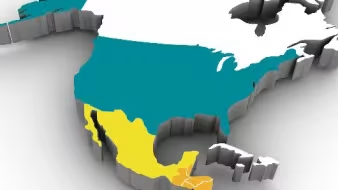
Wall or no wall, deeply intertwined social, economic, business, cultural, and personal relationships mean the U.S.-Mexico border is more like a seam than a barrier, weaving together two economies and cultures, as MPI President Andrew Selee sketches in his latest book.
Mexico faces huge crime and corruption problems, but its remarkable transformation over the past two decades has made it a more educated, prosperous, and innovative nation than most Americans realize. Through portraits of business leaders, immigrants, chefs, movie directors, police officers, sports executives, and others, Selee looks at this emerging Mexico, showing how it increasingly influences daily life in the United States in surprising ways—the jobs Americans do, the goods they consume, and even the new technology and entertainment they enjoy.
From the Mexican entrepreneur in Missouri who saved the U.S. nail industry, to the city leaders who were visionary enough to build a bridge over the border fence so the people of San Diego and Tijuana could share a single international airport, to the connections between innovators in Mexico’s emerging tech hub in Guadalajara and those in Silicon Valley, Mexicans and Americans together have been creating productive connections that blur the boundaries that once separated them from each other.
Table of Contents
Introduction
I. We Built a Bridge Across a Fence
II. North America Has Become a Shared Production Platform
III. Production Has Gone Up, Employment Has Gone Up, Investment Has Gone Up
IV. Creating Innovative Technology That Solves Real Problems
V. We Can't Talk About U.S. Energy Independence, But We Can Talk About Energy Independence in North America
VI. We've Got a Huge Problem Here
VII. Turning the Cosa Nostra into the Sopranos
VIII. If I Were to Go Back, I'd Still Be Homesick
IX. I Now Feel Welcome in This Country
X. A Tsunami of Mexican Talent
XI. We've Gone from Ethnic to Mainstream
XII. Vanishing Frontiers
About the U.S. Immigration Policy Program
The U.S. Immigration Policy Program provides analysis of U.S. immigration pathways, the impacts of enforcement and other policies, and the characteristics of immigrant populations.


Related Content