A Profile of Current DACA Recipients by Education, Industry, and Occupation

DACA holders are a largely middle-skilled, economically integrated population. Under the Trump DACA termination, they would lose work permits at an average pace of 915 per day starting March 2018.
With the rescission of the Deferred Action for Childhood Arrivals (DACA) program moving into full force in spring 2018, an average of 915 young unauthorized immigrants will lose their work authorization and protection from deportation each day beginning on March 6, 2018 through March 5, 2020, according to MPI estimates.
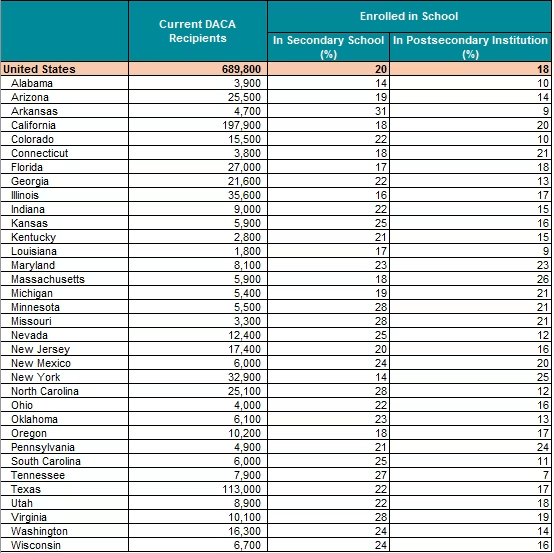
This fact sheet examines predicted DACA expirations, as well as offers estimates for the educational and workforce characteristics of the nearly 690,000 current DACA holders. Among the national and state-level estimates offered: school enrollment and educational attainment, labor force participation, and top industries and occupations of employment.
Among the top findings:
- While DACA recipients are almost as likely as U.S. adults in the same age group (15-32) to be enrolled in college (18 percent versus 20 percent), they are far less likely to have completed college (4 percent versus 18 percent).
- Forty-four percent of DACA holders have completed secondary education, but are not enrolled in college. Another 20 percent remain in secondary school.
- Female DACA recipients are more likely than men to be enrolled in college (20 percent versus 15 percent), but less likely to be working (48 percent versus 64 percent).
- Fifty-five percent of DACA recipients are employed, amounting to 382,000 workers. They account for 0.25 percent of all U.S. workers. Sixty-two percent of those not in the labor force are enrolled in school.
- DACA holders are much less likely than young unauthorized immigrants who are ineligible for deferred action to work in construction jobs and are more likely to work in office support jobs, showing that DACA can be a means to occupational mobility.
- While significant numbers of DACA recipients are employed in professional occupations, the most common industries of employment are hospitality, retail trade, construction, education, health and social services, and professional services.
The fact sheet uses a unique MPI methodology that permits the modeling of the size and characteristics of unauthorized immigrants in U.S. Census Bureau data. MPI previously released analysis of some of these characteristics for the DACA-eligible population. But data released for the first time by U.S. Citizenship and Immigration Service in September 2017 on the age, gender, origin country and state of residence of program participants have permitted updating of the methodology to better reflect the DACA-participating population.
Related Links
DACA Recipients by State
- For DACA holders’ educational enrollment and attainment, workforce participation, and industries and sectors of employment, click here
About the National Center on Immigrant Integration Policy
The Center is a national hub connecting policymakers, educators, community leaders, and service providers with evidence-informed policy research, technical assistance, and data to advance effective immigrant integration at U.S., state, and local levels.
About the U.S. Immigration Policy Program
The U.S. Immigration Policy Program provides analysis of U.S. immigration pathways, the impacts of enforcement and other policies, and the characteristics of immigrant populations.






Related Content