

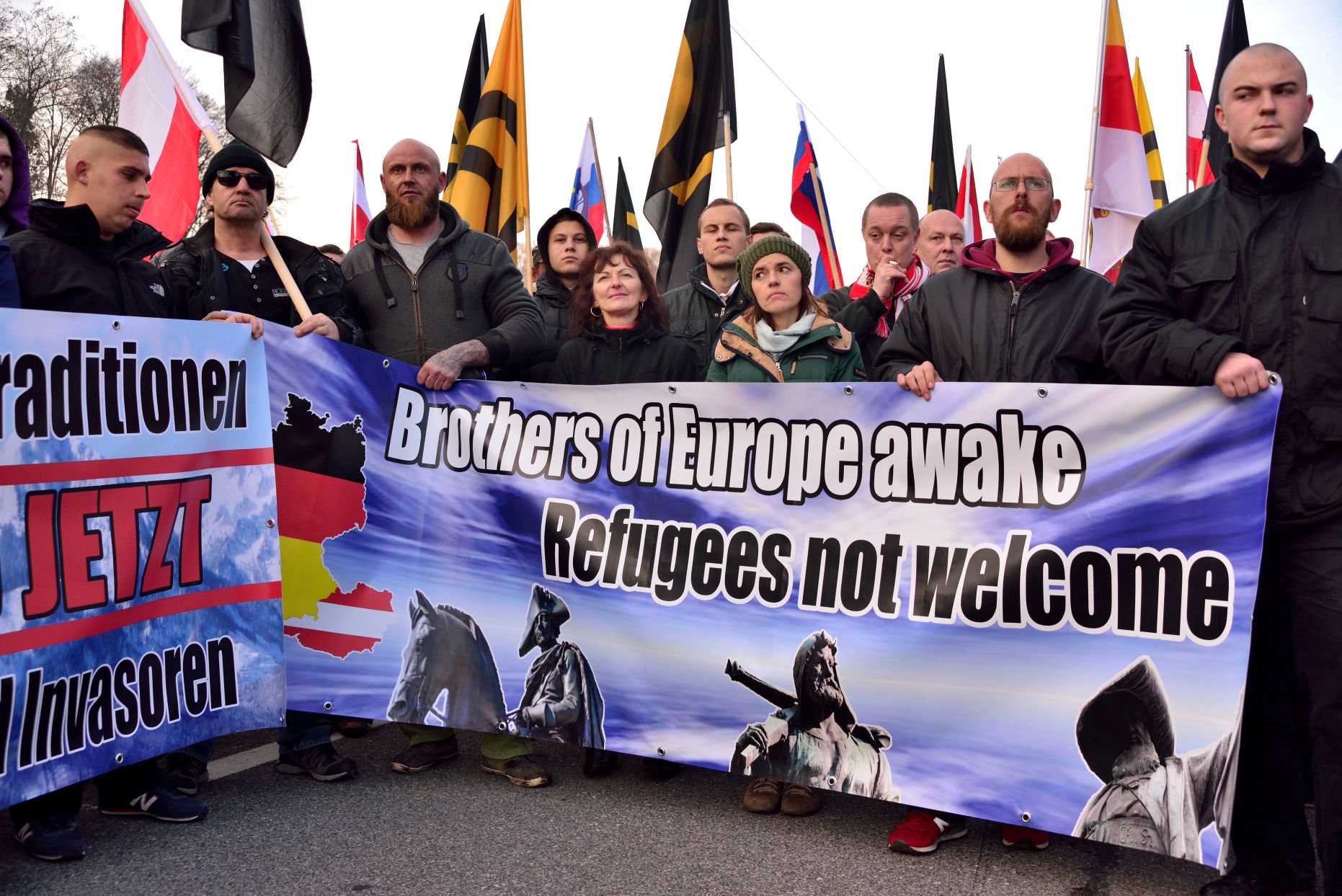
Anti-refugee activists in Austria. (Photo: Johanna Poetsch/iStock.com)
In recent years, violence linked to anti-immigration vigilantism has been on the rise. While especially pronounced in Europe, groups of individuals forming to conduct patrols, stage parades, and commit violence have been witnessed in parts of North America, Africa, Asia, and elsewhere.
Incidents of vigilantism in Europe rose during the 2015-16 migration and refugee crisis and now appear to be staging a strong comeback in several countries, ten years later. In the United Kingdom, the summer of 2024 saw a series of riots and demonstrations in front of hotels housing asylum seekers, following a violent attack, initially falsely attributed to an asylum seeker, in which three young British girls were killed and ten others injured. In Spain, the city of Torre-Pacheco saw several nights of rioting in July 2025, with far-right militants organizing mob attacks in response to the assault of an elderly person, allegedly by people of North African origin. That September, a demonstration against migration in The Hague, organized by the Dutch influencer Els Noort (better known as Els Rechts), descended into chaos, involving clashes with the police that left at least two officers injured. In Ireland, several riots targeting migrants have occurred in recent years following accusations of crimes committed by immigrants; in October 2025, a police van was set on fire as at least 1,000 people protested near a Dublin hotel housing asylum seekers, where a migrant had allegedly sexually assaulted a young girl.
In the United States, small armed groups have often patrolled the border with Mexico seeking to detain migrants arriving without authorization. Elsewhere, vigilantes have sought to prevent migrants from accessing health care and other services, and in some cases attacked them.
While these and other episodes have their own unique characteristics, they share similarities. Many vigilantes claim that government authorities have been negligent on controlling migration, thereby harming public safety, and engage in activities to spur authorities to action. While episodes of violence and protest may be the highest profile, most vigilante actions tend to be more mundane patrols along a border or through the streets. Yet these actions are often highly performative and meant to carry heavy symbolic weight.
This article provides an overview of the motivations and trends in vigilante movements targeting migrants—especially asylum seekers and other humanitarian migrants—and communities of minority backgrounds, particularly in Europe. For the purposes of this article, vigilantism is defined as activities of policing including surveillance, direct intervention against supposed offenders, and extrajudicial sanctions that are carried out by ordinary citizens without the supervision or authorization of local authorities.
What Exactly Is Anti-Migrant Vigilantism?
The sociologist Lesley Wood has shown that anti-migrant movements can manifest in two ways. The first is through traditional demonstrations, which are usually nonviolent and involve actions such as marches, making speeches, circulating petitions, and banner drops.
The second form is vigilantism, which is much more radical. Most often comprising small groups of men, these movements view all immigrant populations as crime- and violence-prone social groups who threaten the majority population. These vigilantes believe that if one migrant or child of immigrants commits an act of violence, the entire group is collectively responsible and deserves some form of punishment (the same standard, notably, does not hold for criminals of the majority population). They also believe that immigrants, as a population, must be disciplined, controlled, and punished.
To this extent, as the political scientists Jon Rosenbaum and Peter Sederberg theorized decades ago, anti-migrant vigilantism constitutes a form of social group control. Unlike most groups that organize to counter crime, vigilantism does not target individual perpetrators of crimes, but entire social groups whom it seeks to secure and discipline. Vigilantes organize themselves, typically into small groups, claiming to protect territories from the alleged abuses of migrant populations.
A Decade of Border Vigilantism in Europe
The summer of 2015 was marked by a significant influx of asylum seekers and economic migrants reaching European borders without prior authorization to enter, which policymakers, the media, and others presented as a crisis. This period offered a good illustration of the reach of anti-migrant vigilantism across Western countries.
No subregion of the continent was immune to anti-migrant vigilantism. The trend was shown to be very present in Central and Eastern Europe, particularly Russia, Bulgaria, Hungary, Slovakia, and the Czech Republic. The actions of groups in these countries, including paramilitary ones, ranged from relatively harmless street patrols to extrajudicial executions and bomb attacks targeting refugees and people of Roma ethnicity.
The phenomenon was also present in Southern Europe, including patrols by members of the neo-fascist Forza Nuova party in Italy. Members of Greece’s Golden Dawn, a militia-based former political party that was once among the country’s most popular, also committed acts of violence; some activists were convicted of assaulting and killing migrants and political opponents.
Episodes of vigilantism also occurred in Western Europe, notably in Calais, France, where vigilantes patrolled the edges of a now-defunct migrant encampment known as “The Jungle,” claiming to “protect the residents.” In the United Kingdom, Britain First activists organized “Christian patrols” in neighborhoods populated by Muslim immigrants. The phenomenon seemed particularly developed in Germany, where numerous groups have been active and large-scale demonstrations have been held, particularly in the eastern city of Chemnitz. Germany has also seen arson attacks and extrajudicial executions by vigilantes, including the June 2019 killing of center-right politician Walter Lübcke; a far-right activist was convicted of the murder, which has been described as the first right-wing extremist political killing in Germany since the Nazi era.
Scandinavia, meanwhile, witnessed the development of Soldiers of Odin, a Finnish group partly stemming from the biker community, which has had chapters in at least 21 countries.
Despite their diversity of geography and character, these groups present similarities. First, they have roots in the far right, even if they are not all linked to a specific political formation. In general, their membership is relatively small, involving a few dozen to a few hundred members. Perhaps surprisingly, the core of their activity is not directing or even threatening violence against migrants or minorities, but rather patrolling and surveillance. Their actions seem to be largely performative: Asserting a vigilant presence through patrols is intended to reach and mobilize a likeminded audience opposed to immigration.
However, violence against migrants and minorities remains present on the periphery of these groups’ activities. This is the case in places such as Germany, Greece, Hungary, and Russia, where vigilantes have engaged in beatings, arson, and executions. Vigilantes have sought to take advantage of declining confidence in government and the existence of a strong public anti-migrant sentiment. One of the keys to the sustainability of these groups is their ability to find a favorable audience—including at least a certain tolerance by local authorities. When authorities do decide to crack down on these groups, as has occurred in Russia since 2014 and in Greece after the 2013 murder of the antifascist rapper Pavlos Fyssas, the vigilante groups’ actions are durably hampered or even nullified. This underscores the importance of the state's attitude towards these groups in their continued operations.
Vigilantism in the United States and Elsewhere
Europe is not alone in this trend. Anti-migrant vigilantism has returned in the United States. This iteration has primarily developed along the U.S.-Mexico border, as evidenced by the Minuteman Project launched in 2005. These militias tend to comprise middle-aged men, frequently military veterans. Through their involvement in patrols along the border, these militias furthered communitarian life experienced in combat during members’ time in the military and put pressure on U.S. immigration authorities to increase their numbers and expand their operations. Although other major factors were certainly also at work, these demands were partially met by an increase in U.S. Border Patrol personnel under President George W. Bush and, above all, during the two terms of President Donald Trump, including his administration’s expansion of the border wall and, more recently, the very sizeable ramping up of immigration enforcement operations within the U.S interior.
Vigilantism in the United States is also part of a process of authorities involving citizens in the surveillance of suspected unauthorized immigrants. For instance, in 2006, the Texas government established a Virtual Border Watch Patrol that allowed individuals to log on to a website to monitor cameras placed at strategic points along the border and report any unauthorized crossings to the authorities. (The program has since been discontinued.) And recently, the Department of Homeland Security (DHS) established a call-in line for individuals to report “all foreign invaders.”
The sociologist James Walsh has described these developments, which engage the entire population in the creation of security policies, as the emergence of a society of “watchful citizens.”
Finally, it should be noted that migration vigilantism is not limited to Europe and North America. Cases of vigilantism against Venezuelan migrants were observed on the Brazilian border in 2018, among other occasions. Recent cases in South Africa occurred as part of Operation Dudula, a social movement that has become a political party. In India, the targets of vigilantism are often broader than solely immigrants, including the entire Muslim minority and people of Bangladeshi descent.
Understanding Anti-Migrant Vigilantism
Some research on vigilantism considers it to be a form of social movement. While some activities aim to provide immediate responses to perceived security issues, vigilantes’ main objective is to influence policy by changing the way societies perceive migration. Thomas Schmidt-Lux, a political scientist, has explained that there are several types of vigilantism. The first is “vigilantism instead of the state,” which occurs when vigilantes believe that the security forces are unable to perform their duties and individuals must step in as a replacement. The second is “vigilantism better than the state,” which criticizes the way in which the state carries out its duties and seeks to change standards. The third is “vigilantism beyond the state,” which establishes a system of standards, rules, and values that contradict those of the state.
As a general rule, most anti-migrant vigilantism falls into the second category, in which the vigilante groups call for drastic and restrictive changes to migration policies. This makes it particularly important to understand them as a social movement. Their worldview and demands are often presented in a progressive manner, from claims echoing mainstream media narratives to extremely radical propositions. The groups begin with a framing on immigration that is relatively less controversial. Most claim not to be against immigration in general, but oppose irregular migration for security reasons. They argue that irregular migrants are unverified and their numbers include dangerous individuals such as criminals, sex offenders, and terrorists. Based on this framing, anti-migrant vigilantes tend to attribute responsibility for individual criminal acts—sometimes horrific ones such as rape, murder, or terrorism—to the entire immigrant population, portraying it as prone to crime and dangerous to society.
This leads to a broader narrative that portrays unauthorized and humanitarian immigrants as an existential threat to the host society. For example, some activists whom the author has interviewed have portrayed asylum seekers as an “army of men of fighting age,” suggesting that they are a type of invading force. Some see migration as part of a plan—or even a conspiracy—hatched by globalized elites to destroy Western populations demographically and culturally. They claim that their populations are doomed to extinction because of demographics and the supposed violence of immigrant populations, thus echoing prophecies of civil war.
Anti-migrant vigilante groups operate in this context. One important activity is patrolling to secure borders and areas where migrants are located. Some groups, such as Génération Identitaire in France (banned in 2021) and the Defend Europe campaign, carry out these actions purely for symbolic reasons, producing spectacular images for public consumption. Others, such as anti-migrant groups in Bulgaria and Greece, go further by tracking down and apprehending migrants arriving at the border. These movements target not only asylum seekers, but also nongovernmental organizations (NGOs) and refugee support efforts, which are denounced with almost equal virulence.
This activity occurs alongside more traditional social movement practices, such as demonstrations, petitions, sit-ins, and banner drops. This means that these are both vigilante groups and conservative social movements. Social media also plays an important role: These groups prioritize video production. They film patrols and their interactions with opponents, who are often subsequently condemned online by the groups’ supporters. In this sense, their vigilantism should primarily be understood as performative; its purpose is to produce spectacular images and sequences with high viral potential in the various digital spaces in which they operate.
How Vigilantes Frame Vulnerable Refugees as Security Threats
It is important to consider the consequences of vigilantism. It does not in and of itself have an immediate impact on border security, which remains under the control of state authorities. However, the effects are more evident in public opinion, which is extremely sensitive to migration issues, and in that way can indirectly affect policy. According to some research, migration issues are the main factors influencing votes for far-right parties in European countries, which have been on the rise in recent years.
Anti-migrant groups affect public attitudes in two ways. Firstly, they perpetuate the perception that asylum seekers who arrive irregularly are criminals who should be dealt with solely through security measures. This approach is at odds with decades of international conventions, norms, and practices that guarantee the rights of refugees and asylum seekers as vulnerable people who must be protected. By portraying them as criminals and dangerous, vigilantes seek to push a security-centric approach—meaning humanitarian migrants should only be treated as criminals.
The second consequence of anti-migrant groups’ focus on illegal border crossings and asylum seekers is that it obscures the fact that most migration occurs through legal channels. In the United Kingdom, for instance, about 46,000 people crossed the English Channel illegally in the year ending September 2025, compared to 839,000 legal visas issued for work, study, family, and humanitarian reasons. Irregular arrivals therefore represent a tiny percentage of the total. The nearly 440,000 student visas granted during that time are crucial for the British university system, particularly private universities which rely heavily on tuition fees from non-European students. Similarly, the more than 175,000 work visas granted in the year ending September 2025 are vital for many sectors of the British economy.
The actions of vigilante groups therefore obscure the statistical reality of migration flows and focus attention on a small proportion of migrants, portraying them as criminals and public charges taking assistance away from needy domestic populations, rather than noting their roles as workers and contributors to society. In a nutshell, most immigrants are allowed into the United Kingdom because of their productive contribution to the British economy, as members of the workforce in the case of work visas, and as paying customers of the strategic sector of the service industry that higher education has become. However, the massive impact of anti-migrant communication makes invisible this positive economic contribution in order to spin immigration as the arrival of a threatening and unproductive population.
Choreographed images of vigilantism, intended to fuel social media, play a central role in this narrative. Even if the number of participants in vigilantism are small, they have had very real consequences, including violence, the shifting of public opinion against immigration, and ultimately increased securitization by state authorities.
Sources
Allison, Simon. 2023. South African Anti-Migrant “Vigilantes” Register as Party for Next Year’s Polls. The Guardian, September 26, 2023. Available online.
Arzheimer, Kai. 2018. Explaining Electoral Support for the Radical Right. In The Oxford Handbook of the Radical Right, ed. Jens Rydgren. Oxford, UK: Oxford University Press.
BBC News. 2025. Government Plans to Overhaul Asylum Appeals System. BBC News, August 24, 2025. Available online.
Bjørgo, Tore and Miroslav Mareš, eds. 2019. Vigilantism against Migrants and Minorities. London: Routledge. Available online.
Codaccioni, Vanessa. 2020. La société de vigilance: Autosurveillance, délation et haines sécuritaires. Paris: Textuel.
Kassam, Ashifa. 2025. “Most of This Is Symbolic”: The New Wave of Anti-Migrant Vigilantes in Europe. The Guardian, August 30, 2025. Available online.
Le Monde and Agence France-Presse. 2025. Confronté à des manifestations anti-immigration, Londres promet des mesures pour accélérer les recours des demandeurs d’asile. Le Monde, August 14, 2025. Available online.
Rosenbaum, Jon and Peter Sederberg, eds. 1976. Vigilante Politics. Philadelphia: University of Pennsylvania Press.
Schmidt-Lux, Thomas. 2013. Vigilantismus als politische Gewalt. Eine Typologie. Behemoth: A Journal on Civilisation 6 (1): 1-20. Available online.
Shapira, Harel. 2013. Waiting for José: The Minutemen’s Pursuit of America. Princeton, NJ: Princeton University Press.
Stroobants, Jean-Pierre, 2025. The Hague Rocked by Far-Right Protest, “an Unprecedented Outburst of Violence” in the Netherlands. Le Monde, September 22, 2025. Available online.
UK Home Office. 2025. How Many People Come to the UK Each Year? November 27, 2025. Available online.
---. 2025. How Many People Come to the UK Irregularly? November 27, 2025. Available online.
---. 2025. Why Do People Come to the UK - Study? November 27, 2025. Available online.
---. 2025. Why Do People Come to the UK - Work? November 27, 2025. Available online.
Walsh, James. 2014. Watchful Citizens: Immigration Control, Surveillance and Societal Participation. Social & Legal Studies 23 (2): 237-59.
Wood, Lesley. 2017. Anti-Immigrant Protests, Past and Present (1920–36 and 2000–16). Paper presented at the conference Alternative Futures and Popular Protest, April 10-12, 2017, Manchester, England