

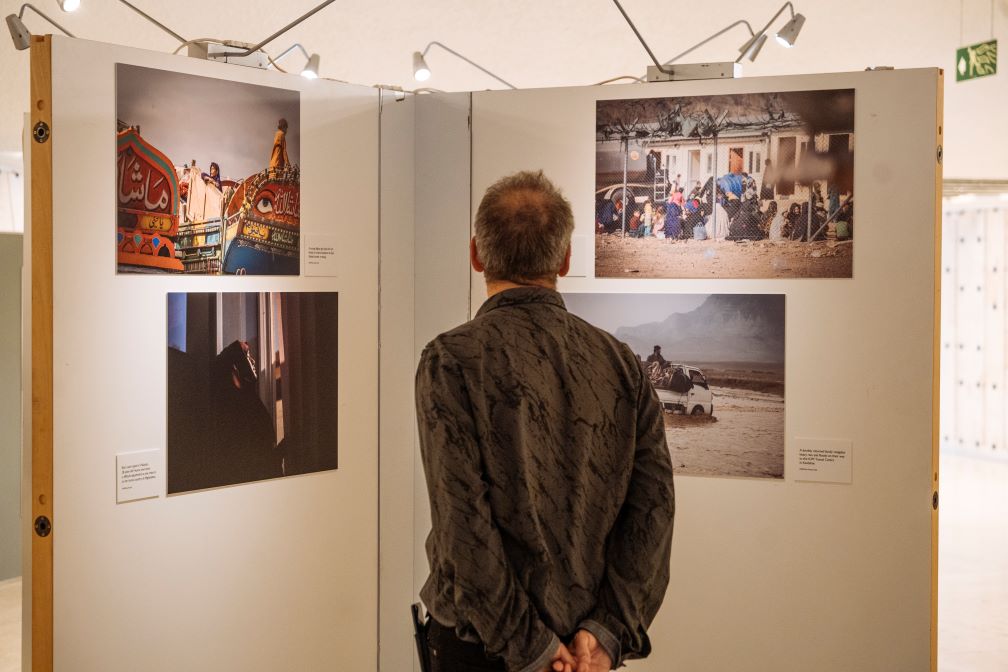
A person views photos in an art exhibition. (Photo: IOM/Pippa Lowe and Muse Mohammed)
Visual portrayals—including photographs, films, graphics, and short videos—have long been used to shape and inform public discussions. Media outlets, advocacy and other nongovernmental organizations, politicians and governments, international organizations, and others necessarily use images to illustrate their work and accentuate their messaging. These visuals are far from inconsequential, and in fact can bolster or undermine public perceptions of the actions, intentions, and impacts migrants have on receiving societies. This is especially the case for asylum seekers, who arrive without prior authorization to enter the country where they are seeking refuge, but also holds true for other types of irregular arrivals as well as refugees.
Scholars have categorized visual representations of irregular and humanitarian migration into two dominant themes: the threat discourse, portraying immigration as a challenge to security or stability, and the humanitarian discourse, emphasizing migrants’ harsh conditions and misery. These two narratives were on full display during the 2015-16 period in the European Union, when 2.5 million asylum seekers and other migrants arrived in the bloc. A decade later, these two themes continue to dominate public imagery of asylum seekers and others traveling irregularly, including those crossing the Mediterranean, arriving at the U.S.-Mexico border, at the EU-Belarus border, and crossing the English Channel. They set the tone for how forced and irregular migration is visually depicted in many countries worldwide.
The stark, devastating images of a drowned Syrian toddler on a Turkish beach had a near-immediate and measurable impact on humanitarian policy in the United Kingdom, Canada, and other countries. And the endless TV footage and images of asylum seekers and other migrants marching through dense South American jungle, atop trains traveling through Mexico, or massing at the U.S.-Mexico border played an opposite role: hardening the U.S. public against humanitarian migrants.
Governments, the media, and activists often rely on one of these twin narratives to influence public discourse, shape policy, and increase fundraising. By highlighting only one dimension of individuals’ nuanced identities, however, these representations often neglect migrants’ agency and the broader context of their journeys.
This article provides an overview of the major themes in visual representations of humanitarian migration, focusing particularly on examples from Europe over the last decade. It demonstrates how these narratives are used, the impacts they can have, and explores alternative approaches to visualizing migration.
Irregular migrants, asylum seekers, and refugees, tend to be depicted in one of two ways: as threats or victims.
The Threat Discourse
The discourse of threat portrays irregular migrants, including asylum seekers, as a danger to security and order. Photographs and videos employing this discourse often depict migrants as overwhelming, largely faceless masses advancing toward borders and being aggressive or vandalizing border infrastructure. This is supported by oral or textual context suggesting certain interpretations of these visuals. During the 2015-16 EU crisis, news organizations and others commonly featured chaotic scenes from key migration corridors such as the Balkan route spanning Bulgaria, Croatia, Hungary, and Romania. Individuals were depicted as shouting and physically forcing barriers and fences. In such representations, migrants were framed as aggressors who clashed with border authorities. Similarly, along the Mediterranean, images of overcrowded boats full of males became symbols of what nationalist leaders including Italy’s Matteo Salvini and the Netherlands’ Geert Wilders described as an "invasion" of Europe. Often, these visuals carried religious undertones, with a focus on garb, especially females’ veils and headscarves, and other indicators suggesting the Muslim backgrounds of many migrants. Moreover, the fact that many had dark skin was interpreted by some as a sign of their foreignness. This portrayal ties closely to the rise of Islamophobia in Europe and beyond, which the anthropologist Sindre Bangstad has described as a form of "cultural" or "new racism.” Similar depictions also emerged from visual narratives at the U.S.-Mexico border, framing migrant caravans and other large crowds as threatening masses.
These narratives resurfaced in 2021 at the EU-Belarus border, where tensions grew as migrants attempted to cross into Latvia, Lithuania, and Poland. The Polish government’s communications strategy during this period focused exclusively on presenting the border situation as a threat to national security. The government released an array of photographs and videos, often from security cameras, in which migrants attempted to force their way across fences and threw objects at border authorities. These incidents were framed as evidence of migrants’ hostile intent and used to justify harsh restrictions, including the declaration of a state of emergency and an unofficial practice of pushbacks into Belarus. During a press briefing that September, officials from Poland's Ministry of the Interior and Administration showed images allegedly found on detained migrants’ phones, including content involving pedophilia. These claims were used to support the continuation of the state of emergency at the border.
Beyond photographs and videos, migratory movements are often depicted using symbols such as large arrows on maps, which are reminiscent of illustrations of troop movements during war. This visualization style has drawn parallels between migration and an armed invasion. Frontex, the European Border and Coast Guard Agency, has been prominent in promoting this type of representation, often using maps involving large, menacing red lines depicting migrants’ movements that cut across national boundaries. These invasion-like arrows usually bear little resemblance to actual migration routes or offer any sense of scale.
On their own, visual representations may have limited power. But they are contextualized within broader narratives that frame humanitarian and irregular migration as an influx of unwanted individuals who intend to prey on the receiving community and leech off its government. Such framing can stoke public fear and create urgency to prevent migrants’ arrival, thereby justifying restrictive policies such as 2016 EU-Turkey deal to redirect irregularly arriving migrants, the United Kingdom’s 2022 plan to relocate asylum seekers to Rwanda, or Poland’s 2024 migration strategy threatening the right to seek asylum.
The Humanitarian Discourse
In contrast, some media outlets, organizations, and activists present a perspective that emphasizes humanitarian urgency. This narrative often highlights the plight of individuals—frequently women and children—in emotionally charged images. Such portrayals may include refugees crying in camps with questionable sanitary conditions, displaced mothers seeking shelter with their babies, activists rescuing people from sinking boats, or detained children standing meekly near border guards.
For instance, Pulitzer Prizer-winning photojournalist Javier Bauluz gained international acclaim for a 2001 photograph of beachgoers in Tarifa, Spain who seemed indifferent to the nearby body of a man who died in a shipwreck. Similarly, images of a shell-shocked and barefoot Syrian child covered in white dust and blood after bombings in Aleppo captured international headlines in 2016 and focused attention on the country’s refugee crisis.
Perhaps with the most widely recognized images of this type are those of Alan Kurdi, a two-year-old Syrian boy who drowned in the Mediterranean in 2015 while attempting to cross with his family. Photos of his lifeless body, face down on a Turkish beach, ignited a wave of public support and pressure for governments to prevent such tragedies and aid desperate Syrians. The images by photojournalist Nilüfer Demir temporarily shifted public discourse toward greater sympathy for asylum seekers, resulting in more welcoming policies in places such as Canada, Germany, and the United Kingdom; a dramatic uptick in donations and other support for migrant-serving organizations; as well as more sympathetic stories in newspapers and on social media. However, the shift proved short-lived, especially after horrible events that became linked to migration, including deadly terrorist attacks in Paris and Brussels in 2015 and 2016, as well as hundreds of rapes and assaults reported on New Year's Eve 2015 in Cologne.
These kinds of images—captured in migrants’ origins, their temporary stops in makeshift camps and detention centers, and in their destinations—serve as reminders of why these individuals fled their homes and the physical and emotional challenges they faced. Indeed, these depictions serve a clear purpose: to shake the public into action. Often, this results in charitable donations and may also lead to protests against restrictive policies at borders and in destination countries.
Implications and Limitations of the Discourses
The two discourses are used instrumentally and have clear implications for migration governance. Governments in Europe, North America, and elsewhere have legitimized strict migration policies through “visual proofs”—photographic and film depictions of “foreign-looking” migrants breaching borders en masse. These images have been cited to justify pushbacks, suspensions of asylum consideration, and other actions. Counternarratives from activists and some journalists may employ the humanitarian discourse, focusing instead on migrants’ suffering and misery and often evoking compassion and sympathy, which may translate into financial and ideological support. Presented visual depictions of migrants, offering fragmented narrations of their journey and contextualizing it in a way that addresses certain goals, have therefore played a pivotal role in political struggles, policy decisions, and in sustaining financial and moral support for organizations.
While undeniably useful for specific purposes, the two dominant visual discourses raise important ethical concerns about how people on the move—and individuals more broadly—should be represented. Both types of visual representation can strip individuals of their agency and portray them either as faceless masses devoid of personal histories or as vulnerable victims who are unable to take control over their lives. In many cases, these representations infringe upon privacy. Worse, they have sometimes been accused of violating the dignity of the deceased, which is considered ethically questionable if not outright unacceptable, and of unnecessarily exposing audiences to graphic horrors.
Against these reductive portrayals, however, every migrant carries an individual story, shaped by diverse and often complex motivations, positionalities, and strategies for navigating their circumstances. Individuals exercise agency even in the most challenging physical and emotional contexts. Depictions of them solely as aggressive violators of border laws fail to explore the sources of such actions, resulting in fragmented narratives that are prone to manipulation. Similarly, representations that reduce them to vulnerable victims overlook their resilience and efforts to assert control over their lives. Although the two discourses serve starkly different purposes, neither provides a complete, nuanced picture.
Artists and academics have offered alternative approaches for depicting humanitarian and irregular migration stories. These approaches aim to restore individuals’ agency, enabling them to convey their situations on their own terms while acknowledging the broader context of their lives. Such methods emphasize respect for the boundaries between what can and should not be shown.
One approach is to hand the camera to migrants themselves. This method provides an insider’s perspective on migrants’ everyday lives and living conditions, while maintaining control over privacy, as limitations are set by the image-takers themselves. It was employed by Karolina Augustová, a migration scholar who gained visual access to the experiences of irregular border crossers along the Balkan route from 2017 to 2019 (see Image 1). Although these images may still capture suffering or harsh living conditions, they have the potential to contextualize the difficulties individuals face.
Image 1. Image Taken by Migrant in Serbian Camp, 2019
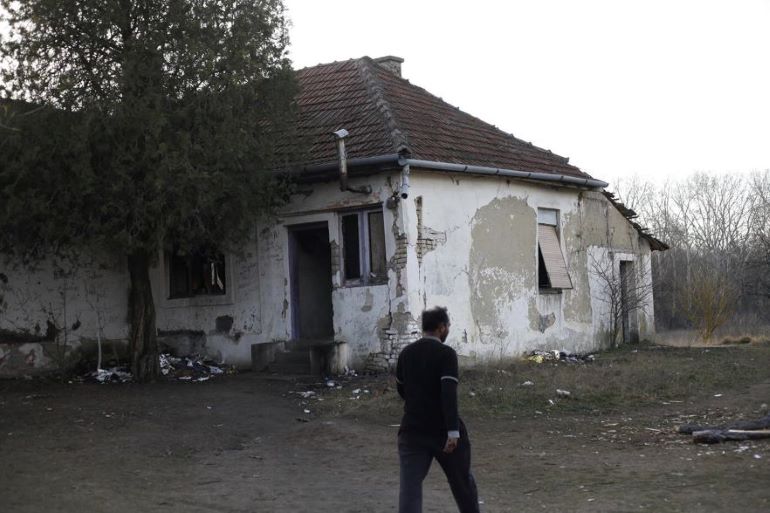
Source: Photo by Karim, provided courtesy of Karolína Augustová. Photo was also published in Augustová, “Photovoice as a Research Tool of the ‘Game’ along the ‘Balkan Route,’” in Visual Methodology in Migration Studies: New Possibilities, Theoretical Implications, and Ethical Questions, eds. Karolina Nikielska-Sekula and Amandine Desille (Cham, Switzerland: Springer, 2021), available online.
Another option is to focus on the everyday activities of forced and irregular migrants in places they temporarily or permanently inhabit, such as children playing or people cooking, tidying, and earning money. An example here is a 2024 photo illustrating an International Organization for Migration (IOM) article on Syrian children in Turkey (see Image 2). Similarly, a 2023 episode of the YouTube show “Best Ever Food Review Show” focused on cooking in a Syrian refugee camp in Lebanon, highlighting the difficult but dignifying act of preserving pre-migration habits and showcasing resilience of people amid harsh conditions. Elsewhere, the documentary Water, by Max Harwood and Yahya Al-Abdullah, features the struggles alongside the resilience and agency of Syrian refugees in Istanbul, through showing their resourcefulness in finding ways to earn a living by adopting a popular local entrepreneurial practice of selling water.
Image 2. IOM Image Used to Illustrate Syrian Refugee Migration in Turkey, 2023
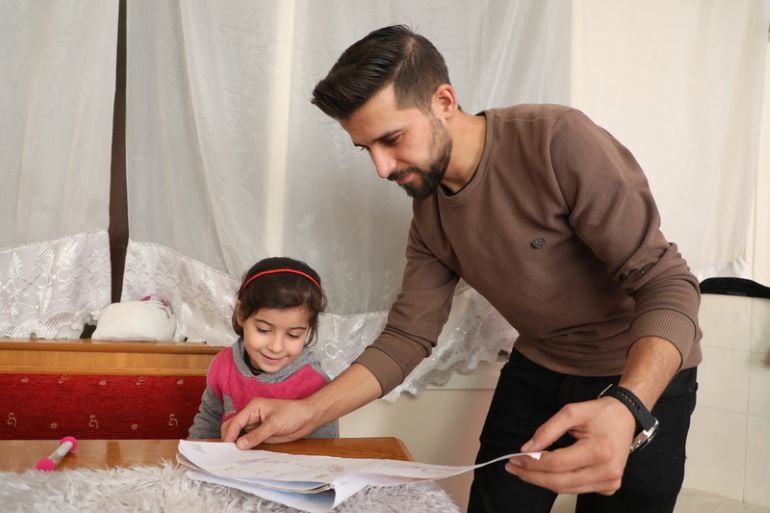
Credit: International Organization for Migration (IOM) / Başak Nur Yirmibeşoğlu.
While some of the resulting images may still feed into the broader threat or humanitarian narratives, incorporating migrants’ perspectives and a larger context of their situation—both visually and orally—can provide a richer, more nuanced understanding of their experiences. As sociologist Howard Becker noted, context is crucial for interpreting documentary images. While Becker was referring to textual context, visuals often dominate as the primary mode of communication in today’s fast-paced, social media-driven world, making it essential to embed context directly into still and moving visuals. Providing context visually can help move away from fragmented, reductionist portrayals and toward more well-rounded depictions of migration.
Another approach focuses on items rather than people (see Image 3). For instance, Augustová, the migration scholar, conveyed the experience of border crossings along Europe’s Balkan route through the image of muddy shoes provided by one of her interlocutors. Similarly, human-rights activists with Grupa Granica working at the Polish-Belarusian border curated a traveling exhibition in Poland, which was most recently displayed in December 2024 at Jagiellonian University in Kraków, featuring items found in the forest commonly used for irregular crossings. By highlighting intimate belongings such as a doll, backpack, and bra, rather than deceased bodies or injured limbs, this tactic seeks to tell compelling stories that reveal the humanity of migrants, communicating their struggles without devolving into caricature. While the exhibition had real-life objects, the focus on items instead of people can be well transferred to visual depictions. A viewer looking at these belongings is likely to realize they own these same or similar objects, fostering empathy. As the academic Patricia Prieto-Blanco pointed out, emphasizing items over people preserves the anonymity of migrants, many of whom are in vulnerable or precarious legal positions, while still shedding light on the challenges they face.
Image 3. Image from U.S.-Mexico Border, 2023
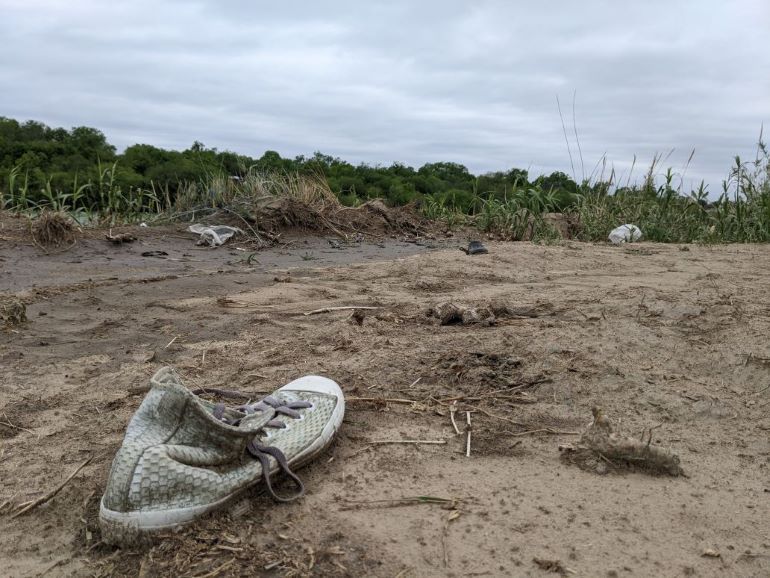
Credit: Ariel G. Ruiz Soto.
Finally, staged photoshoots in safe spaces can provide an opportunity to depict refugees and asylum seekers beyond their current hardships. One example is the Vision Not Victim project, which, among other activities, photographs refugee girls in costumes that represent their dream careers. Similarly, the 2018-20 photo exhibition Another Way Home aimed to portray refugees and others on the move in ways that highlighted their agency and determination. Some exhibition photographs recreated challenging moments of migrants’ journeys, such as enduring hunger, but visually conveyed strength and resilience. Staging these kinds of portrayals for which migrants can prepare ahead of time can help them regain agency and present their stories in a dignified and self-determined way. This approach enables migrants to share their multifaceted identities, moving beyond reductive views of migration and the associated struggles. Migration and the vulnerable situations migrants may find themselves in constitute only one, usually temporary, dimension of who they are. Focusing on the shared humanity in visual depictions could encourage balanced policies.
Two-Dimensional Images for Three-Dimensional Lives
The approaches presented above are not an exhaustive list of alternative visualizations for migration. And they may not align with the objectives of those who use imagery to help govern and manage migration—including governments, political parties, and humanitarian organizations—which can pose an obstacle to their adoption by some actors. Nonetheless, entities that are key conveyors of information about humanitarian and other migrants, including news organizations and advocates, could reconsider ways of visually portraying migration, keeping at the forefront context for complex processes and human beings’ own agency.
That said, visual portrayals of migration inherently involve risk of misuse. This risk arises from the polyphony and fragmentation of meanings conveyed by visuals, regardless of how ethically they are produced, as well as the rapidity with which they can spread. While the alternative approaches discussed here seek to minimize these risks, the multiplicity of ways in which migration-related images can be repurposed remains beyond creators’ control once they are published. This is an important consideration for all involved in disseminating such portrayals.
Sources
Augustová, Karolína. 2021. Photovoice as a Research Tool of the “Game” along the “Balkan Route.” In Visual Methodology in Migration Studies: New Possibilities, Theoretical Implications, and Ethical Questions, eds. Karolina Nikielska-Sekula and Amandine Desille. Cham, Switzerland: Springer. Available online.
Bangstad, Sindre. 2016. Islamophobia: What’s in a Name? Analysing the Discourses of Stopp Islamiseringen av Norge (Stop the Islamisation of Norway, SIAN). Journal of Muslims in Europe 5 (2): 145-69.
Best Ever Food Review Show. 2023. Food Inside Syrian Refugee Camps!! My Shocking Discovery!! November 12, 2023. Available online.
European Journalism Observatory. 2015. Research: How Europe’s Newspapers Reported the Migration Crisis. November 9, 2025. Available online.
Farida, Vis and Goriunova Olga. 2015. The Iconic Image on Social Media: A Rapid Research Response to the Death of Aylan Kurdi. N.p.: Visual Social Media Lab. Available online.
Frontex. N.d. Migratory Routes. Accessed January 30, 2025. Available online.
Kingsley. Patrick. 2016. The Death of Alan Kurdi: One Year on, Compassion towards Refugees Fades. The Guardian, September 2, 2016. Available online.
Prieto-Blanco, Patricia. 2021. Afterword: Visual Research in Migration: (In)Visibilities, Participation, Discourses. In Visual Methodology in Migration Studies: New Possibilities, Theoretical Implications, and Ethical Questions, eds. Karolina Nikielska-Sekula and Amandine Desille. Cham, Switzerland: Springer. Available online.
Resistance Communications. N.d. Vision Not Victim: Girls Transforming Their Lives and Communities. Accessed January 30, 2025. Available online.
Slovic, Paul, Daniel Västfjäll, Arvid Erlandsson, and Robin Gregory. 2017. Iconic Photographs and the Ebb and Flow of Empathic Response to Humanitarian Disasters. Proceedings of the National Academy of Sciences 114 (4): 640-44. Available online.
Śnieć, Paweł. 2023. Ataki na granicy polsko-białoruskiej. Poland Border Guard Service, July 13, 2023. Available online.
UN News. 2025. Syria Emergency: Four Children a Day Killed or Injured by Leftover Explosives. January 14, 2025. Available online.
Van Houtum, Henk and Rodrigo Bueno Lacy. 2020. The Migration Map Trap: On the Invasion Arrows in the Cartography of Migration. Mobilities 15 (2): 196-219. Available online.
Yamagata, Yukiko and Siobhan Riordan. 2018. Announcing Moving Walls 25: Another Way Home. Open Society Foundations, September 13, 2018. Available online.