- Keywords
- K-12 Education
- Early Childhood
Immigrant Integration: Essential to the Success of Immigration Policy
Part of The World of Migration
This transcript was generated using AI and may contain inaccuracies. If you notice an error, feel free to email [email protected].
CHAPTERS
[00:04:57]: How immigration spread from five states to nearly every corner of America
[00:07:26]: Why Canada, Australia, and Europe are far more intentional about integration
[00:12:05]: How COVID exposed immigrant families falling through the cracks
[00:17:12]: What it will take to get English learners back on track post-pandemic
[00:19:58]: Why immigrant parents speaking their native language at home matters
TRANSCRIPT
[00:00:02.27]
Welcome to the World of Migration, the podcast that the Migration Policy Institute has launched as part of its 20th anniversary celebration. This series showcases some of the top thinkers on migration policy who are central to MPI's creation or who have long been part of its leadership. In this podcast, we're asking experts to reflect on how policy has changed over the past two decades, and we're also asking them to share some of their reflections on their careers and thoughts for today's emerging migration experts. My name is Ivana Tú Nhi Giang and I'm a program and research assistant with MPI's National Center on Immigrant Integration Policy. Today, I'm delighted to be Speaking with Margie McHugh, who directs the National Center on Immigrant Integration Policy inside MPI. We just call it the center, which she co-founded early in MPI's life. Margie came to MPI from a career in immigrant integration and related issues in New York, where she was Executive Director of the New York Immigration Coalition for many years, and before that she served in the New York City government as Deputy Director of the city's 1990 census project, among other responsibilities. Margie is nationally renowned in immigrant integration circles and and is the recipient of dozens of awards recognizing her efforts to bring diverse constituencies together to tackle tough problems.
[00:01:26.18]
As such, I can't think of anyone better for our topic today, which is called Immigrant Integration Essential to the Success of Immigration Policy. Margie, thank you so much for coming on the podcast.
[00:01:38.09]
Ivana, so great to be having a chance to talk to you about things that we never have time for in our regular lives at MPI.
[00:01:46.22]
Yes, I'm very excited. First off, before we dive into the topic, Margie, maybe can you give me a quick minute on what MPI's integration center does and where it sits within the field of immigrant integration?
[00:02:00.08]
Sure. So our center since its founding has been focused on what you might expect at a place like MPI. Policy analysis, research, data products. I think maybe the thing that folks who aren't really familiar with our work wouldn't be aware of is that we also do quite a bit of technical assistance and capacity building work and initiatives usually focused on working with people who are important actors inside and outside government. You know, community leadership organizations or folks in school districts or state agencies that are running major service systems. So we try to work with those sorts of actors to actually support them, trying to figure out what are effective policies for working with immigrant and refugee families. So it's those kinds of functions that kind of under the center's umbrella or in our bailiwick. But then we're also focused. Integration just cuts across everything. So we do a lot of work in those kinds of efforts in the early childhood, adult and workforce K12 education spaces. And also issues like language access, which is basically how do agencies set up translation and interpretation services to allow immigrants to allow them to be in touch with immigrant families or serve them effectively.
[00:03:36.10]
Yes. And it's been such an honor to be part of that work over this past year. And in your work, you have described immigrant integration as the domestic policy side of the immigration policy debate, in other words, the secret sauce as to whether immigration policy is successful or not. Why is immigrant integration essential and not just for immigrants?
[00:03:57.09]
Well, anyone who knows me knows that I have been very frustrated over the years that in the immigration debate in the U.S. we think of it just in terms of really numbers and categories of who's going to get into the country and, or who might be subject to deportation or removal. And we don't put nearly as much energy into trying to make sure that immigration works when you're close to the ground, that it's a win-win. I would say a win-win in the sense that both immigrant families are able to succeed and that it's a good thing for the communities that they settle in, that we really are helping to create a cohesive and productive society and that immigration supports, that supports the overall good of the country and of immigrants who are coming here. And it's not easy. We're a big country. And when I came into the field, it was only really, I know some people would disagree with me about this, but maybe there were really five states that had significant numbers of immigrants kind of in the, in a, in the modern day sense, starting in the 1990s, say.
[00:05:19.06]
And those five states were new York, Texas, California, Illinois and Florida. And over the course of my career, we're now at more like 45 states where immigration is really an issue. And so supporting all of these states that really did not have significant numbers of immigrants in this modern chapter of the country's immigration history, there's been a lot of growing pains in different parts of the country. And so paying attention to that and responsibly trying to deal with that is such an important piece of immigration policymaking, I would say. And so in co-founding the center with Michael Fix, who was a wonderful colleague who I knew before he even came to MPI when he was head of the Urban Institute's Immigrant Policy Project, I thought it was so wonderful when he went to MPI because it really brought the sorts of issues that he functioned up, that he focused on at the Urban Institute over into MPI. And then it was just such an exciting prospect to join him in co-founding the center so that we would be able to really try and bring these issues up into the national level conversation around immigration policy.
[00:06:42.07]
Yes. So I think in my time at MPI, one of the values of the institute that have really stuck with me is the idea that immigration, when well managed, can be beneficial to immigrants receiving communities and society as a whole. And I feel like your answer speaks to that. So thanks for sharing that. So thinking more comparatively across the globe, some countries, for example, in Europe are far more intentional than the United States is about shaping integration policy agendas and funding them. The U.S. which likes to describe itself as a melting pot, has a far more laissez faire policy. When you, Margie, look across your career and your knowledge of these different approaches, why do you think countries have taken such divergent directions on immigrant integration?
[00:07:26.27]
Well, I would say it's not hard to answer that question, but my goodness, it just encompasses just so many different realities and the implications are so broad. Ivana, that is a super interesting point to make and one that connects to so many pieces of MPI's work because of course, the international program at MPI and I've been very privileged over the years to work here and there with that team and with MPI Brussels on integration issues, particularly in the European space, but also a bit with the Canadian and Australian governments as well. But the work there is so much more intentional and I would say, except in the cases of Canada and Australia, is because by and large, in the European space, those are countries that are defined by blood or citizenship is defined by blood in those country in those countries and sort of a, you know, deeper shared past culture in history. Whereas of course in the U.S. and also in, in Canada and Australia, those are countries that, in the, in the modern era, I guess, you know, over the past several hundred years that those are nations that arose by, through immigration and developed systems and identities that allowed citizenship to be obtained or a sense of belonging to be had by folks who were, who were joining from multiple cultures, speaking multiple languages, although ultimately kind of becoming these sorts of melting pots and where English is the most common, commonly spoken language.
[00:09:21.26]
So, you know, it's a bit of a problem in the U.S. that we, because we have that history that we, that we think it kind of happened by magic that somehow everyone was integrated and we really don't think about how different the nature of the economy was through those several hundred years. And in the many investments, particularly post the Depression and World War I and World War II in the U.S. where we had major investments that really went across the board trying to bring the country together and make a major push with helping families join the middle class. And so I think it's. We often look with envy at the policies that are in place in places like Canada, Australia and Europe, where there's so much more intentional policy making related to integration. In the European case, I think, because they know, they say it right out. We are not countries that are used to... We just don't know how to do it conceptually. How do we have people join us who don't speak our language, don't share our culture. It's just, it's just not part of our national identity or it has not been a part of our way of living.
[00:10:55.24]
Whereas I would say Canada and Australia, they are more intentional than the U.S., even though they tend towards more of a melting pot idea. They're just a lot more intentional in terms of saying that it's not easy in the modern, you know, in this modern chapter of migration history to have this all work because it's not as easy for people to jump into the middle class or to make a one generation jump into the middle class in the way that it might have been for earlier generations.
[00:11:32.10]
I think that, you know, we spend so much time in the center talking about issues in the U.S. and at the state and local level sometimes that there's so much more that I realize I need to learn about integration across the globe. So thanks for sharing that. And turning back to the U.S. the COVID-19 pandemic has obviously been a major event in the history of the country. And we also know that it has disproportionately impacted immigrants and their families. Margie, how would you say that it has affected work in the integration field?
[00:12:05.19]
I would say in the early days when we started the center, we were trying to build an identity for the integration field. And so it's part of why we ran an integration prizes program and really tried to push the idea of integration into immigration policy conversations and have it be comfortable language for folks across the many different stove pipes of integration services, early childhood, K12 adult ed workforce training to be using as they were trying to name what the, what the issues were that they were facing and the policy making and programmatic challenges they were trying to address and also take advantage of opportunities to really really help families thrive. We have had some very good policies in place, particularly in K12 education, that have had English learners, for example, be identified and be able to receive or be required at least to have services available to support their education. So when we arrived at the pandemic, it's still very much a patchwork of how we were doing in different states and different systems in terms of being able to effectively understand and work on integration challenges and opportunities. And then COVID, on the one hand, impacted so disproportionately and so heavily immigrant and refugee families because of their place very often in the economy and the workforce and, and just the, you know, they.
[00:13:50.08]
They were so often not in jobs that people could work remotely and they really needed to be truly on the front lines in so many industries. And, and also they were just disproportionately impacted from a health perspective, lack of childcare, just all sorts of issues. And it also was very disruptive for the education of immigrant children who were English learners. So in the midst of all of that pain and disruption in communities, I think it really put issues of integration on the map in many systems in a way that they really hadn't been just looking at headlines for months and months. And even now across the country, the understanding of the lack of digital access for, you know, for so many immigrant families, the fact that parents had to be working on the front lines and couldn't be home, you know, supervising their kids, moment-to-moment learning. So I do think that COVID has been hopefully a. A moment of kind of cultural understanding and also very practical understanding of some of the issues and challenges that we need to address from an integration point of view. And a lot of the equity dialog that's emerging as a result of the impact of the pandemic, I think will also-
[00:15:23.09]
It's also a unique opportunity. In the course of my career, I would say, the fact that President Biden, that his first executive order is about advancing equity and that it's a chance to look at racial and ethnic subgroups and to understand how federal policies might be overlooking ways that it could do a better job of identifying and addressing some of the ways in which our policies and our systems are not really addressing equity issues that stand out in data or that stand out in terms of how services and systems are structured. To me, it's really deep, wide and deep what might be able to happen as a result of that. So I think the pandemic definitely has, you know, has been a. Has two face, has its two sides. But you know, out of all of this sadness and misery and disruption, I think that we may be able to actually take some really critical steps forward,
[00:16:41.15]
maybe that there's a silver lining that the pandemic brought us with this new
[00:16:46.08]
emphasis on equity, if we can take advantage of it.
[00:16:49.23]
Right. So as you said, we understand that COVID and the move to remote learning in school districts across the U.S. have proven particularly devastating to English learners, ELS, immigrant children and those in low income families more generally. Margie, what interventions do you think are necessary to help get these students back on track?
[00:17:12.24]
We've done a lot of work on this. I think folks can certainly find it on our website. We've dug deep on the issue of assessments and so much of how we track how English learners are being served is via assessment systems. And a lot of that has fallen down for obvious reasons during the pandemic. And then I think we've also seen that in the early childhood space that children who are from immigrant families and who are dual language learners were the most likely not to be getting early childhood or pre K services, pre K programming. And so that's a much harder issue to fix. I think K12, I think a lot of K12 teachers would tell you, we know we've got a big problem on our hands, but we know what we need to do do, and we know how to do it. So just give us the, you know, give us the, the room to, to really work with these kids and, and try and make up for, for the losses that we've had. It's not so easy in the early childhood space and partly because we just aren't very well staffed there. There's not a lot of linguistically and culturally competent early childhood services and, and these are kids who were moving forward without us being able to try and close gaps for them.
[00:18:50.04]
So I would say I'm much more worried, I'm much more worried about that part of the system. I hope it will help us understand that parents are such an important, parents of young children are such an important part of the solution here and that we really have not. It's one of the things we've overlooked, looked over the last 30 or 40 years, that parents are really our frontline, they're really the army that can help close the gaps in the early childhood space, but that we're thinking in terms of center based programs as opposed to really making the most of what parents would be motivated and happy to do if we could just help help them understand U.S. systems better. And some of the approaches to early Learning that are proven, the things that are important for helping children to really be ready for success in school.
[00:19:58.20]
Could you say more about the specifics of what that parental role would be for children that young ages 0 to 5?
[00:20:07.27]
Well, it's very much about rich language development. Very often immigrant parents think that somehow they'll be hurting their children's chances of learning English if they speak to them in their native language. And if a parent is fully proficient in English and another language, then there's of course, a different way that parents can approach their children's language language learning. But especially for parents who have limited proficiency in English, since so much about their, about early childhood brain development is just developing neurons on top of neurons on top of neurons. That all comes from a child just being excited to be talking to their parent and, or talking to, you know, people that caregivers and family members and the like who are going to engage them and keep talking a little bit at the edge of the child's language ability and at the edge of the child's understanding of how things work in the world. And so what that does is just grow a denser and denser network in the child's brain of how to both understand the world, how to name things in the world, how to understand how things happen that they're observing. And it's really that brain development that's the critical piece of success when a child's arriving at the school door.
[00:21:41.06]
And it doesn't matter that the child, I mean, it matters in a technical sense about how are you going to interact with a child that has all this fabulous brain development, but it's all in a language as is in English. But our systems know how to do that, or they, they should be able to do that. But really that critical role of the parents in, in laying the, in creating the foundation cognitively, I mean, it's also social, social, emotional is, is undergirds all of this. It's too much to get into here. But really it's the cognitive piece that I think parents need to have the confidence that they're doing the right thing by talking in rich language to their children. And the rich language is usually available in the language the parent is most comfortable in. And there's lots of different strategies and lots of different resources out there. But so much of this is invisible to families that are recently-arrived or it's not part of the culture and the approach that they come from and the like. That's really, that's really what we need to, I think, get to now and I hope we'll be able to, as we, as we think about how to come out of the pandemic and make sure that we're especially helping young children.
[00:23:05.01]
It's not just a pandemic issue because honestly, it'll be a few decades before we can build our early childhood systems to be linguistically and culturally competent and to be able to really reach and engage immigrant families, especially very diverse families who speak languages other than Spanish, for example. And so, you know, parents were, and they are, and they especially still are post the pandemic. The place for investment, I would say, in the early childhood space.
[00:23:38.10]
Absolutely. You have me on board with that. So in asking you to reflect a little bit back on your career at MPI, which spans much of its life, what do you see as the biggest changing trends in the immigrant integration space?
[00:23:53.23]
Well, I mentioned earlier that when we started, when Michael Fix and I started the center, one of the really important initial programs that we ran was in the E Pluribus Unum Integration Prizes program. And if you think of that as the. That'll be the point that I'm sort of measuring from that. At that point, we were saying how do we have even just the, the words immigrant integration become part of the vocabulary at the federal level and also have all of these wonderful programs that are working all around the country identify as integration practitioners, if you will? We weren't looking for them to actually call themselves that, but just that they saw themselves as part of this larger societal project and all this important work that really needed to be be named and better understood in the, in national policy conversations. And that was a period where the National Immigrant Integration Conference got started. The National Partnership for New Americans, which is an umbrella organization for, for many groups that work on these issues at the state. Many networks of groups that work on these issues at the state and local level also came together into one national umbrella organization
[00:25:20.06]
just of infrastructure, I would say, grew over the years. And I would say that where we're at now is this unique moment that we spoke about post-COVID where there's much more of a national dialog around racial equity that is inclusive of issues related to immigrant and refugee families and that has real data underneath it in the last 30 years or so. And we didn't really have a framework for talking about how that is relevant within a number of different systems and that we're talking about both that we're really talking, I would say at the family level, understanding the impacts of low wage work, high cost housing, skill mismatches, the importance of early childhood, the importance of high school graduation. You know, like, we're so developed now, I think, in a number of policy fields where immigrant and refugee children and families are embedded in those conversations and data, and this national focus on equity, it is a trend, but it's also a moment. A lot of things have gotten us to this point place, but it's also this moment where things can be pulled together. And so I'm very excited about that. And I also feel that on the one hand, it's very disappointing to see that there's so much controversy around immigration policy and so many challenges, unexpected challenges for, for example, that have arisen just in the past year in terms of the number of asylum seekers at the southern border, the issues related to the Afghan refugee population and the like, that we're just completely preoccupied with the immigration debate and with immigration issues.
[00:27:29.20]
But this has been the story of trying to get to integration issues for a good number of years now that they keep. They keep being sort of steamrolled over because we're so mad about immigration policy or we have so many issues that need to be addressed there. But I do think that there's a rich enough conversation within systems now about whether or not they are working effectively with immigrant background, children and families. And then we've had this additional moment because of COVID So. So I think on both counts, we're on a stronger footing in terms of being able to really move this up in the national conversation and try and bring the integration and immigration policy pieces together. And honestly, I think all of MPI's work internationally to raise up the investments that so many other countries are making, and innovations in their policy thinking and approaches to address integration issues is also challenging the U.S. You know, we're not. We're not unique in facing these issues, and other folks are really taking them on. And then we also have that sort of innovation at the state and local level in the U.S. with creation of more integration offices at the state level and also many of them at the city level.
[00:29:04.10]
So I see it as sort of bubbling up in the U.S. from the local and state level into the. Into the national conversation. And it's also, in a sense, out there in the international conversation, which is also pushing in on the U.S. conversation. So I do think that. I do think that it's ripening on many levels.
[00:29:27.18]
It's always such an honor when I get to catch some of your time to hear about the insight that you have after your very long and successful career. So I Just wanted to ask if you have any parting thoughts.
[00:29:39.07]
I just think that one of my main parting thoughts is that we have so many terrific staff who are coming to U.S now with really serious academic credentials and backgrounds in these issues in a way that, you know, people didn't focus on this in their academic careers 20 years ago in the way that they do now. And so I would just say people like you and those on our team and those more broadly at MPI, I think really stand the field in good stead. And you know a lot about our various interns who come through who also are really have terrific skill sets and experience, experiences that are deep and relevant. So I do think that the leadership and thought, careful thought on these issues is critical that these, when you think about just back to where we started, domestic policy is complicated. We are a big country. Everything is true somewhere in the country. It is so hard to aggregate and and make policies that are relevant for all the different local contexts in every kind of policy area that exists in the domestic policy space. And then integration issues cross cut all of those.
[00:31:05.08]
So the need for the rising generation of activists and academics and people who are going to be working in all of these different fields to really embrace the complexity of these issues, I think that it's happening and like every hard thing, you just have to do the work to get through it. And I just am grateful to see that a lot of people are really rising in the field and across the country who want to take these issues seriously. And that includes you, Ivana.
[00:31:47.01]
Thanks, Margie.
[00:31:48.02]
It's been my pleasure to be able to spend this time with you and talk about some of these things.
[00:31:55.15]
Yes, this is wonderful and also a great place to leave things. Thank you, Margie. This has really been an interesting discussion and I appreciate you coming on the podcast.
[00:32:05.01]
Thank you, Ivana.
[00:32:09.06]
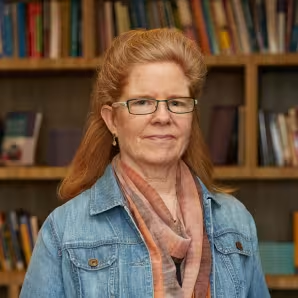
Margie McHugh is Director of MPI's National Center on Immigrant Integration Policy. Thanks for tuning in to this episode of the World of Migration, MPI's 20th anniversary podcast. For more on MPI's first 20 years, please visit migrationpolicy.org/about/20th. You can find all of the episodes for the World of Migration and other MPI podcasts online at migrationpolicy.org/podcasts or you can find us wherever you get your podcasts. Just search for World of Migration and please give us a review while you're there. This episode was produced by Michelle Mittelstadt and Yoseph Hamid and made possible through the assistance of Lisa Dixon.
While Canada, Australia, and Europe invest intentionally in immigrant integration, the U.S. still treats it as an afterthought—the consequences show up in classrooms, labor markets, and communities nationwide.
Immigrant integration is the domestic policy side of the immigration debate: The secret sauce as to whether immigration policy is successful or not. Yet the issue of how immigrants and their children fare and the integration policies and programs that help ease their incorporation into society often receive far less attention, certainly in the U.S. context, than questions around immigration levels, border security, and the unauthorized population. Some countries are quite intentional about their immigrant integration programming, while the United States has a more decentralized approach, even as immigrants have moved beyond the handful of traditional destinations in recent decades. In this conversation, Margie McHugh, director of MPI’s National Center on Immigrant Integration Policy, chats with Ivana Tú Nhi Giang about why integration is important not just for immigrants and their families but for the broader society as well.
About the National Center on Immigrant Integration Policy
The Center is a national hub connecting policymakers, educators, community leaders, and service providers with evidence-informed policy research, technical assistance, and data to advance effective immigrant integration at U.S., state, and local levels.
- Keywords
- K-12 Education Early Childhood
- Regions
- North America Europe
- Country
- United States
- Speakers
-
Margie McHugh
Director, National Center on Immigrant Integration Policy