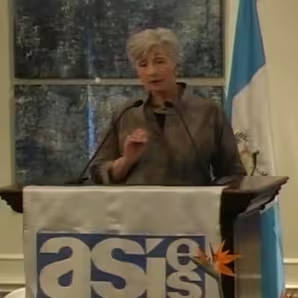
Victoria Rietig
Victoria Rietig was a Policy Analyst at MPI, where she worked for the Regional Migration Study Group and the Transatlantic Council on Migration. She was also a Nonresident Fellow with MPI Europe.
Her research expertise included forced migration, human trafficking, labor migration, and international development. She conducted field research on forced migration in Mexico, analyzing the impact of organized crime and violence on human trafficking.
Prior to joining MPI, Ms. Rietig worked for the United Nations, NGOs, and the U.S. government. At the United Nations Institute for Training and Research (UNITAR), she developed and implemented conferences and trainings for high-level officials in the Migration and Development Seminar Series at UN headquarters in New York. After that, she worked as a project leader for Fairfood International, where she was in charge of establishing the NGO’s Berlin office. She also consulted for the U.S. government, and developed strategic recommendations for the Human Smuggling and Trafficking Center (HSTC), an interagency center of the Departments of State, Justice, and Homeland Security.
Ms. Rietig received her master in public policy from Harvard University, Kennedy School of Government, and holds an M.A. in American studies, history, and psychology from Freie Universität Berlin, with a focus on Latin American migration to the United States. She also studied and conducted research at Universidad Nacional de Córdoba (Argentina), New York University, and El Colegio de México (COLMEX).
Explore Content by Victoria Rietig
Showing 1-9 of 9 total results
Moving Beyond Crisis: Germany’s New Approaches to Integrating Refugees into the Labor Market
Despite political commitment, oversubscribed language courses and a hard-to-penetrate vocational training system constrain refugee labor market integration in Germany.

The New Reality: Germany Adapts to Its Role as a Major Migrant Magnet
Germany long denied being a country of immigration, even as it became the world's second-largest immigrant destination; landmark reforms since 2000 on citizenship, labor migration, and integration formalized a major shift.
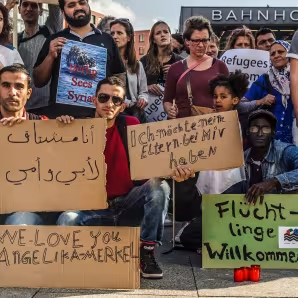
A Shared Challenge: Europe and the United States Confront Significant Flows of Unaccompanied Child Migrants
Surging arrivals of unaccompanied children are testing European and U.S. systems in parallel ways.
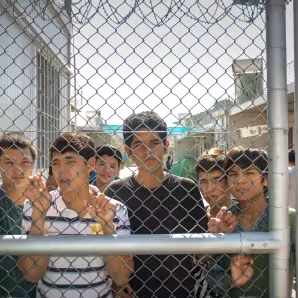
Stopping the Revolving Door: Reception and Reintegration Services for Central American Deportees
Northern Central American governments offer basic returnee reception but long-term reintegration programs reach only a fraction of returnees, leaving many at risk of remigration.

Migrants Deported from the United States and Mexico to the Northern Triangle: A Statistical and Socioeconomic Profile
Mexico is intercepting more northern Central American migrants before the U.S. border. But shifting flows without addressing root causes is not a lasting solution.

Building Skills in North and Central America: Barriers and Policy Options toward Harmonizing Qualifications in Nursing
Nurse qualification harmonization can ease North American shortages and cut brain waste, but regulatory gaps and credential barriers need political will to overcome.

Changing Landscape Prompts Mexico's Emergence as a Migration Manager
Mexico’s shift from major migrant sender to regional migration manager has raised questions about the balance between enforcement and protection.
Migration with Chinese Characteristics: Hukou Reform and Elite Emigration
China’s leaders paired ambitious hukou reforms with concern over elite emigration, reshaping internal and international migration.