Lillie Hinkle
Lillie Hinkle was an Associate Policy Analyst with MPI’s National Center on Immigrant Integration Policy, where they worked on issues including refugee resettlement, unaccompanied children's services, and access to benefits and services for immigrant families.
Prior to joining MPI, Mx. Hinkle worked with the International Rescue Committee in employment placement and family mentorship, providing services to newly arrived refugee families in Richmond, Virginia. They previously interned with MPI and a 3D printing lab specializing in archaeological curation.
Mx. Hinkle holds a master’s degree in refugee and forced migration studies from the University of Oxford, where they focused on the intersections of trauma and refugee service provision in the United States. During their graduate studies, they provided research assistance to the Rights in Exile Program, recruiting country-of-origin experts for an online legal aid resource network. They hold a bachelor's degree in anthropology and philosophy from Virginia Commonwealth University.
Explore Content by Lillie Hinkle
Showing 1-8 of 8 total results
Connecting Immigrant Communities to Infant and Early Childhood Mental Health Services
Speakers discussed the importance of infant and early childhood mental health services and how to better connect immigrant and refugee families to these resources.

Supporting Immigrant and Refugee Families through Infant and Early Childhood Mental Health Services
Immigrant and refugee children face major barriers to mental health services, with screening gaps, insurance disparities, and a shortage of culturally responsive care.

The Importance of Community Consultations in the U.S. Refugee Resettlement Network
This conversation considered the importance of community consultation in the U.S. refugee resettlement landscape in 2023, and explored actionable steps toward a more inclusive, collaborative, and adaptable process.
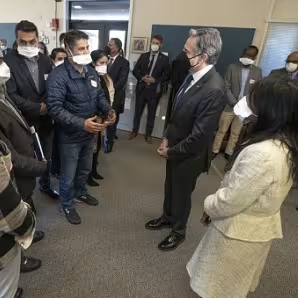
The Unmet Potential of Community Consultations in U.S. Refugee Resettlement
U.S. refugee resettlement consultations with receiving communities fall short of their potential, hampered by the narrowness of their scope and limited meaningful dialogue.

SNAP Access and Participation in U.S.-Born and Immigrant Households: A Data Profile
Post-1996 federal welfare rules bar many lawfully present immigrants from SNAP. In 2019, many of the 13 million people in low-income immigrant households faced limited or no access to food assistance.

The Missing Link: Connecting Eligible Asylees and Asylum Seekers with Benefits and Services
Asylees are eligible for many U.S. refugee-equivalent benefits but lack systems to connect them. Weak outreach and fragmented data leave many underserved.

Advancing Digital Equity among Immigrant-Origin Youth
This report examines digital equity barriers facing immigrant-origin youth in the United States and offers recommendations to help schools and policymakers close technology gaps.

A Solvable Challenge: Improving Asylee Access to Health and Other Benefits
While asylees are eligible for many of the same public benefits and services as resettled refugees, including health care and employment assistance, there is no system to inform them of their eligibility and to help connect them to resources. MPI estimates that fewer than 20 percent of those granted asylum in recent years received Office of Refugee Resettlement benefits during their first year. The U.S. government could address this gap with a few simple measures.
