Brian Salant
Brian Salant was a Research Assistant with MPI’s International Program, where his research focused on skilled labor mobility in the ASEAN region, qualifications recognition, and public attitudes toward migration.
Prior to joining MPI, Mr. Salant interned at the Public Diplomacy Section of the U.S. Embassy in Ankara, Turkey, where he coordinated youth outreach programs, and later at the Meridian International Center in Washington, D.C. designing exchange programs to nurture social entrepreneurship among youth leaders from around the world.
Mr. Salant holds a master’s degree in European and Russian studies from Yale University, a master’s in EU studies from the University of Ghent, and a bachelor of arts from the University of California, Los Angeles.
Explore Content by Brian Salant
Showing 1-10 of 12 total results
Balancing Acts: Policy Frameworks for Migrant Return and Reintegration
Compulsory returns pit rule of law against humanitarian and development goals—making reintegration assistance the clearest lever for sustainable returns.
It’s Relative: A Crosscountry Comparison of Family-Migration Policies and Flows
Family admissions dominate immigration across all nine countries studied, and backlogs of up to 30 years show that formal reunification rights often fail in practice.

Moving Beyond “Root Causes”: The Complicated Relationship between Development and Migration
Development aid may spur emigration before reducing it. The evidence shows only structural economic and governance investment creates durable alternatives to leaving.

As Displacement Becomes Long-Term, Refugee Hosts Grapple with New Normal
Global displacement hit a record 65.6 million in 2016, straining first-asylum host countries as refugee resettlement fell far short of need.

Increased Focus on Forced Return of Migrants and Asylum Seekers Puts Many in Peril
In 2017, governments worldwide ramped up forced and coerced returns of migrants and refugees, sending hundreds of thousands back to fragile, conflict-affected countries.
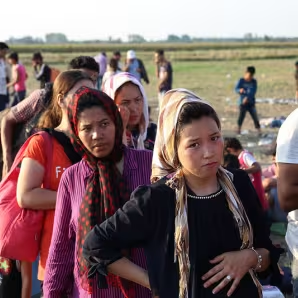
Tracing the Channels Refugees Use to Seek Protection in Europe
Europe cannot reliably track how refugees arrive, but available data point to irregular entry as dominant and resettlement as covering only 1 in 10 protection decisions.
Improving the Labour Market Integration of Migrants and Refugees: Empowering cities through better use of EU instruments
European cities are front-line integration providers, but funding constraints and governance gaps limit their impact. Smarter use of EU instruments could change that.

Strengthening Local Education Systems for Newly Arrived Adults and Children: Empowering cities through better use of EU instruments
European cities lack the policy authority, flexible budgets, and EU support needed to educate newly arrived migrants effectively despite bearing the frontline burden.

Reinventing Mutual Recognition Arrangements: Lessons from International Experiences and Insights for the ASEAN Region
Mutual recognition arrangements are declining in number globally and mostly cover academic diplomas. They must be reformed to be relevant for 21st-century labor markets.

Open Windows, Closed Doors: Mutual Recognition Arrangements on Professional Services in the ASEAN Region
ASEAN's seven Mutual Recognition Arrangements diverge significantly in structure, constraining their potential to enable real professional mobility across Member States.