Integration Futures Working Group
Since its launch in 2016 with funding from the Robert Bosch Stiftung, the Integration Futures Working Group has provided a critical platform for senior leaders to debate new ideas on the future of integration policy in Europe. It brings together senior integration policymakers, experts, and civil-society and private-sector leaders to create a platform for long-term strategic thinking, drawing on regular meetings and original research.
Its agenda is organised around several questions shaping the future of integration policy in Europe:
- Restoring public trust. It is exploring the levers available to policymakers to rebuild trust in governments’ ability to manage migration and integration fairly, and how to design services that mitigate pressures on communities.
- Pillars of effective integration governance. As integration policy is evolving in response to political, demographic, and labour market pressures, integration policymakers are grappling with core tensions, including how to balance migration management and integration concerns.
- AI, behavioural insights, and data innovation. The Working Group is exploring how AI and other tools can personalise integration pathways, how behavioural insights can strengthen programme effectiveness, and how innovations in collecting and analysing data can improve outcome monitoring.
- General Inquiries





Showing 1–10 of 24 results
Beyond Control Signalling: Designing integration policies for better outcomes and public trust
In many high-income countries, governments are scrambling to prove they are in control of immigration. While some policies signal toughness, they do not necessarily improve outcomes.

Confronting Compassion Fatigue: Understanding the arc of public support for displaced populations in Turkey, Colombia, and Europe
Compassion for displaced Syrians in Turkey, Venezuelans in Colombia, and Ukrainians in Europe is fading as displacement persists and public anxiety over housing, jobs, and identity deepens.

Displaced Ukrainians in European Labour Markets: Leveraging innovations for more inclusive integration
Russia's 2022 invasion of Ukraine displaced millions of Ukrainians into Europe; innovations in credential recognition and flexible training can help them reach their potential.

Why the European Labor Market Integration of Displaced Ukrainians Is Defying Expectations
People displaced from Ukraine are finding work more rapidly in European countries than prior refugee cohorts. But uncertainty over how long they will stay, combined with hurdles such as language barriers, has meant many are prioritizing any job over the right job. This commentary examines how policymakers could address this waste of skills as they seek to fill pressing labor needs and facilitate deeper integration of the new arrivals.

How Will the Pandemic Reshape Public Health for Migrants?
In the wake of COVID-19, speakers reflected on the implications of the public-health crisis for migrant health and discussed innovations that could reduce health care disparities for immigrants and other diverse populations.
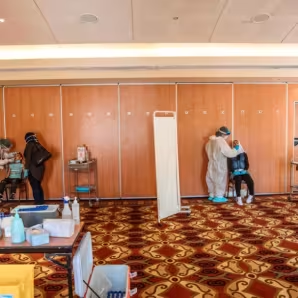
Healing the Gap: Building inclusive public-health and migrant integration systems in Europe
COVID-19 deepened migrant health disparities in Europe. This report suggests a coordinated, prevention-focused approach that shifts beyond emergency-driven responses.

‘Diversifying’ Social Investment: European welfare states and immigrant integration in the wake of the COVID-19 crisis
COVID-19 exposed deep welfare gaps for migrants in Europe. Diversifying social investment with tailored, needs-based support can advance integration outcomes and social cohesion.

Taking the Long View: Options for inclusive post-pandemic labor markets
Migrants in Europe bore outsized COVID-19 job losses. Entrepreneurship, social economy pathways, and employment services reform can support a more inclusive recovery.

Solidarity in Isolation? Social cohesion at a time of physical distance
Lockdowns paused migrant integration in Europe, widened digital divides, and frayed social cohesion, while new local solidarity networks emerged but proved short-lived.

Welfare States and Migration: How will the pandemic reshape a complex relationship?
This MPI Europe webinar reflects on the implications of this current moment for European economies and societies and the role of immigration and immigrant integration policy, and highlights research from the European Commission’s Joint Research Centre on the fiscal and demographic impacts of migration.