The ESSA Waiver Landscape and Implications for K-12 English Learners
This transcript was generated using AI and may contain inaccuracies. If you notice an error, feel free to email [email protected].
[00:00:00.09] - Delia Pompa
Thank you for joining us this afternoon. We have quite an interesting program for you. I'm Delia Pompa. I'm a senior fellow at the Migration Policy Institute, and we're here today to talk about the ESSA waiver landscape and implications for K-12 English learners. This session is being brought to you by the Immigrant Integration— excuse me, the Immigrant Integration Policy Center within the Migration Policy Institute. Our center exists to serve many, many types of stakeholders, all of whom are interested in the challenges and the opportunities that immigration brings to local communities. We work on several different topics within education and, and also on areas that touch education. Some of the areas we work in that you may have attended sessions for are early childhood education, language access, adult education, and definitely K-12 education. So today we're going to be talking about ESSA waivers. Now I just want to say very quickly that, um, The issues that the Center focuses on are not— are often issues that are very general, and nobody stops to think about how they implicate English learners or immigrant students. And that's the case today. Everyone's talking about waivers. Everyone's concerned about waivers. We've seen very little discussion of the implications for English learners, and we'd like to raise that topic today.
Each of our invited speakers brings a unique perspective to the topic and what it means for English learners, and we're going to begin by hearing from each of the three, and we'll then we'll have lots of time for questions and answers, and we hope you will put your answers in. And you've got instructions as to— excuse me, your questions in there. You've got instructions as to how to do that. So let me start with our first speaker. Our first speaker is Dave Powell, who's a senior consultant with Education First. We've had the opportunity to work with him very closely over the last couple of years. Within his role, Dave partners with clients on designing community-driven strategies and solutions that focus on educational equity in the classroom. He's on the Engaged Students team and has focused on a variety of systems and enabling conditions to ensure that policies and practice for students from all backgrounds are addressed accurately and appropriately within the classroom. So, Dave, let me turn it over to you.
[00:02:31.17] - Dave Powell
Thank you. I'm so happy to be here today. I'm going to give a bit of an overview about what are these things, ESEA waivers and/or ESSA waivers, and what, why a state might pursue that, and what we're seeing with some of the current states. So I'm drawing from a paper that I co-published with Anne Hyslop, who was at All4Ed until very recently. I'll share that at the end so you guys can dig in more if you want. But so essentially, these waivers, I think there's a few things to know upfront. One is that although we refer to ESSA waivers, and I'll be talking about the current law passed in 2015, that reauthorization of the Elementary and Secondary Education Act, these waiver provisions have been around for decades within that law in some format. And the, the real purpose of them is for the federal government to recognize that while they're establishing this law, not everything might work right in this, in the same state or within student populations perfectly. And so this is a way for states to request some flexibility from federal law, and it's not meant to be indiscriminate, or it's not meant to be just because it you have a different policy priority.
The waivers are supposed to advance student academic achievement. And in their waiver request, they have to lay out how they think that this flexibility from federal law would allow them to advance student academic achievement. And the Secretary of Education is supposed to base their decision based on those grounds. So just note every administration, Republican, Democrat, the last 25 years has granted these sorts of waivers. And another thing to note is that they have to gather and address public comment before they submit these waivers to the Department of Education, and that can create an advocacy opportunity that we might hear more about later today. So just a couple other little quick side notes. I mean, one thing to know is that, you know, these waiver requests are pretty robust. The states are supposed to show not only how it will advance student achievement, but how will they monitor and regularly evaluate the effectiveness of the plan. And they also have to describe how they're going to provide assistance to the same populations that are served by the programs that might be impacted. And so for the, in today's case, if a program's impacting ELL students, they should explain how that's happening.
So one important thing to know is that not everything in the federal law can be waived. There are 10 fundamental provisions that cannot be waived. These are laid out in the paper I'll share. We call them the unwavables. But essentially, they are related to how funds are distributed from the federal government to the states and from states to local districts. They cannot— and other key fiscal requirements. They can't waive civil rights protections that are laid out in other laws, such as the Civil Rights Act. There are statutory requirements about family and parent engagement that can't be waived. And then there's a number of things about limits on the secretary's authority. So the, the secretary cannot, for example, mandate that a state uses a specific curriculum or instructional approach, and that you can't waive that. There's a lot more detail in the paper I'll share, but just to help you all understand what can be waived, Accountability and assessment provisions can be waived, and there's a lot of focus on the field right now within that. And then if you want to do some innovative things within that, those structures, you might have to get waivers.
So for example, the most common waiver that is granted is a request to provide alternative student assessments to more than 1% of the student population in the state. So, for example, 2024, 21 states made waiver requests, and all but 3 of them were for that. But you also could make waiver requests to have an accountability indicator that can only be disaggregated at the school level and not the student level. You could have accountability waivers requesting changes to how you identify schools in need of improvement or the timeline through what— by which you identify them through. So those are just a few examples. So that brings me to today. So right now, under the Trump administration, there's been 7 states that are somewhere in the ESSA waiver process. They're all states that are led by Republican governors. One of those has been approved, Iowa. I'll talk about it a little bit more in a minute. One state, Indiana, submitted their request, but it hasn't been approved yet. Three of them have gone through public comment period but haven't submitted yet. That's Idaho, Louisiana, and Kansas. And one of them is still in their public comment period.
That's in Alabama. and a final state, Oklahoma, went through the process but then would— decided not to submit their application when they had a change in their state superintendent. I think one of the important things to know is that all of these waivers so far basically touch on two big buckets of ideas. One is around requesting additional flexibility in how federal funding works. I'll explain a little bit more in detail there in a second. And then the second one is around assessment and accountability provisions. So for example, we'll hear more about how in Indiana later, but another example would be Idaho is requesting to, instead of giving a statewide summative assessment every year in ELA, they want to move to using a reading screener, and they're also proposing making some changes to their high school assessment system. And so just to talk a little bit more about the federal funding flexibility piece, there are limitations, right, about how a state can do this in the law. So I said it earlier that the secretary can't waive how funds are— federal funds are allocated and distributed. But several states, Louisiana, Indiana, Iowa, have all requested to be able to consolidate what are called state set-asides funds. That's essentially a small percentage of funds that the state is able to keep within different programs—Title I, Title II, Title III—and use those for statewide activities. And so it might be supporting a new reading program statewide, those sorts of things. And so it's important to note that Iowa, which did request that, it was approved by the federal government. And so I would anticipate that similar requests in Indiana and Louisiana will be approved as well. And so in practice, what this means is that now funds from a variety of different titles for the state set-aside will be allocated within one bucket to the state, and they can spend them out of that as one bucket rather than having to spend them on the specific targeted populations that those funds might have been intentionally or originally intended for. So for example, with that consolidation, Title I funds wouldn't have to go directly to supporting low-income students. For the purpose of this conversation, it's important to note that Title III is included in all 3 of those states that I mentioned— Louisiana, Indiana, and Iowa. And so that means the Title III funds for the state set-aside are now mixed together with other Title funds.
The other thing I'll just note is that, you know, these requests aren't just happening automatically. And so, you know, we don't have a lot of visibility into what the conversations between the state and the, and U.S. Department of Ed are. But despite the Department of Ed being very clear that they want to offer more state authority to states, you know, there are some signals that like the conversation around these waivers is more nuanced. So both Iowa and Indiana revised their waiver requests after their initial public comments. And then states like Idaho and Kansas, although they've gone through the public comment, have not submitted their waivers yet. And there's some speculation at least that that's because they're hearing from the federal government about changes that might need to be made before they would approve the request. We don't know whether that's true for sure, but I do think it's important to note that like there isn't like a rubber stamp so far that's happening with these waiver requests. It's a more nuanced discussion. Between the department and states. So I think I will wrap up my comments there. I'm going to share 2 resources. One is a paper called ESEA Waivers 101.
It just goes through the process, all the rules and the law, that sort of thing in a more readable format than the federal law is. And I'll also share what's called the ESSA Waiver Watch. It's by— been done by a set of advocacy organizations and they're just keeping tabs on all of the waiver developments and where the processes are. Really good analysis of what's in each one of the states' requests and that sort of thing. So, um, thank you.
[00:12:24.21] - Delia Pompa
Thank you, Dave. Um, we're going to go now to the state perspective, and to do that, I'd like to introduce Megan Hopkins, who is professor and chair of the Department of Education Studies, UC San Diego, and she's also the co-advisor for the English Learner Collaborative for the Council of Chief State School Officers. She engages in a wide range of applied research projects and technical assistance on English learners and working with educational leaders in states on bettering education for English learners. We've had the pleasure of collaborating her with Megan on a couple of projects over the last few years, and I'm very pleased she could be with us today. So Megan, take it away.
[00:13:07.13] - Megan Hopkins
Good afternoon, everyone, and thank you, Delia, for the introduction. It's a pleasure to be here. Today I'm going to walk us through a bit of a framework to help us think about what might strengthen protections for English learners within ESSA waivers and what might weaken protections, which is what we are seeing and what Dave was commenting on previously. So I'm gonna also talk specifically about 3 things today: how waivers could potentially affect English learners, what concerns leaders are raising, particularly at the state level, and what meaningful engagement in the waiver process could look like. So I'm going to talk about more about what these things could look like, as I said, rather than giving specific examples of state plans and activities. And I'm going to use this diagram to help us frame the conversation. So at the top, of course, as Dave mentioned, are civil rights guardrails. So that's Title VI as well as related obligations that are articulated, as we know, in federal policy and case law. So these establish the legal floor for what is required to provide English learners with a meaningful access to the curriculum. And of course, waivers do not remove those protections.
Then below that are ESSA's accountability and funding systems, which is the focus of my comments today, you know, given as we know those are where a lot of the flexibility lies within ESSA waivers. So these systems, this policy translates those protections into operational policy. So that includes, I'll go through a few of the things that that includes for English learners. The visibility of English learners in Title I accountability systems, particularly through annual English language proficiency assessments and associated growth measures. It also includes how schools are identified for improvement, as Dave mentioned, and the extent to which English learner growth is considered in that identification. ESSA, of course, also outlines funding provisions, particularly under Title I and Title III for English learners related to programming and family engagement. So as we know, these funds carry supplement, not supplant requirements. So that means that states really must cover core English learner services and use federal dollars to really expand or augment them, but not to, to cover what is core in English learner programs. So the civil rights protections and ESSA policy does two things: makes English learners visible and attaches resources and consequences to that visibility.
So here I put the ESSA waiver at the center of this diagram, given it's our focus today. And we know the waiver system, the waiver operates inside this ESSA layer. And as I mentioned, it'll, it, you can adjust two important functions for English learners, accountability and funding. So below that, within that box, there are two realities that shape what happens next and whether ESSA waivers might strengthen or weaken systems that play into when ESSA waivers might be designed, but also in their implementation. So that's implementation capacity and infrastructure, as well as governance and voice. And so I'm gonna dig into those two things more in a moment. But first, I wanna cover the first question, that's how waivers can affect English learners. And they can do so both explicitly and implicitly. So explicitly, a waiver might change how ELP growth is weighted in accountability systems. Even small adjustments to how that growth is weighted or calculated could alter how English learners are prioritized in improvement efforts at the local level. So for example, if ELP growth becomes a smaller share of a school's rating, attention will shift accordingly among educators in that context. A waiver could also alter group reporting requirements.
So example, for example, changing how English learners are counted, how long-term English learners defined, how recently arrived students are incorporated into accountability. These are all important considerations for English learners. And then of course on the funding side, as Dave mentioned, waivers can affect how funds are braided across Title I and Title III, how supplement not supplant is enforced, and whether streams, funding streams are consolidated into broader set-asides. So those are the direct explicit changes. They reshape what districts are held responsible for and might motivate leaders to attend to English learners in decision-making in different ways. So that means there are very also implicit effects that are just as consequential because the waivers are changing the rules, the, but they're also changing signals as to what's important. So they might influence what state leaders emphasize in meetings or what data gets examined or what superintendents are asked about. And if English learner accountability becomes less central or if funding becomes more flexible, English learners can gradually become less visible in decision-making spaces, even if those civil rights protections remain intact. And when that visibility shifts, we know the priorities shift. And so that can affect staffing decisions, professional learning investments, resource allocations.
So the impact of the waivers, to summarize, is not just technical, it's cultural and structural because it also shapes incentives and norms and monitoring routines within states. So this is an important lever. It's what the point I'm trying to make. So that brings me to the concerns I hear most frequently from EL leaders. On the accountability side, the primary concern is dilution. So if English learner progress, like I said, carries less weight or group reporting becomes less transparent or harder to interpret, the pressure to improve outcomes can soften even if the statutory requirement didn't change. And on the funding side, the concern is about guardrails. So supplement, not supplant provisions exist to ensure that federal dollars add to core services. But if waivers introduce greater flexibility, the key question becomes, are those protections still clear and enforceable? And is EL funding still clearly supplemental and targeted as it should be? And another concern, and this is where those two boxes within the ESSA waiver come in, is uneven implementation. So what happens next kind of depends on implementation infrastructure and governance. So with strong states and districts that might have more robust data systems or monitoring capacity or stable leadership, they may use potentially flexibility to sharpen their systems.
So they could refine growth models or align funding coherently or strengthen support for schools. But in contexts with weaker infrastructure, that same flexibility often widens disparities. So reduced accountability pressure combined with those looser fiscal guardrails leads to diffused responsibility. So that brings me to the third question, which is how advocates are involved in the waiver process. And so we see that in that second box through governance and voice. So ESSA, as Dave requires, or sorry, ESSA waivers, excuse me, as Dave mentioned, requires stakeholder consultation. But we know that consultation can vary dramatically in depth and timing. So in some states, English learner advocates could potentially be involved very early in that process. Maybe they would review draft proposals. Maybe they would sit on advisory councils or be involved in fiscal modeling. So they would be part of the conversations about accountability weights and funding flows. So in that context, one would hope then that ESSA waivers would tend to be more carefully designed because there's expertise in the room related to English learners. So in other states, which we're seeing this trend as of late, as Trish is gonna talk about, consultation is narrower and later.
So drafts might be released close to submission. English learner experts might not be consulted at all before it's submitted. Technical language might obscure the fiscal shifts. And in that case, advocates are really reacting rather than shaping policy. So important questions here would be, are English learner leaders at the decision-making or waiver writing table? And do they have an ongoing role in monitoring implementation? So that's kind of where we get to this fork in the road that's at the bottom of the diagram. And the pathway toward— so the pathway toward strengthening protection would happen when English learner voices shape decisions early. And implementation systems are strong enough to sustain accountability and fiscal transparency. And on that pathway, we might see more precise growth measures for English language proficiency, clearer reporting, stronger fiscal guardrails, etc. The alternative pathway emerges when the opposite conditions hold, where EL expertise might be peripheral or reactive, included at the last minute or not at all, and monitoring and fiscal systems are not robust enough to support increased flexibility. So then guardrails would be loosened. We'd have reduced emphasis on English learners, blended funding with less transparency and weaker monitoring. So what determines the direction a state might take is both the design of the ESSA waiver, its infrastructure, and the extent to which English learner leaders are included in governance and have a voice in the process.
So just to summarize, civil rights protections remain the floor. Those cannot go away. ESSA provides the accountability and funding systems that makes those civil rights operational, and then waivers adjust those systems, right? So the question's whether those adjustments can sharpen visibility and targeting or dilute them. So here are a couple of key questions that I'll close with that advocates should be asking when they're involved or thinking about ESSA plans. First is visibility. Are English learner outcomes clearly measured and reported? Second is targeting. Are funds demonstrably supplemental? And third, monitoring. Is there a plan to evaluate implementation? So these are the kind of questions that can help ensure that flexibility strengthens rather than weakens protections for English learners, because flexibility alone doesn't necessarily determine equity outcomes. Design and implementation are also an important part of the process.
[00:22:56.08] - Delia Pompa
Thanks. Oh, and thank you for your presentation. We're going to move on to a more focused approach by our final speaker who's going to focus on a particular state, Indiana, that has submitted a waiver and talk to us about that process and how it went. The speaker is Dr. Trish Morita-Mullaney. Dr. Mullaney is a professor of English language learning at Purdue University. She comes to this position from a long background as a teacher and administrator in Arizona and Indiana. In addition to that, she served as president of the Indiana chapter for Teachers of English to Speakers of Other Languages. And her research focuses on the intersection between language learning, gender, and race, and how all of this informs the identity acts of educators and bilingual education. So Trish, let us know what happened in Indiana. All right.
[00:23:48.18] - Trish Morita-Mullaney
Thank you so much, Delia, for that generous introduction. It's good to be with you all. So I'm going to give you a little bit of a backdrop to understand that these flexibility waivers, to Dave's point, didn't come out of the stratosphere. They have long been inculcated within law. And so states often ask for flexibilities, but these are much larger in scale. And so because they've been a part of the process but are so tiny, we haven't seen— they don't show up in demonstrative ways, but these particular ones are very large in scale, both about how we think about money and how we think about programming. So I think it's really important to venture back to the history of Indiana and our history with flexibilities because we did this back in 2012 when during that time President Obama at the time introduced the whole notion of flexibility waivers. And this really opened the gate for not just blue or red states to pursue this, but really any state. And most states in the country did so because they knew that they weren't going to reach everybody will be 100% proficient by 2014. And so the flexibility waiver added this dimension of value-added models where we look at the dimension of academic growth.
And in our particular context in Indiana at the time, there was a hyperfocus on the lowest performing quadrant, what was referenced as the super subgroup. And then there were also teacher incentives assigned to student outcomes. So to give you an example, if you were working with a well-achieving subgroup, so to speak, regardless of identity category, you might get a bonus, right? And there are some districts that continue to do that even though this particular policy no longer is federally required, there's still districts that are doing it. So that's always the concern is when we move on to new authorizations, new flexibilities, the erosion can still be longstanding. The outcomes of this particular VAM model in our state was specific EL services were diminished or eliminated. The focus was on growth and it obscured and hid that ELs were still underachieving. So the statement typically on the street was, "Oh, they're growing so much." But when you looked at the bar, they were not necessarily reaching the bar. And so growth models can often really obscure or hide the actual performance of emergent bilinguals. So what happened with this hyperemphasis is that you have things that become officiated in very, what we call, de facto ways.
So you have this official policy, but how it gets interpreted at the local level, at the LEA level, is, well, then we have to put all our energy on the lowest quadrant, and therefore, English learner teacher, you're going to work with the lowest performing kids. Which may include kids that you're not specialized to work with. And then that became the de facto ESL service, was meeting their achievement needs, which is very different than meeting their English language development needs and rights. So what we see here during this period is a delinking of the programmatic requirements, and that's something that I've written about, and I will put that in the chat here when we're done. But let's move forward to today and looking at the ESSA, uh, flexibility waiver that's currently in a state of revision in the state of Indiana. And so here, learning from the flexibility waiver the first time around, we come to progress and outcomes that we're still looking at. How are children progressing? And then how are they achieving? But there's also another big emphasis on this, which is consistent across many of the waivers that Dave talked about earlier, is it de-emphasizes compliance and increasing capacities for outcomes.
So for example, in the waiver application, it says we spend 75% of our time on compliance and 25% of our time on capacity and outcomes of students, and so therefore we need to flip that. And so that is what they're asking of flexibility around. So there's that, you know, it gets really— it's very nuanced in the sense of if we flip it and we have 75% on capacity and 25% on compliance, the concern is do we even at a baseline have compliance in given LEAs? So I'm going to focus on one part of the ESSA waiver in our state, and that is the portion related to innovation models, and what this does shaves off a proportion of title allotments and places them like somewhat in a bucket, as Dave was describing. And certain title dollars can be redistributed for competitive innovation models, suggesting that there would be a request for proposals and a district or a group of districts could say, we want to do an innovative model on this and we believe that it will lead to good student outcomes. But it's with a caveat. They have to be within these priorities, which are early literacy, STEM, career working, coaching, and work-based learning, which are educational priorities with our current legislative team and our, our Department of Education.
So the concern about these innovation models, right, when you hear the term innovation you think creativity. But if they're narrowed to this particular focus, the concern is, is that the focus is not on the pro— is on the program and not on the population, specifically English learners. So what is distinctive about this model is we see an additional layer of delinking where we're delinking programmatic and financial, what I call financial earmarking, dollars designated for students on a formula per pupil basis that, that becomes very diffuse, and the concern is those dollars will be spent in ways that were not originally intended to be spent on. So that is the concern. So I want to bring us to something that I wrote about in a book chapter, and I— this is just a way that I thought about dual language specifically and all the different funding sources But what I really want us to focus on is this bottom portion where I have the arrow about the distinction between population and program. And for me, that has been a really helpful conversation to have with EL leaders, district leaders, policymakers at different levels of the state, at the, at the highest level, at the meso level, is what is population-specific funding?
And what is program-specific funding, right? And to talk about it in that way is really important because it helps foreground and center the English learners that may not be in their working repertoire. And so that's just a different way to really frame the conversation. So some of the things that we've done in the state of Indiana is through our, our TESOL organization, Indiana TESOL, we have a regional collaborative with 9 different regions. And we've been meeting for the last 12 years every year at our annual conference. And when there's a hot topic related to English learners, they are quickly notified and the advocacy begins both centrally and in regional areas of the state. So we recently wrote a paper in advance of the proposal for ESSA waiver going in called Financial Earmarking. And I've got a QR code here. You can read it online. But we use this language of the money following the child, which is discourse that's really understood in the local context, particularly around school choice. And so we use this language to say, if you have particular money, for example, Title III money that is earmarked for identified English learners, then we need to really account.
So that goes to Megan's point about when implementing, what is the monitoring? How do we ensure that those dollars are actually going for the students and not for a particular priority that really diffusely considers population? Another thing we did is we conducted various advocacy sessions. I think we did 7 in total. and we would basically put it out there. Different districts would come attend, and we said, "We're going to teach you how to make a phone call. We're going to teach you how to write letters." And so what we did is there was a period of public feedback, and so we helped people understand how they could provide feedback specific to English learners. So these were the questions asked in the public commentary. Do you believe that Indiana leaders and educators should have maximum flexibility to allocate our federal grant funds based on the unique needs of Indiana students? And you can see here that, that this really lends itself to saying yes. And so we said an example would be no, and this is how you would frame it. So maximum flexibility runs counter to accountability, and that goes to Megan's point. About that if the signaling around what counts becomes so diffuse, then those signals get weaker if progress and outcomes become less noticeable at the population level.
So those are just some examples of some things that we did, and I think I'll just end right there.
[00:34:25.18] - Delia Pompa
Thank you. Thanks very much, Trish. And now we're going to open it up to questions. I'd like to ask you to please type your questions into the Q&A box so that we can read them and post them. Lorena Mancilla, my colleague, will be helping me answer these questions and keeping an eye on that. And while she does that, I'd like to ask the first question of Dave, and this is just a very technical operational kind of thing, but you broadly talked about the waivers going in. What, how does the state actually submit it to the Department of Education, and what happens to it once it gets there?
[[FOR THE Q&A PORTION OF THE TRANSCRIPT, SPEAKERS ARE NOT IDENTIFIED BY NAME. PLEASE SEE THE RECORDING TO IDENTIFY SPEAKERS.]]
[00:35:04.13] - Speaker 2
Great question. So it gets submitted by the department, the State Department of Education, or a tribe to the federal Department of Education, and it is reviewed by the team within the elementary and secondary education team. So generally the assistant secretary oversees it. They have 120 days to review the application and then make a decision about whether to approve or deny the waiver request. And so that's like the general process, although I will say that as we noted throughout today a little bit, there tends to be a little bit more nuance in a back and forth, right? So, you know, a state may revise their waiver request and then resubmit it. Like, it can be, a bit more of a conversation between the federal government and the state as well. And I assume that in many cases there are conversations before any kind of waiver request is officially submitted as well.
[00:36:15.03] - Speaker 1
Thank you. Thank you. Megan, I have a question for you. It is broad, but maybe I think you can answer it. I think you could take it. Can a waiver be used to give a state more flexibility in using ELP scores across multiple years to determine if a student can exit EL services? My guess, that's my guess, is that means like averaging out EL scores over multiple years to get to a score that then triggers that exit. This shows you how, yeah, ways these kinds of questions, uh, sometimes they can be very technical and it's got, there's a lot of, of, uh, what would I call it, variations and nuances to it. But then let me just ask you another question as you think about that, and we may not have the answer to that. We may, for the, for the person who submitted this, we may ask you a little bit more and then respond to you via email. But you mentioned generally some things that could be good for English learners within the waiver process that we, if a state submitted a particular waiver, are you aware of anybody taking the opportunity to submit any questions that are innovative that would support English learners?
[00:37:34.15] - Speaker 1
No. Okay, that's a good— that's an important question and an important answer, I think.
[00:37:40.17] - Speaker 3
Yes, I was— I didn't want my talking points to be doom and gloom, and I was also thinking about if we were actually to use this system to strengthen protections for English learners, what could it look like? So, you know, Trish could maybe give an example from Indiana where we have these innovative models, what if it was centering English learners in the STEM innovation at a particular site? What would that look like, right? And why might we want to do that? Because actually that might transform STEM learning for all students, right? So thinking about ways to embed English learners in that decision-making process as at the core, and then of course continuing to monitor that, ensuring that the funds are allocated appropriately and that there's transparency and guardrails around the funding for that as well as for monitoring it moving forward. Good example. And I don't know about the ELP assessment score. I think no, but I mean, it's becoming more—
[00:38:43.20] - Speaker 1
We'll get you more detail and then you can respond via email. Okay. I'd like to introduce my colleague, Lorena Mancilla, who is Assistant Director for See, I forget all the titles. And by the way, earlier I botched the title of our center. It is the National Center on Immigrant Integration Policy. Familiarity sometimes causes you to forget the real titles, and I don't wanna forget Lorena's real title. So she's Assistant Director for Practice and— tell me, Lorena.
[00:39:14.02] - Speaker 5
K-12 Policy and Partnership.
[00:39:15.17] - Speaker 1
Thank you, thank you, thank you. Okay, you have a question.
[00:39:18.24] - Speaker 5
Yes, I do. This came in before we switched from Megan, since Megan was speaking.
[00:39:24.08] - Speaker 5
Megan, could you please review the questions that you shared that advocates should be asking?
[00:39:30.17] - Speaker 3
But they are related to 3 things: visibility, targeting, and monitoring. So visibility is, are English learner outcomes clearly measured and reported? Targeting is related to funding. Are funds demonstrably supplemental, so not embedded in set-asides? And monitoring, is there a plan to evaluate implementation? Of the plan around English learners.
[00:39:54.05] - Speaker 1
Thank you.
[00:39:55.22] - Speaker 4
I will— can I add something to Megan's point about what innovative models? Please. So I will tell you that in anticipation that this waiver may go through, we, before it was submitted, sat down with the person responsible for submitting the ESSA waiver on behalf of the Department of Ed and talked to them about innovation for English learners, and we provided examples of districts and communities that were doing innovative things and said, would those applications be considered? And the answer was yes. So to your point, Megan, if these are the priorities around particular waivers where they are program-specific around a particular content area or particular educational priority, How do we figure out how the population gets embedded into that programmatic piece, and how does it become innovative? What's hard from an equity perspective is that our funding for Title III, and granted it hasn't been around— Title III started, what, at the NCLB interval, right, where it was a per-pupil allocation. Prior to that, we had Title VII, which was competitive. So that wasn't very— well, I guess it's 25 years ago, right? We went to per-pupil funding, a per-pupil funding amount, right?
[00:41:20.16] - Speaker 4
So, but now we're moving back to competition for those innovation dollars. So if we have to compete to be innovative, what can we learn from that to potentially kind of make— be at the table so we can ensure those safeguards are in place?
[00:41:40.23] - Speaker 1
So thank you. Thank you. I want to ask you a follow-up question, Trish. Lots of folks who are on the webinar today, or participants, are from advocacy organizations that are focused on English learners and immigrants, not necessarily experts in education. I know your group, that teach— TESOL is specifically focused and very invested in what happens in education. How would you suggest that these these folks who are also interested in general but don't have maybe the time within their work scope or the expertise to be monitoring these things? How would you— how did you bring in those kinds of organizations in your work and what— how could they be sort of in the know about what's happening?
[00:42:28.11] - Speaker 4
Sure. I think one of the things is that when we think about the ESSA waiver, there's— we're putting— we're centering our attention on that today, but there's a lot of other things going on simultaneous in the states that are going through these waivers. The enhancement of school choice, the privatization of the public sector, um, relming things around competition. We have in the EL-specific world, we have different policies that are lowering the level of proficiency one needs to be be at in order to become exited or reclassified. So that's changing. So one of the metrics is if you've lowered the number of English learners, then the thinking is, oh, the population is declining, when you really just changed the metric. So those are the things that I think advocacy organizations should do in partnership with education, and education needs to get better at articulating the narrative of what that means. Because we get all excited in the teacher's lounge about, oh my gosh, they changed the cut score. We're going to have— who's going to lose their job? You know, and really the bigger question is, what do English learners need? What is their right? And what is going to happen if these things happen structurally?
[00:43:53.24] - Speaker 4
Because I think if families know about that, advocacy organizations know about that, they're going to be able to make connections to the constellation of possible fallout. So those one little baby decisions that might happen, you know, the changing the proficiency level, for us that's cataclysmic, right? But it's also in relationship to other things that are going on. And that's where community agencies that are doing advocacy, I'm so glad you're on the call, those are the things that you can help us understand. Because when we come just as educators to say, "This is not good," or, "This is what can be better," it certainly is more powerful when we have representation from the community. So it's not what we think is best, it's something that we've constructed as being moral and ethical in response. So we should be doing more in coalition with each other.
[00:44:48.04] - Speaker 1
Let me ask each of you that— I'm sorry, Lorena, is there a question that you want to ask? Has another question come in?
[00:44:53.15] - Speaker 5
Yes, yes, there's a question here. If Dave, Megan, or Trish, if anyone has any more insights or opinions to share on Iowa's waiver, which was approved.
[00:45:07.05] - Speaker 1
Or Dave, maybe you want to talk about that.
[00:45:09.08] - Speaker 2
I can jump in real quick. So the Iowa request essentially allows the state to blend or consolidate their title, their, the set-aside funds for their title programs. So normally when I, and when I say set-aside funds, it means like a small percentage. So for example, for Title III, it's a 5% amount of funds that the state can keep. and they use it for different statewide activities like supporting the infrastructure in the state that supports English language learners. And so Iowa has— approval will allow them to combine those funds with Title I funds and other funding sources, which means that those Title III funds will no longer have to be spent on on EL, English language learner activities. And so, but it's only within that 5%. And so the 95% of Title III funds that flows down to districts is not being impacted by this request. So that gets me back to the opinion piece, which is, I guess, a little bit twofold. One, it's a fairly small amount of funding, but it is a fun amount of funding that can have a real impact. And so I think we have to keep a real careful look on it.
[00:46:37.17] - Speaker 2
I will say that it does not look like so far that US Ed has been willing to allow blending of that larger 95% of the funding that goes to the states, right? And, or goes to the LEAs. And so the amount of income or is impacted is small right now. Having said that though, the law says that that you can't waive the formula and allocation provisions of the law. And you could certainly argue that that's exactly what's happened in Iowa, just with a small percentage of the funds and not a large percentage of the funds. So there are certainly some experts that are raising the question of whether this is really legal and/or at least follows the intention of the law.
[00:47:25.19] - Speaker 1
So Megan, you commented— thank you, Dave. You commented on that. You want to talk about that?
[00:47:33.01] - Speaker 3
Oh no, yeah, I 100% agree with Dave that it raises questions about the legality of consolidating the funds, though I will note that Iowa did explicitly say that they would use some of those funds for professional learning for teachers of English learners so that they wouldn't have to pay for additional certification or preparation.
[00:47:52.11] - Speaker 1
So there's— Watch and see. Yeah, watch and see. In the spirit of watch and see, you know, Trish's comment that waivers are happening in the context of lots of other changes in education, cuts, backs in the Department of Education, cutbacks in funding. And so also related to what Trish said, I think that was a very good point. Those of us in the teacher's lounge who talk about this and we deal with it every day can get very alarmed at some of these things because we know the context. I guess this question is I don't know, it's general, but I think it's more philosophical question, Dave, and you, you deal with policy changes across the board. How does one evaluate how a policy change is going to work? What would you suggest to someone who works with policies when you, when you hear a policy and immediately alarms go off, then how do you deal with it? How do you look at that policy objectively and how do you treat it on a practical level? Is that a fair question?
[00:49:05.15] - Speaker 2
It's a big question. I mean, I think the first thing to ask ourselves is, you know, what's the potential impact on students and families here? And, uh, and then also, you know, the other adults that are serving these students, their educators. Um, I know that's like a very broad, basic answer, but like to break it down a little bit more, you know, I think you want, need to think about it from, you know, an equity perspective and a historical perspective. And then, you know, you need to collect your evidence, right? So like, you know, what does the evidence say is strategic and impactful and what is not? You make sure that you're putting a policy through that lens. And then I also think though that sometimes us in the policy field can be a little bit too focused just on the evidence. I think it's important to Talk to the people who are going to be impacted and understand how it may impact them. There's a lot of anecdotal evidence and stories that are just as important as the, you know, the hard research.
[00:50:16.19] - Speaker 1
Megan, a question for you in following up on Dave's answer, which thank you for that. That's a good answer. Made me think about that a little. When you talked about evidence, I do think there are two phenomena that happen. We don't always have a lot of evidence from English learners just because of the way data systems are kept and how, you know, what, what we collect about students and all. And then in addition to that, um, the people who represent English learners in states are not always part of the bigger conversations, like about waivers and that sort of thing. Uh, as you speak with state directors, do they have thoughts about how we mitigate those two situations or what we should be thinking about going forward. Not necessarily in the context of waivers, although I think waivers is a trigger for this question right now.
[00:51:10.20] - Speaker 3
So let me make sure I understand. How do we mitigate the fact that most often English learners are an afterthought rather than a priority?
[00:51:20.20] - Speaker 1
That's a good way to summarize it.
[00:51:22.16] - Speaker 3
Okay, okay. You know, I've seen— I've thought about this a lot, and I've seen it happened in various ways, but often it is most tenable when it comes from higher-level leadership. So when there is a higher-level leader in a state department of education who really understands that English learners and multilingual learners are important and core to the work that the state does. And so then that trickles down to all aspects of what happens within a state department of education or state education agency to include things like developing a statewide plan for English learner, multilingual learner education that then can be leveraged to support work across the state. A key tool in informing that work and in developing a statewide plan is the use of data and evidence to show within the state what is working and what is not and why attending to English learners is so critical, both from a data and research perspective. So those are really research and evidence as well as formal authority is, are often sort of the, the two key levers. And so if it's not a superintendent or a commissioner, it's having an English learner-focused leader in a cabinet-level position that can really continue to message English learners and bring English learners up on the agenda regardless of what the focus of a meeting might be.
[00:52:54.01] - Speaker 1
Thank you very much. Lorena, any questions that we need to look at?
[00:53:00.14] - Speaker 5
There's one final question in the Q&A, and this is for any of the panelists. Where do you see the biggest research gaps in understanding the impact of ESSA waiver flexibility on the EL achievement?
[00:53:14.14] - Speaker 1
Good question. Who wants to take it?
[00:53:19.12] - Speaker 4
I'll, I'll take a stab at it. So this has been really thought-provoking for me to think about Title VII, which was the prelude to Title III, which was 25 years ago was competitive. Then we went to per pupil allocation, which was distribution equally, and now we're kind of moving into a hybrid model. So, um, repeat the last part of the question, Lorena.
[00:53:49.18] - Speaker 5
Where do you see the biggest research gaps in understanding the impact of ESSA waiver flexibility on EL achievement?
[00:53:58.02] - Speaker 4
For states that have done flexibility waivers before that have impacted English learners in some way, I think hearkening back to the outcomes of that, and that's extant data that exists. So if you're a scholar on this call or a burgeoning scholar or know a scholar waiver. Those are studies that should be done and conducted to see what the impact of the waiver was. So I did that with our NCLB waiver and used something called signaling theory, which to Megan's point is, you know, when the weighting for English learner progress on ELP proficiency, when that is too minimally or proportionally represented, then the signals are weak. And if the signals are weak, then energies follow. And so if we can do studies like that, and sort of have a national agenda around that, based on historic flexibilities, I think that would be super helpful. Because, you know, as I said before, we've been here before. So I think if we can think about signals within accountability, that's one thing. but also we have to think about process, we have to think about outcomes. I go back to the opportunity to learn literature, right? So this kind of goes back to the premise of Lau, which Lau is all about access, but it was also about outcomes and engagement and meaningful instruction, which was different than Brown, which was just about access.
[00:55:32.14] - Speaker 4
And so Lau took us step further with that, but I don't know that we're documenting that at different levels of our school organizations. And then also making the connections to greater community impacts, right? If achievement goes up among a particular subgroup or within a given community, what are the ripple effects of that, which is much more large-scale in scope.
[00:55:59.06] - Speaker 1
So. Thank you. For non-educators, NCLB is the No Child Left Behind Act, which was an iteration of the Elementary and Secondary Education Act from how many years ago? I forget, 20, 30-something years ago. But thank you, Lorena. I don't know if there are any questions coming in. We're about to wind up. So if you have any questions, type them in quickly. And let me just ask what I think might be a final question. And that is elaborating on what Trish said earlier about the need for communication between educators and the community. Um, you know, we're talking about a topic that within education is not so niche, but in general for parents and for community, waivers are not something they talk about every day. So that's a good example of how does education stay in touch with the community about issues such as this one when they've got all these other things going on in their day and it's not necessarily, as I said, something that hits them in the face every day. Dave, you want to start? You look like you've got an answer.
[00:57:07.03] - Speaker 2
I don't know if I have a great answer or not, but I think story and narrative is really important. And so I think, you know, helping to see people within their story and within the narrative is really helpful. So to, you know, and then and what does that mean for the broader community they're part of? Start with like the heart and not like the— Megan, any thoughts?
[00:57:36.03] - Speaker 3
I will say the, in the places where I've seen positive policy change outside of ESSA waivers, it's because there has been a community coalition pushing for that change and working in direct collaboration with the State Department of Education, in particular the English learner leaders within the state education agency to push that change. So that's, you know, like state associations of bilingual education and other sort of language-focused groups or coalitions. So I would say, you know, reaching out and creating, if you don't have it already, a cross-coalition of folks who can really work with the state to push positive changes is really a key— is also a key lever. And I see Trish, I'm sure, has some insights on that as well.
[00:58:20.24] - Speaker 4
So ditto to everything that you said, but just think that no venue is untapped, right? So if you're working with a community organization or professional organization, like for us, the Indiana Principals Association, we just make sure that we've got our pulse on them and that there's somebody that has that background and that advocacy from within. And hey, it would be great if you could write a newsletter article, or can you put this out on your feed? Need. So the messaging isn't just coming from the expertise, right? Expertise can be very intimidating, and one thing that I've learned in leadership, particularly school leadership, is that it's not good to be uncertain. It's not good to wonder, right? We don't encourage, we don't foster leaders like that, unfortunately. And so if people are uncomfortable being uncertain, right, then we need for that to become part of the ethos. And so I think working in those coalitions, we can begin to develop that ecology of curiosity so we can ask each other questions and then say concretely, this is the outcome of this ESSA waiver on our neighborhood. This is the, the outcome of privatization on how the ESSA waiver gets understood.
[00:59:42.12] - Speaker 4
Anyway, I'll stop there.
[00:59:45.08] - Speaker 1
No, thank you so much. And thank you to all of you. It's been a very enlightening session, and we all appreciate your various perspectives. And for our audience, I'm sorry if we didn't get to some questions you still might have. We will be posting an audio and video recording and related resources on our website. If you've got some burning questions, you might want to email Lorena or myself, and we'll see if we can get back to you and get in touch with the speaker for you. And finally, reporters on the call can contact Michelle Mittelstadt, and I think her address is on there. Yes, up in the upper right-hand corner with any questions. Thank you all so very much, and we'll continue to monitor the situation and post any new information we get on it. Thanks a lot for listening today, and good luck in your everyday implementation of education in these trying circumstances.
Focused on the federal government's invitation to states to seek waivers of their obligations under the Every Student Succeeds Act, this discussion explored what waivers mean for English Learners.
In 2026, as states begin to take up the U.S. Secretary of Education’s offer to apply for waivers to their obligations under the Every Student Succeeds Act (ESSA) of 2015, there are significant implications for English Learner (EL) students around the country.
In July 2025, the U.S. Department of Education issued a letter encouraging states to seek waivers to their federal mandate to improve student academic achievement and maximize the impact of federal education funding. One state, Iowa, received waiver approval, and several other states began the waiver request process.
ESSA outlines statutory requirements that not only fund public education, but also provide guardrails to ensure all students, regardless of their background or community, have access to a quality education that prepares them to achieve in today’s world. The law also grants the Secretary of Education the authority to waive certain requirements outlined in the law, which has long been viewed as ensuring that ELs and all other students receive an equitable, quality education.
While states have long had the ability to seek waivers, the Trump administration’s efforts to end the federal role in education, including by diminishing civil-rights oversight of schools, and attempts to cut program funding for particular populations, such as ELs, underscore the importance of understanding the potential implications of these actions for ELs and their communities.
This webinar brought together a panel of experts to discuss the ESSA waiver process and requirements, an overview of current state waivers and their objectives, and what these developments mean in practice for ELs and the schools they attend.
Speakers:
Megan Hopkins, Professor & Chair, Department of Education Studies, University of California, San Diego
Trish Morita-Mullaney, Professor, English Language Learning, Purdue University
Dave Powell, Senior Consultant, Education First
Moderator:
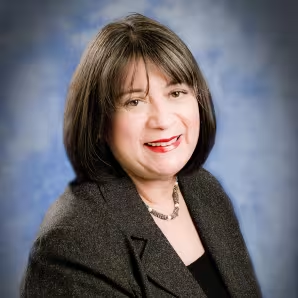
Delia Pompa, Senior Fellow for Education Policy, MPI
About the National Center on Immigrant Integration Policy
The Center is a national hub connecting policymakers, educators, community leaders, and service providers with evidence-informed policy research, technical assistance, and data to advance effective immigrant integration at U.S., state, and local levels.
- Topics
- Education Integration
- Keyword
- K-12 Education
- Region
- North America
- Country
- United States
- Speakers
-
Megan Hopkins
Professor & Chair, Department of Education Studies,University of California, San Diego

Trish Morita-Mullaney
Professor, English Language Learning,Purdue University
Dave Powell
Senior Fellow for Education Policy,MPI
Delia Pompa
Senior Fellow for Education Policy

Related Content


