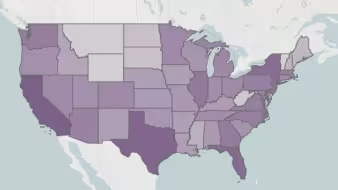
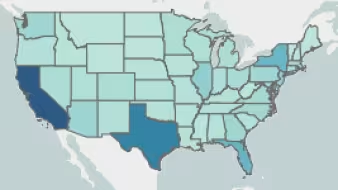
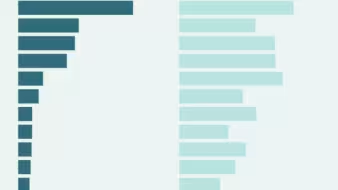
Number and Share of Limited English Proficient (LEP) Persons, by State, 1990-2024
In the United States, limited English skills can create obstacles in many aspects of life—from education and work to health care and civic life. This chart offers data on the number of people with limited English proficiency in each state as well as their share of the state's total population. Such data are important for planning adult education services, language access policies, and more. Click the “Get the Data” button above for U.S. and state data over time.
Notes
1. American Community Survey (ACS) asks respondents if they speak a language other than English at home. For those who answered that they speak a foreign language, the survey then asks them to self-assess their spoken English proficiency. Limited English proficient are persons age 5 and older who reported speaking English “not at all,” “not well,” or “well.”
2. The U.S. Census Bureau experienced significant challenges collecting data in 2020 due to the COVID-19 pandemic and released only a small number of data points from its 2020 American Community Survey (ACS), which it called “experimental.” This data tool does not include estimates from the 2020 ACS.
Source
Migration Policy Institute (MPI) tabulation of the U.S. Census Bureau’s 1990 and 2000 Decennial Censuses and 2010-2024 American Community Surveys.