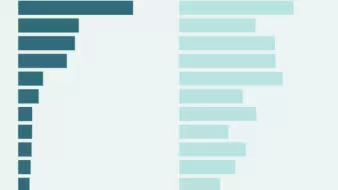
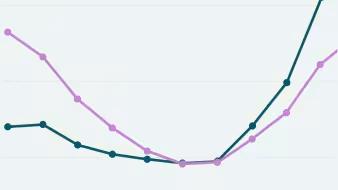
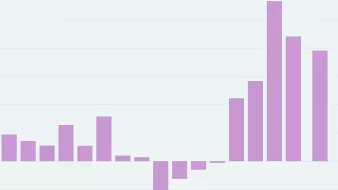
Share of All Children in Immigrant vs. U.S.-Born Families, by State, 2000 and 2024
The number of immigrants and refugees settling in the United States has increased dramatically in recent decades, as has their dispersion to numerous states that have not traditionally been destinations for immigrants. The overwhelming majority of children under 18 in immigrant families (85 percent in 2024) are U.S. born. This tool shows how the share of children of immigrant vs. U.S.-born parents changed between 2000 and 2024 for the nation overall and for individual states. It also allows you to examine these trends for two additional groups of children: those between ages 0 and 5 and those between ages 6 and 17.
Notes
The data here include only children between ages 0 and 17 (regardless of their nativity) who reside with at least one parent. The term "children of immigrants" (or children in immigrant families) refers to children under 18 with at least one immigrant parent. The term "immigrants" refers to people residing in the United States who were not U.S. citizens at birth. This population includes naturalized citizens, lawful permanent residents (LPRs), certain legal nonimmigrants (e.g., persons on student or work visas), those admitted under refugee or asylee status, and persons illegally residing in the United States. Since 2013, the U.S. Census Bureau has included children of same-sex married couples in its count of children in families and subfamilies. As a result, child counts may be larger than in previous years.
Sources
Migration Policy Institute (MPI) tabulation of data from U.S. Census Bureau, 2024 American Community Survey (ACS) and 2000 Decennial Census; 2000 data were accessed from Steven Ruggles, J. Trent Alexander, Katie Genadek, Ronald Goeken, Matthew B. Schroeder, and Matthew Sobek, Integrated Public Use Microdata Series: Version 5.0 [Machine-readable database] (Minneapolis: University of Minnesota, 2010).