Unauthorized Immigrants by Country/Region, Top States and Counties of Residence, 2023

Unauthorized Immigrants by Country/Region, Top States and Counties of Residence, 2023
This interactive map, based on MPI estimates, shows the top states and counties of residence for unauthorized immigrants in the United States as of mid-2023, by country or region of origin. Select a country or region from the dropdown menu to learn where immigrants from that geography settle primarily. Hover over a state to get state population estimates. The top county concentrations are displayed with bubbles, sized according to the estimated unauthorized population in each county. (Hover over individual bubbles for county estimates.) And for detailed demographic profiles of the unauthorized population at U.S., state, and top county levels, click here.
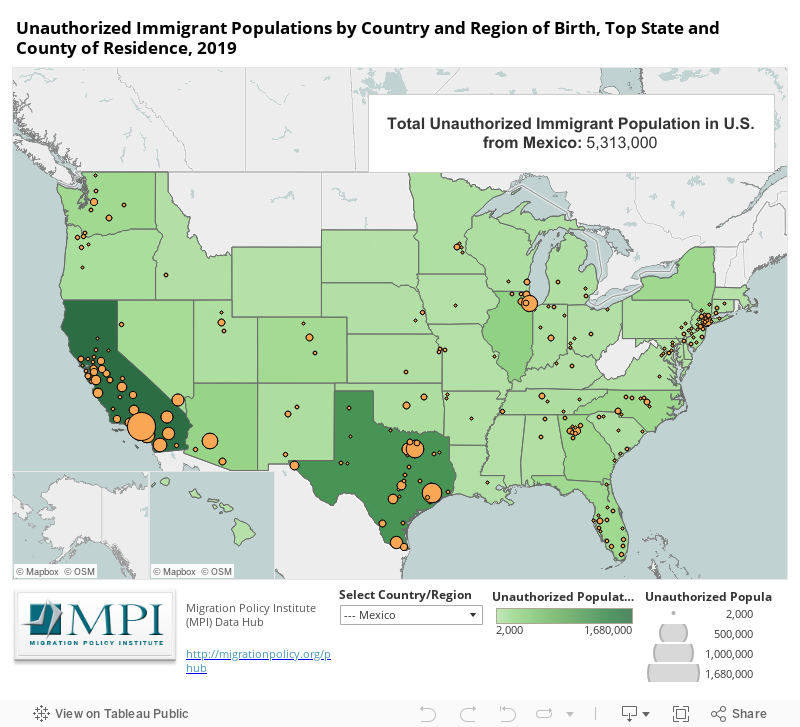
1) Estimates are rounded to the nearest 1,000. Shares of unauthorized immigrants out of the total unauthorized immigrant population in states and counties are based on unrounded numbers.
2) Estimate for China includes Hong Kong but excludes Taiwan; estimate for Korea includes South Korea and North Korea.
3) The suburban Denver counties designation includes: Broomfield, Clear Creek, Douglas, Elbert, and Gilpin counties, as well as portions of Adams, Arapahoe, Boulder, Jefferson, Teller, and Weld.
4) NECTAs refer to New England City and Town Areas, geographic entities defined by the the U.S. Office of Management and Budget. If an MSA crosses state boundaries, for the purposes of this analysis, that MSA includes only the portion in the state of Massachusetts.
These mid-2023 estimates result from a Migration Policy Institute methodology that imputes unauthorized status using analysis of U.S. Census Bureau data from the pooled 2019-23 American Community Survey (ACS) and the 2023, 2022, and 2008 Survey of Income and Program Participation (SIPP), weighted to 2023 unauthorized immigrant population estimates provided by Jennifer Van Hook of The Pennsylvania State University.
For detail on the methods, see MPI, “MPI Methodology for Assigning Legal Status to Noncitizen Respondents in U.S. Census Bureau Survey Data.” These estimates have the same sampling and coverage errors as any other survey-based estimates that rely on ACS and other Census Bureau data.