Elizabeth Collett

Elizabeth Collett is a Global Fellow at MPI, and is a member of Australia’s Ministerial Advisory Council on Skilled Migration (MACSM) and chair of MACSM’s Expert Subcommittee, which offers advice and research insight to inform government migration policy. She previously was Special Adviser for Policy and Strategy to the Director General of the International Organization for Migration (IOM), and before that was Founding Director of MPI Europe in Brussels and Senior Advisor to MPI's Transatlantic Council on Migration.
She has more than 20 years of experience in the migration policy sector, and has produced dozens of working papers, policy briefs, and memos focused on global trends in migration, EU immigration and asylum policy, as well as national-level migration policy developments. She has consulted for numerous government ministries and nongovernmental organizations, including foundations, nonprofits, and UN agencies.
Prior to joining MPI, Ms. Collett was a Senior Policy Analyst at the European Policy Centre, a Brussels-based think tank, and was responsible for its migration program. She previously worked in IOM's Migration Research and Policy Department in Geneva and for the Institute for the Study of International Migration in Washington, DC. She also served as a Research Associate at the Centre for Migration Policy and Society, Oxford University (2011-13).
She is a member of the Strategic Council of the European Policy Centre and a Visiting Fellow at the Australian National University.
Ms. Collett holds a master's degree in foreign service (with distinction) from Georgetown University, where she specialized in foreign policy and earned a certificate in refugee and humanitarian studies, and a bachelor's degree in law from Oxford University.
Explore Content by Elizabeth Collett
Showing 1-10 of 39 total results
International Student Mobility: A Post-Pandemic Reset or a Broader Challenge?
International student enrollment has tripled since 2000, but post-pandemic surges in Australia, Canada, and the United Kingdom have strained housing and policy systems.

The State of Global Human Mobility More than Two Years into the Pandemic
Coming into the third year of the pandemic, this webcast examined the state of mobility across world regions, remaining travel restrictions, and policy adaptations.

The COVID-19 Shock to the System of Human Mobility and the International Response
What did COVID-19 reveal about global migration governance, border closures, and international coordination?

After the Storm: Learning from the EU response to the migration crisis
The European Union made real gains in crisis coordination after the 2015-16 crisis but still lacks permanent mechanisms to manage future emergencies—and risks losing the progress made.
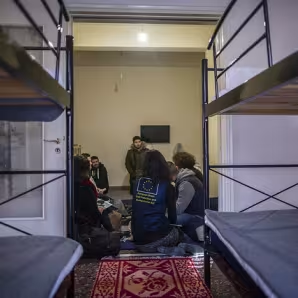
Europe Pushes to Outsource Asylum, Again
EU proposals for external asylum processing centres face serious legal, logistical, and humanitarian obstacles that leaders championing the idea have yet to resolve.

Turkey-Style Deals Will Not Solve the Next EU Migration Crisis
The EU-Turkey deal is a poor template for future migration challenges, as rising flows from Turkey, Libya, and Ukraine would strain the bloc's weakest asylum systems.

Borderline Irrelevant: Why reforming the Dublin Regulation misses the point
EU focus on Dublin Regulation reform sidesteps deeper questions about the Schengen Agreement's future, national asylum capacity, and political will to share responsibility.

EU Migration Partnerships: A work in progress
The European Union's 2016 Migration Partnership Framework is a step forward. But a deep mismatch between EU goals and partner-country interests threatens its effectiveness.
A Game of Chess, Not Tennis: Unraveling the rights and status of 'Brexpats'
The complex rights of 1.2 million UK citizens living in EU countries, or 'Brexpats', remained largely overlooked in early Brexit negotiations.

New EU Partnerships in North Africa: Potential to backfire?
Fragile governance and absent protection systems in North African states undermine EU plans to work in partnership to curb Mediterranean crossings.
